It is no secret—we have been talking about a time of famine and chaos coming since 2023. I released my very first writing about this after several dreams and conversations I’d had with the LORD. It is no coincidence that He has placed me in a position of leadership in the largest homesteading movement across the nation (and world). And I really try not to take that lightly. I fear God too much to not talk about this topic. Yahweh always prepares His people. And, when preparation isn’t possible, He always makes a way.
We now know, after many prophetic voices have been receiving the same prophetic utterance from the Holy Spirit, that something is coming. And at this point, it doesn’t even have to be prophetic—it is now simply expected and seen. It doesn’t take a rocket-scientist to realize the world is spinning out of control.
What is uniquely different about true prophetic voices versus doom and gloom is this—every single one of us feels a significant amount of hope and excitement about the times ahead. Why? Because God has very clearly shown us that He is calling us to a modern day Goshen.
What Was Goshen?
In the time of Egypt’s plagues, Goshen was mentioned over and over again as a place of protection and refuge for the Israelites. Refuge is the key word, here. Since 2008, some prophetic voices have been hearing this word. It was amplified in 2016, and again in 2020, and again right now.
We see Goshen, and God’s providential hand of protection, in Exodus 8:22-23 (NKJV) where God says, “22 And in that day I will set apart the land of Goshen, in which My people dwell, that no swarms of flies shall be there, in order that you may know that I am the Lord in the midst of the land. 23 I will make a difference between My people and your people.”
Yahweh went on to say this about other plagues, too. In Exodus 9:4-6, God said, “4 And the Lord will make a difference between the livestock of Israeland the livestock of Egypt. So nothing shall die of all that belongs to the children of Israel.” Notice that God says none of His people would be touched, and neither would their livestock. It was clear, God was setting a standard. And it would be a testimony to all of Egypt. We will see later, however, that the story of Joseph was a little different.
An important note—in 1 Peter 2:9, the church has been grafted in and is also now called God’s chosen people—”But you are a chosen generation, a royal priesthood, a holy nation, His own special people, that you may proclaim the praises of Him who called you out of darkness into His marvelous light…”
This is important to remember in the days that are ahead, because it will remind us the truths of what God has said. We are His chosen ones, and He will take care of us. Two truths, however, can be the same at one time. We can be provided for and sheltered, but we can also die for the gospel. These two truths are important to find balance in.
Let’s continue on about Goshen…
We can go back even further into Genesis during the time of Joseph. In this case, Joseph already knew that a famine was coming due to Pharaohs dreams that he had interpreted. Joseph and all of Egypt had prepared ahead of time, heeding God’s merciful warning. This is important to note, because this situation was much different than the Israelites. There is a difference between a people that have been warned, and a people that had no option (the Exodus Israelites). The Israelites had little land or authority over their property.
The plagues of Egypt was a direct judgement on Egypt. But the famine during Joseph’s time was a very different scenario. Joseph made it very clear that God had decided there would be a famine. For what reason, I don’t know that anyone is really sure. We can make speculations, but from my understanding, there doesn’t seem to be an exact reason. One thing we can all agree on—it vastly settled God’s people in that location, and the Israelites expanded their territory through this movement to Goshen.
Could it be that God will ask the body of Christ to take territory in this same way as we prepare?
Genesis 41 says this, ‘“This is the thing which I have spoken to Pharaoh. God has shown Pharaoh what He is about to do. 29 Indeed seven years of great plenty will come throughout all the land of Egypt; 30 but after them seven years of famine will arise, and all the plenty will be forgotten in the land of Egypt; and the famine will deplete the land. 31 So the plenty will not be known in the land because of the famine following, for it will be very severe. 32 And the dream was repeated to Pharaoh twice because the thing is established by God, and God will shortly bring it to pass.”
We like to say that God doesn’t cause these natural disasters, but the scripture shows otherwise. He always has a reason, of course.
Let’s continue…
When Joseph’s family came to Egypt during the second year of the famine, there were a few interesting things to note. Joseph said to his brothers, “Hurry and go up to my father, and say to him, ‘Thus says your son Joseph: “God has made me lord of all Egypt; come down to me, do not tarry. 10 You shall dwell in the land of Goshen, and you shall be near to me, you and your children, your children’s children, your flocks and your herds, and all that you have. 11 There I will provide for you, lest you and your household, and all that you have, come to poverty; for there are still five years of famine.” ‘
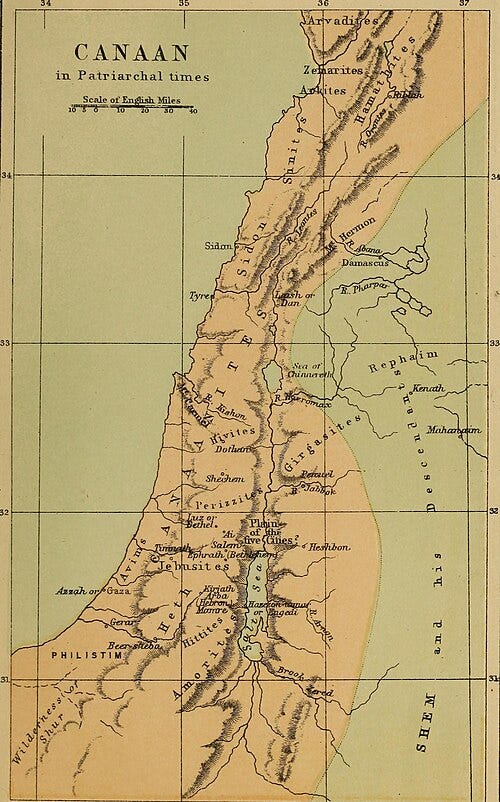
When his family arrived and spoke with Pharaoh, Genesis 47 says, “Your servants are shepherds, both we and also our fathers.” 4 And they said to Pharaoh, “We have come to dwell in the land, because your servants have no pasture for their flocks, for the famine is severe in the land of Canaan. Now therefore, please let your servants dwell in the land of Goshen.”
Hard stop.
This is where we need to become very cognizant that the famine then was not in a grocery store shelf. It was not just food—it was a true famine of the land. God even stated this through Joseph (above scripture). There was a massive drought—no rain, no pasture, no food. This was a judgement on the earth, or at least a larger portion than just Egypt. Canaan, where Joseph’s family had just come from, was not in Egypt. This was not a judgement on Egypt, but a much broader region (possibly even continental, or beyond). Historically, Canaan would have been located much closer to what is now the Israel/Jordan/Palestine/Lebanon/Syria region today. Egypt was, and still is, on the continent of Africa.
Genesis 46 goes on to say, “Then he sent Judah before him to Joseph, to point out before him the way to Goshen. And they came to the land of Goshen.”
I highlighted this portion because I feel it is necessary in parallel to today. When God sends a warning through His prophetic people, it isn’t to cause fear. It is to cause provision. It is to instate leaders whom He has given a vision to. People who will guide and “point out” the way to Goshen.
There are two vastly different scenarios between the Egyptian plagues and the time of famine with Joseph. But the general thread woven through it all is this—God will provide. And often times, He uses His people to provide. We cannot be an inactive people.
When God appointed Moses to Egypt, these things happened suddenly. There was no preparation time. Therefore, God fully provided for His people during that time. One of those places being in the land of Goshen, where they all resided.
However, in the testimony of Joseph, God’s people were spread out abroad, not just in one place. The provision now became a central location through an Egypt that was run by a Godly governor who had planned ahead of time—Joseph. And then, on to Goshen.
The question is not “will this happen again?” The question is, will you be ready? How are you preparing? Why is the church not already prepared?
It is clear that God provides for His people, and He also warns His people to provide in advance. We are in this time right now. Maybe it isn’t for you, maybe it will be for your children. Though the timeline many have been shown says sooner rather than later.
Prophecy after prophecy has come forth that our nations are headed towards a time of “famine” and chaos. The time to build is now. Not out of fear, but out of grace and mercy, and obedience.
The plagues fell on Egypt. The sky rained hail, darkness settled so thick a man couldn’t see his own hand—and in the middle of all of it sat a region called Goshen, where the sun still shone, the fields were still green, and God’s people still had bread on the table.
Same nations. Same famine. Same plagues. Two completely different outcomes.
Goshen was spared because that is where God’s people dwelt—and because a man named Joseph had the foresight to store up grain in the years of plenty, long before anyone felt the years of famine.
That is the whole pattern. Provision prepared before the crisis. A people set apart. A storehouse standing ready when the world runs empty.
So I keep asking: where is Goshen today?
We have built beautiful buildings and polished productions. But when the shelves go bare and the systems shake, will the church have anything in the storehouse? Or will we be standing in the same line as everyone else?
Not me. Not my family. Not the people that sit at my table.
This is not fear talking, this is Acts 4. Land laid at the apostles’ feet. Abundance shared. Not one needy person among them. That church had become Goshen for its own people—and we can be that again.
This isn’t archaic, it is a blueprint for survival and provision.
So consider this your invitation to build. Not another program. Not a ministry ladder to the top. But a storehouse. A refuge. A place of bread and light and the presence of God, right where He has planted you (or maybe He is calling you to move?)
Maybe it will be in your basement with food lined shelves. Maybe it will be in your church building where you are a minister or congregant. Maybe it will be in a shed outside of your home.
Wherever it is, know this—2 Corinthians 6:16-17 says this:
“And what agreement has the temple of God with idols? For you are the temple of the living God. As God has said:
‘I will dwell in them
And walk among them.
I will be their God,
And they shall be My people.’
Therefore
‘Come out from among them
And be separate, says the Lord.’”
I will remind you that in Exodus God said, “And in that day I will set apartthe land of Goshen…”
We must be set apart in the times ahead—spiritually and physically.
May God richly bless you as He shows you your role in the Goshen He is calling you to be a part of in your region. If you need help, or if you’re wondering where to get started, we’ve created a website called The Church Storehouse that can help you. Completely free.
Blessings,
Amy