• Home
  • Membership
  • Shop
  • Cart
  • Our Farm
  • Gut Health
  • Herbal Practice
  • Buy Trusted Supplements
  • Nav Social Icons

  • Skip to primary navigation
  • Skip to main content
  • Skip to primary sidebar
  • Skip to footer
  • Home
  • Blog
  • About Me
  • Our Farm
  • Gut Health
  • HH Membership
  • My Books
  • Youtube
  • Podcast
  • Homesteading
  • Chickens
  • Herbs
  • Family
  • Farmhouse
  • Homemaking
  • Recipes
  • Sourdough
  • Contact Me
  • Herbal Practice
  • Buy Trusted Supplements
  • Mobile Menu Widgets

    Search

    Connect

Amy K Fewell | Homesteading for the Kingdom

Amy K Fewell | Homesteading for the Kingdom

  • Start Here
    • About Me
    • My Books
    • Podcast
    • Youtube
    • Gut Health
  • Blog
    • herbs
    • Bees
    • chickens
    • rabbits
    • Farmhouse
    • gardening
    • devotional
    • homemaking
    • sourdough
    • recipes
  • Courses & Books
    • HH Membership
    • My Books
  • herbs
  • Podcast
  • Contact Me

{What Is Homesteading?} And Why We Call Ourselves Homesteaders

January 19, 2015 · In: homesteading

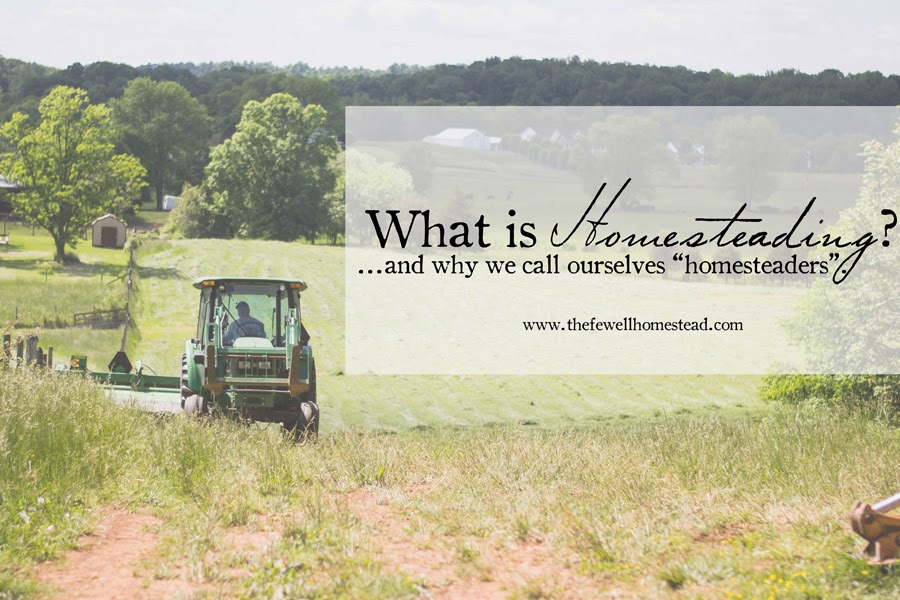
I don’t own a tractor (that’s my grandfather above). In fact, I don’t even own 100 acres of land with roaming cattle, horses or sheep. I don’t have a farm store, and I don’t even have a farm. But I’m a homesteader….
 
The word “homestead” has meant so many things throughout history. In the 1800’s it was often spoken about in reference to the The Homesteading Act of 1862.

“The Homestead Act, enacted during the Civil War in 1862, provided that any adult citizen, or intended citizen, who had never borne arms against the U.S. government could claim 160 acres of surveyed government land. Claimants were required to “improve” the plot by building a dwelling and cultivating the land. After 5 years on the land, the original filer was entitled to the property, free and clear, except for a small registration fee. Title could also be acquired after only a 6-month residency and trivial improvements, provided the claimant paid the government $1.25 per acre. After the Civil War, Union soldiers could deduct the time they had served from the residency requirements.“ [National Archives and Records Administration]

Further down the history timeline, in the 1970’s, our parents and grandparents (and some of our hippie friends) may have began the next homesteading movement. They refused to be controlled by a government that was more concerned with money and prosperity than health and family. Publications such as Mother Earth News began popping up and rising to popularity quickly. The 1970’s movement gave a new meaning to “homesteading” — it wasn’t just about “farming” and land use anymore, it was about a way of life — a life of self sufficiency and doing things the old fashioned way. It was a movement of a better lifestyle, not just for their generation, but for ours.
Here we are now in the 21st Century, and we can thank those 1970’s “hippies” for our homesteading term now. In today’s society, the word “homesteading” is a term used by many people, but ultimately it means the same thing. Homesteading is when you strive to live a self-sufficient lifestyle and conserve the methods used by our ancestors. These homesteaders are dairy farmers, backyard garden and chicken keepers, vegetarians and meat eaters, old and young. Some have a 1/4 acre, some have 300+ acres. Some have cows, while others have rabbits. Some milk goats, and some just have a garden that they preserve every year. No matter where you live or what you’re doing, as long as you are striving to become more and more self-sufficient every year and are living off of your land, you can consider yourself a homesteader. Tractor and money not necessary. In fact, homesteading is the perfect way to spend less money by doing your own work and preserving your own harvests.
Homesteading in its truest form, however, isn’t just throwing some plants in a jug, eating some tomatoes that Summer and considering yourself a homesteader. In fact, many would take offense to that. Homesteading is hard work, but it is joyous work. This past Summer I was incredibly bummed that we didn’t get to plant the garden that we wanted to plant. However, we utilized the farmer’s market a lot and I was still able to support them enough so that I could can several veggies this past season. This year, it’s going to be different!
By popular opinion, here are some things that make you a true homesteader (some, or all):
 
  • You live off of your land. You plant a garden that supports your family’s needs, and preserve what you can for the coming Winter. You harvest your own meat (if you eat meat) directly from your backyard — be it chickens, rabbits, goats, or even venison. It doesn’t matter if you have 1/4 acre or 1,000 acres, you live off of the land that you have, and you enjoy it. You are keenly aware that food from the supermarket doesn’t taste nearly as good as the food you’ve grown yourself, not to mention it is filling your body with unnatural things. You shudder at the thought of eating those veggies stored in metal cans or microwaveable bags. You might not even own a microwave.
  • You own farm animals which have a purpose. That means chickens aren’t just for entertainment, they are for eggs or meat. Rabbits aren’t just cute and cuddly, they are for pelts and/or meat. Goats aren’t just things you walk around on leashes, they are there for milk and/or meat. If you choose not to do these things, that’s ok too! But homesteading, in its truest form, means that everything on your property has a purpose (except maybe that lazy black dog sitting on my sofa).
  • You actually work on your homestead. You get your hands dirty in the garden. You clean out coops, stalls and hutches. You build things (or help), even if you’re a girl. You get muddy when it’s raining, and you freeze your fingers off when it’s -2 degrees outside and you have to water the animals. You help your animals give birth when needed, and tend to the babies not just during the easy times, but the hard times too. Not only do your animals serve a purpose, but you serve a purpose. You’re a modern day Adam and Eve for goodness sake, own it!
  • You strive to live all naturally. You make your own herbal medicines and know that the weeds in your yard can be used to cure a toothache rather than just being run over with the lawn mower. You might make your own hair care products. You are trying to reduce your carbon footprint and the chemicals that leach into the soil from the things that you pour down the drain. And you have found a brand new love for cooking meals from scratch rather than popping a frozen pizza into the oven for dinner every night.
  • You try to be self-sufficient, and encourage others to be as well. All of the above, plus sharing. Homesteading and natural living are contagious, and you want everyone to live just as healthy as you do. It pains you inside to watch your friends and family constantly get sick or go to the doctor when you know that if they just put a little elbow grease into their lives, they would see a major difference in their health and lifestyle. You have a brain full of knowledge and it excites you to share it…never withholding any of it. Because after all, it’s not a competition, it’s a lifestyle that should be treasured and conserved in its purest form. You realize that you are constantly learning, constantly growing, and believe it or not, you know you’re not a know it all. You enjoy new knowledge more than anything.
These are just a few of the main points that make you a “homesteader”, and one of the reasons we really enjoy homesteading. Homesteading isn’t just a thing, it’s a passion….it’s a lifestyle. I know plenty of “farmers” who could care less about self-sufficiency…and I don’t call them homesteaders. I also know plenty of farmers who love self-sufficiency and fight for it…I value them as homesteaders in our community, and I have learned so much from them.
The moral of the story? You don’t have to have a large farm or the family genetics to be a homesteader. All you need is a little land, some calloused hands, a tender heart, and a whole lot of passion and drive. We homestead because we want a better life for ourselves and for our child. We want to be dependent simply on God and on ourselves….not the grocery store or the government. We homestead because we are passionate about life and the freedom that we can enjoy while on this earth. We are passionate about homesteading, because we were given these hands and feet to make an impact not only on others, but on this beautiful Earth that was given to us. Why waste it?
————————————————————————————————–
What are some of your favorite things about homesteading? 
What would you add to this list? 
Feel free to chat on facebook or in the comments below, and I just might share a few of them! 🙂

By: Amy K. Fewell · In: homesteading · Tagged: homesteading, what is homesteading

you’ll also love

The Two-Breed System for Year-Round Meat Chicken Breeding
Homesteading: Building a Parallel System of Kingdom Economy
Home Remedies with Onion: Medicinal for Cough and More
Next Post >

The Basics: Raising, Breeding and Processing Meat Rabbits

Primary Sidebar

meet amy

meet amy
hello!

I'm Amy. I love organic food but I love cookies too. I love Jesus and His grace. I believe broken people make the biggest impact in the world when Jesus makes them whole, and when they share their stories. I believe in stories, and I'm sharing mine.

Read More

Connect

Search

Ads & Sponsors

200x400

Advertise

Follow Along

@amy.fewell

This is your reminder to become a student of the w This is your reminder to become a student of the word, not just a hearer. You can sit in church your entire life and hear someone preach, but that is not the same as doing deep dives into the word yourself. That feeling when you read and a thought pops into your head “what does that mean?” Priceless. The thread begins to unravel as you research and try to understand more. 

One of those things for me this week has been studying Melchizedek. If you were to only read the Old Testament account of Melchizedek, there wouldn’t be much to know. But combined with the New Testament, and the ancient writings and documentation of this incredible “king”, the picture becomes more clear. 

It becomes most clear in Hebrews, as the writer begins to unpackage the parallel of Melchizedek and Jesus—both high priests appointed by God. But interestingly, Melchizedek was a high priest centuries before the levitical priesthood was ever established. This is why scripture says that “Levi was still in the loins of Abraham”, and Melchizedek existed long before Levi was even born or established as priestly.

God has had me sitting in Genesis for a few weeks. It’s a book we feel like we know well, but until we dive deeply into it, do we know it well, or do we know it how someone else taught it in that one hour Sunday sermon 10 years ago? I’ve sat in Genesis for 2 weeks now and I’m barely halfway through. 

It may seem unimportant—what does Melchizedek matter to Christian’s now? Why do Adam, Noah, and Abraham’s covenant matter now? But they matter greatly. Because they are mirrored in the New Testament church—the priestly kingdom that God established. If you don’t understand Melchizedek, and the fact that he was before and outside of the established tribes of Israel, and appointed long before that, then you won’t understand the correlation between a religion of tradition versus a relationship and worship in freedom. 

It is not the levitical priest that Jesus is compared to—it is the priest of the order of Melchizedek. And that’s important. It’s important in how we believe, how we perceive, and how we advance and take dominion. 

I hope to write deeply about this soon.
There are a lot of new faces here over the last we There are a lot of new faces here over the last week due to a post that went semi-viral (about Yahweh calling back the shepherds). So I thought I’d take a minute to introduce myself, since so many of you followed me from content that is only a part of what myself and this page is about. 

My name is Amy. I am first and foremost, unapologetically, a follower and disciple of Jesus Christ. That fact motivates and touches every single other aspect of who I am and what I do. 

I am secondly a wife and mother (of 4). I’ve been married to my best friend for almost 21 years. We have seen just about every high and low, and came out stronger on the other side every single time. We walked through 9 years of secondary infertility, and suddenly God healed me and we welcomed 3 more littles to the crew in less than 7 years. Naturally. 

I grew up Baptist in the early years, then Pentecostal/charismatic. Now—I just follow Jesus. I’ve seen it all—the religion/tradition (on both sides), the good/bad/ugly, the miraculous.

My career was in media/newspapers/marketing before 2016. Then in 2016 I founded an organization called @homesteadersofamerica — where we teach people (and the kingdom) to take back the land, food and health system, the home, government and more. We are building the parallel system to the broken one. We’ve maxed out our annual October event at the current venue—6,000+ people each day.

We host the @homesteadrevivalnow events at our October event, where people encounter the Spirit of God, receive baptism and salvation, are encouraged by the word, and equipped to keep going. 

And most recently we started @thechurchstorehouse , where we are equipping the body of Christ and helping others start gatherings, church plants, refine their current church set up, and build places of refuge for times ahead. 

I’m a worshipper, entrepreneur, have lead in the church and churches, master herbalist, milk maid, author, coffee lover.

Those are just the cliff notes. 

Welcome to my corner of the internet. I pray it encourages, motivates, and spurs you on towards the everlasting goal of the kingdom. ❤️‍🔥
We’ve reached that time in the summer where it’s a We’ve reached that time in the summer where it’s almost fall but still hot outside. And we just need to see a glimpse of autumn showing up in our coffee!

So I’m just over here not using commercially processed creamers and instead using raw cream and infused maple syrups! 

I highly recommend @highlowfarm ‘s vanilla and cinnamon infused syrups, @shepherdscrookcoffee for all your farm coffee needs, and don’t forget that @showalterhomeandforge copper cream ladle 😍

You CAN buy and support your local homesteaders in EVERY way! Check out some of these folks at their vendor booths at the October @homesteadersofamerica conference!
The Senate farm bill got shut down in committee. 1 The Senate farm bill got shut down in committee. 10–11. Party line. Shocker! It’s only 🙄 been since 2018 that we could pass an actual farm bill.

Heres what happened:

The Senate Ag Committee met Thursday to mark up the Agricultural Act of 2026—Chairman Boozman’s “Farm Bill 2.0.” Two Republicans were absent: McConnell, recovering from “illness”, and Tuberville, unexplained. Their proxy votes didn’t count. Democrats voted as a bloc. It failed to advance.

The sticking point wasn’t corn, cattle, or conservation. It was SNAP—specifically, how long states get before they start paying a share of benefit costs. Boozman says one year is the most leadership will accept. Klobuchar says two. That’s the standoff. Ridiculous considering this is all because there is so much corruption in the SNAP aid program. 

Sit with that a minute. The last full five-year farm bill was signed in 2018. Everything since has been extensions and provisions stapled onto spending bills. And what’s holding up credit access, crop insurance updates, more food freedoms,  and FSA loan limits is a one-year versus two-year phase-in on a nutrition program. For real?

What it means for you: nothing changes tomorrow. Programs keep running under existing authority. But “nothing changes” is exactly the problem when input costs, land prices, food access, and rates have moved this much since 2018. Uncertainty is a cost. You just can’t put it on a balance sheet.

Boozman recessed the committee rather than adjourning—a signal he means to vote again in September. Even if it clears then, it needs 60 on the floor. Without a SNAP deal, it doesn’t have them.

The lesson underneath all of it: don’t build your food security on a bill. Build it on your ground, your neighbors, and your skills. Legislation is worth watching. It was never worth waiting on.
I have personally wrestled with the Lord over this I have personally wrestled with the Lord over this topic for months.

Earlier this year, someone asked why we were still hosting fellowship dinners at our home.
My answer was simple:
“Because I refuse to let the sheep scatter again.”

We have watched people leave churches wounded, lonely, and without accountability. Some find healthy places to land. Others simply go through the motions while still feeling empty and unseen.

And it grieves me. More importantly, I believe it grieves Jesus.
Recently, I finally said to a friend, “I think I need to write this out. God is calling back the shepherds.”

And not in the way you may think.

The word translated as “pastor” in the New Testament is poimēn.

It means shepherd.
Not platform speaker.
Not church-building manager.

Biblical shepherds lived among the flock. They knew the sheep by name. They found food and water, recognized danger, fought predators, rescued the wandering, and understood when it was time to move.

They were gentle, but they were not fragile.
They carried lambs, but they also fought lions and bears.
The rod was not used to beat the sheep. It was used to fight off predators.

The staff was not used to control them. It was used to guide and rescue them. And when the wolf came, the shepherd stayed.

Somewhere along the way, we reduced shepherding to preaching a sermon and managing an institution. But biblical shepherding was always more intimate, costly, discerning, and involved than that.

I believe the Lord is about to (or already is beginning to) reform the ministry of the shepherd within the Body of Christ. And do not be surprised when those shepherds do not look the way the religious institution expects.

They may be farmers, homesteaders, mothers, fathers, or people who are perceived as rough around the edges. They may never stand behind a pulpit.

But they will gather around tables, dwell among the people, protect the flock, confront the wolves, and refuse to let the sheep scatter again.

He is calling back the shepherds.

🐑 Comment SHEPHERD and I’ll send the full article to your inbox.

Footer

Learn More

Chickens
Homemaking
Herbs
Recipes
Devotionals

Info

About
Contact
Privacy Policy
Shop

stay in the know

Copyright © 2026 · Theme by 17th Avenue