• Home
  • Membership
  • Shop
  • Cart
  • Our Farm
  • Gut Health
  • Herbal Practice
  • Buy Trusted Supplements
  • Nav Social Icons

  • Skip to primary navigation
  • Skip to main content
  • Skip to primary sidebar
  • Skip to footer
  • Home
  • Blog
  • About Me
  • Our Farm
  • Gut Health
  • HH Membership
  • My Books
  • Youtube
  • Podcast
  • Homesteading
  • Chickens
  • Herbs
  • Family
  • Farmhouse
  • Homemaking
  • Recipes
  • Sourdough
  • Contact Me
  • Herbal Practice
  • Buy Trusted Supplements
  • Mobile Menu Widgets

    Search

    Connect

Amy K Fewell | Homesteading for the Kingdom

Amy K Fewell | Homesteading for the Kingdom

  • Start Here
    • About Me
    • My Books
    • Podcast
    • Youtube
    • Gut Health
  • Blog
    • herbs
    • Bees
    • chickens
    • rabbits
    • Farmhouse
    • gardening
    • devotional
    • homemaking
    • sourdough
    • recipes
  • Courses & Books
    • HH Membership
    • My Books
  • herbs
  • Podcast
  • Contact Me

How to Start Herb Seeds For Your Garden

March 6, 2019 · In: Featured, gardening, herbs

Grow Herbs from Seed

When you want to start an herb garden, it can be intimidating learning how to start herb seeds from start to finish. So many times we start seeds and they simply don’t grow. But with a few simple steps, herb seeds are easy to start indoors before spring arrives.

Whether you’re planing an entire garden full of herbs, or just a set of herbs for your kitchen, anyone can start herbs from seed! Let’s break it down step by step.
When To Start Herb Seeds

Every single region of the country has a hardiness zone. You’ll need to look and see which hardiness zone you’re located in before planting.

If you’re starting herb seeds indoors, the general beginning of herb life is in the late winter months when you begin your other seedlings for the garden. This is usually about 6-8 weeks before your last frost date.

If you’re directly sowing your herb seeds into the ground, wait until the danger of frost has passed in the early Spring. You can also sow your herb seeds into the ground right before the ground freezes in the late fall and cover with a thick layer of straw or mulch. I’ve had some luck with this method in years past, but starting seeds indoors is always more efficient.
Where to Start Herb Seeds

You’ll have several options for where to start herb seeds. You’ll need to begin with a good container, like a peat moss biodegradable container or plastic 2” to 4” containers. You can also plant your herbs in soil blocks, though I find the containers do just as well.

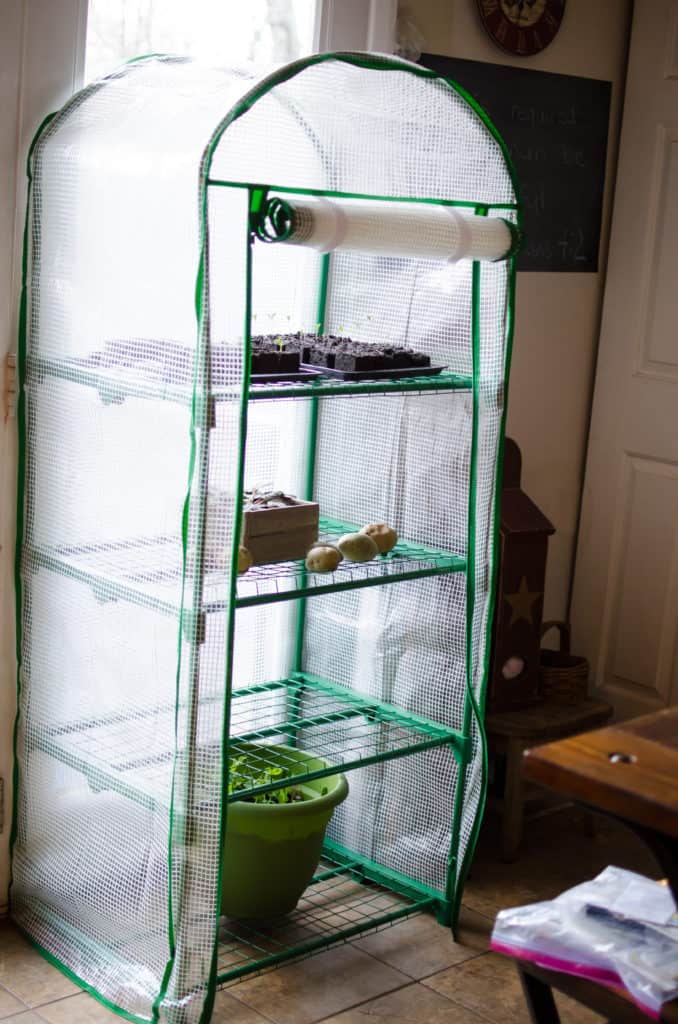
I like to begin my herbs in a small indoor greenhouse. My personal greenhouse is just made of metal tubing and a plastic covering with 5 racks that I got from my local farm store. The bonus is that this greenhouse, when open in the summer, can act as a drying rack for herbs. It is well worth the small investment.

Because the winter daylight isn’t as strong, and also because we heat strictly by wood, a small indoor greenhouse in front of a window that receives good light most of the day is essential. My indoor greenhouse is on wheels and takes up very little space. This allows me to move it about with the sun during the day. However, if you don’t have ample sunlight, grow lights may be needed for your herb starts.

If you wish not to use a greenhouse, you can simply place your newly planted herbs in front of a window. Covering them with plastic wrap for the first few days allows the seeds to germinate more quickly, keeps the moisture in, and creates a greenhouse like effect. Eventually, the plastic will need to come off, but the longer you can keep it on, the better. It creates a mini-permaculture system in your container while your seed grows.

Be sure not to overwater your seedlings, but maintain a moist soil through the entire germination process. Watering from the bottom up is essential
How to Start Herb Seeds

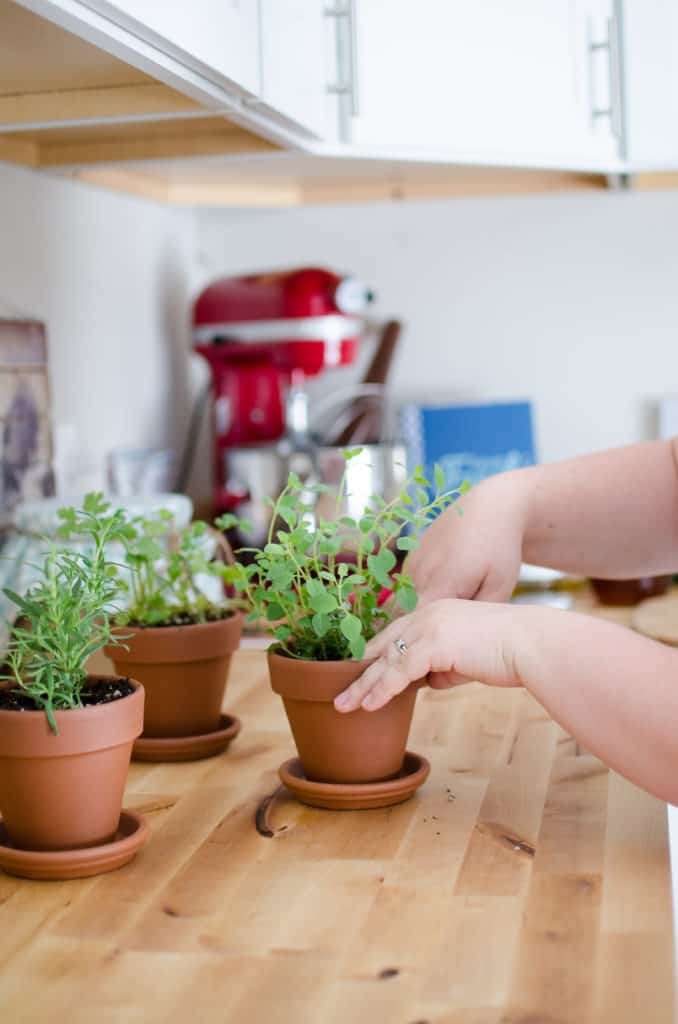
Don’t worry, the process is pretty painless. The seed starting, that is. Be prepared to lose a few startings. Not all seeds germinate, let’s just get that out there. This is just real life. If you can brace yourself now, you won’t feel like much of a failure later.

Step 1: Choose your container

I like to begin with a 4-inch container. A peat moss or plastic container works great. You can even re-purpose styrofoam or plastic solo cups. Just make sure all containers have holes in the bottom for good drainage.

Step 2: Add Your Dirt

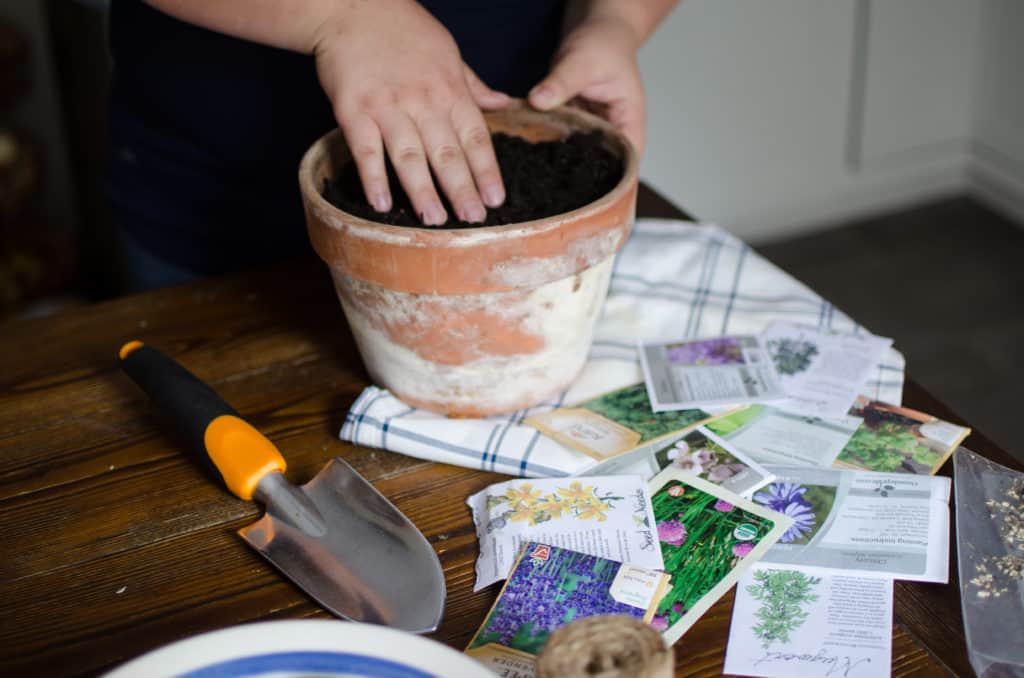
Add your potting mix (like my homemade potting soil) into the planter container, about ¾ of the way. Place 2 seeds into your cup (spaced out). Sprinkle a thin layer of soil over the seeds and press lightly.

The Homesteader's Herbal Companion
Step 3: Make a Greenhouse

Now that your seeds are planted, cover your containers with plastic wrap or place them in your indoor greenhouse. Covering your containers with plastic wrap will generate a greenhouse like effect if you don’t have a greenhouse available to you. It traps moisture and warms the soil in the container.

Step 4: Give Them Sunlight

Place your containers in a tray (baking sheets work!) next to a window that gets direct sunlight during the day. You can move your containers with the sun if necessary. If you don’t have good sunlight in your home, you’ll need to invest in grow lights.

Step 5: Water Those Babies

Keep your soil moist, but never over water. Water directly from the bottom of the container by filling your tray with water and allowing your soil to soak up the water naturally from the drainage holes. This cuts back on mold and mildew issues, and also mimics nature, allowing your root system to grow stronger.

Your herbs will begin to peek their little green heads out of the soil in 1 to 2 weeks. Make sure you keep your soil moist, but not saturated. Watering from the bottom up is extremely important for any plant that you’re trying to grow from seed.
If You’re Direct Sowing Your Seeds

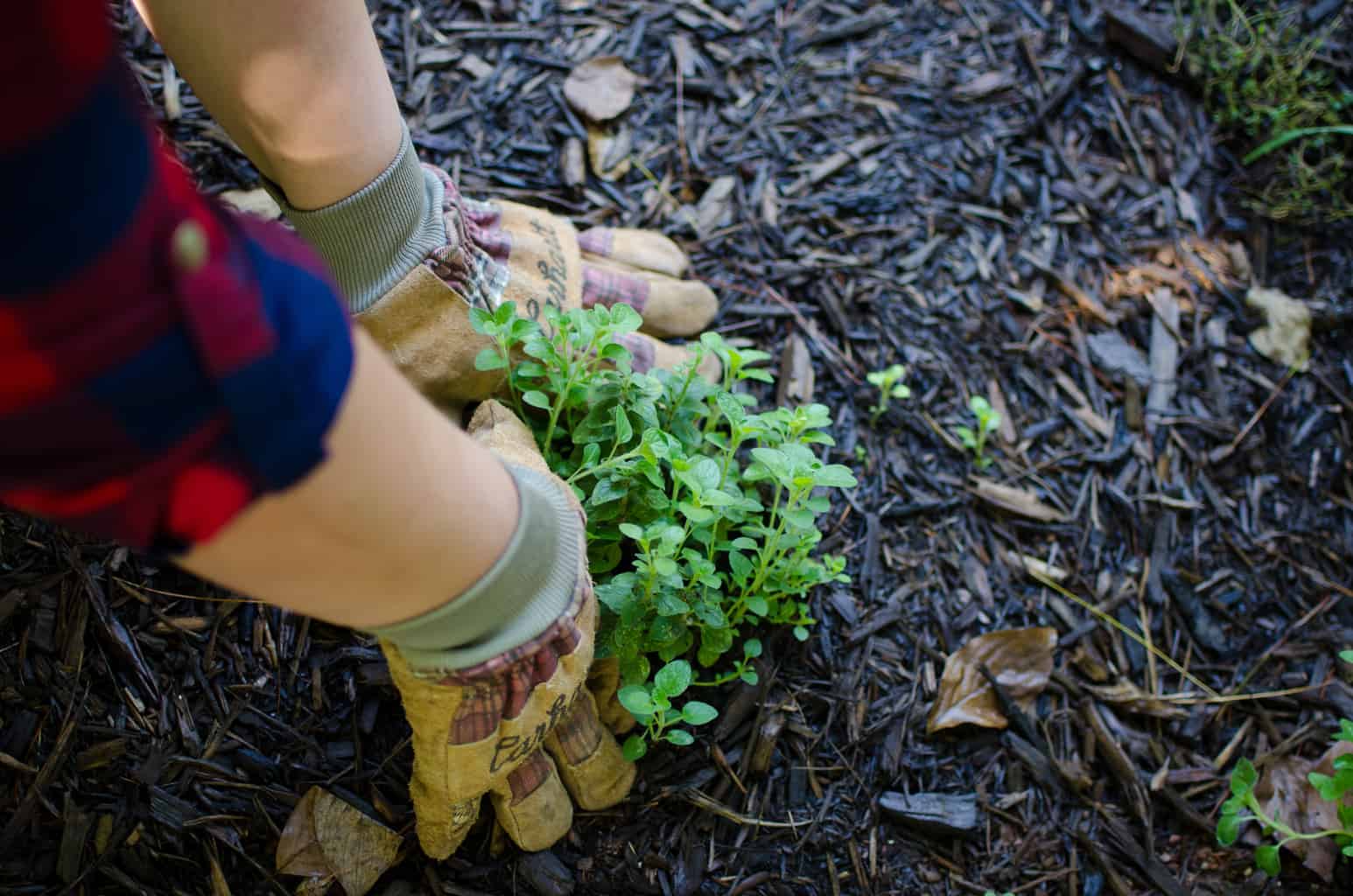
If you’re directly sowing your herb seeds into the ground, you’ll need to wait until danger of frost has passed. As mentioned before, you can absolutely toss some seeds into the ground and cover them heavily in the late fall or early spring with mulch or straw. Just remember to pull back the thick layer of straw that you put over it once the weather begins to even out.

For seeds that can be sown directly into the soil in the spring months, the concept is slightly the same.

Step 1: Make sure your soil is fertile and ready to be planted into. Loose or freshly tilled soil is best.

Step 2: With a stick or garden tool, draw a line for your rows in the dirt. If you’re just randomly sowing into the dirt, you can sprinkle the seeds about over the ground space you’ve chosen.

Step 3: Add your seeds, leaving little spaces according to package, to the dirt. Then, sprinkle a little potting mix or dirt over the area you’ve just seeded.

Step 4: Water thoroughly and cover with a thin layer of mulch. Keep soil moist until seeds begin to sprout, then simply water regularly.
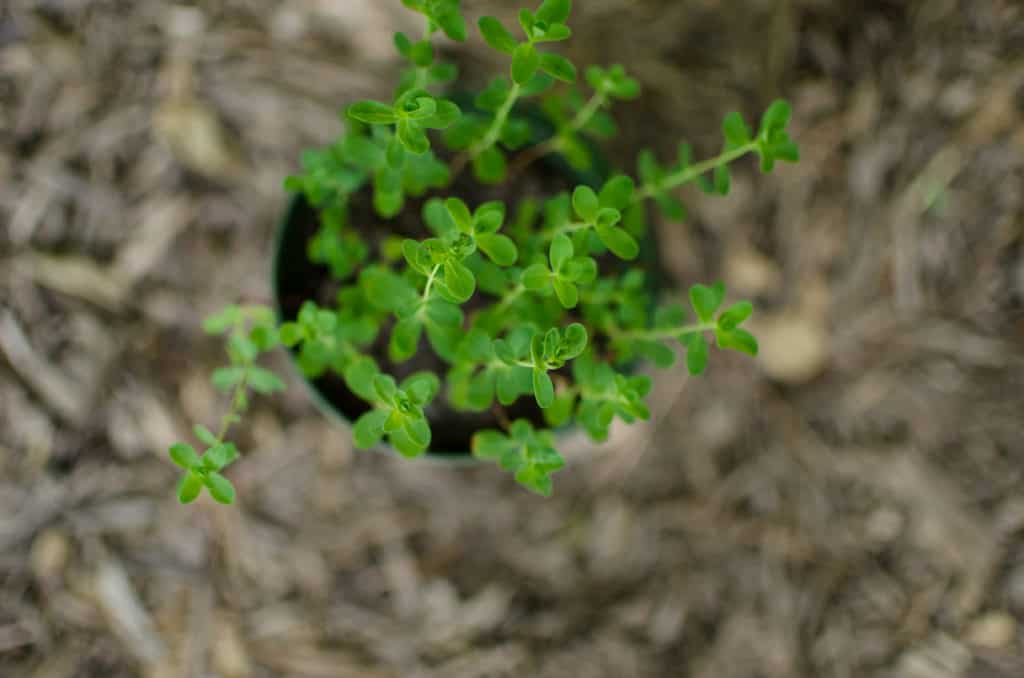
And that’s it! You’re done! You have officially and successfully planted your herb seeds. I encourage you to start herb seeds this year, because you will ultimately growing bigger and stronger plants since they will adapt more quickly to your area and region.

For more information about transplanting, hardening off herbs, and how to put those herbs to good use, check out my book The Homesteader’s Herbal Companion!
By: Amy K. Fewell · In: Featured, gardening, herbs · Tagged: gardening, herbs, seeds

you’ll also love

Client Case Study: Kidney & Liver Levels Balanced
Client Case Study: Seasonal Allergies Eliminated with Gut Healing
The Science of Herbs and How They Work
Next Post >

How to Make a Farm Fresh Frittata

Primary Sidebar

meet amy

meet amy
hello!

I'm Amy. I love organic food but I love Oreo's. I love Jesus and His grace. I believe broken people make the biggest impact in the world when they share their stories. I believe in stories, and I'm sharing mine.

Read More

Connect

Search

join the tribe!

Ads & Sponsors

200x400

Advertise

Follow Along

@amy.fewell

If you’re trying to grow a garden while raising ba If you’re trying to grow a garden while raising babies, chasing toddlers, homeschooling, cooking meals, and keeping a home—you don’t need perfection. You need rhythms that work with your season of life.

Here are a few simple things that make gardening with little ones so much easier:

• Work the garden in the early morning or evening when the heat and sun are lower. It’s easier on your body, your plants, and your children.

• Harvest herbs and vegetables in the morning when they are most hydrated and nutrient dense. The flavor, oils, and freshness are often at their peak before the heat of the day sets in.

• Keep a kiddie pool, shaded tent, or simple play area near the garden so little ones can stay close, play safely, and still be part of what you’re building.

This is the beauty of homestead life. Children don’t always have to be separated from the work—they can grow alongside it.

The garden doesn’t just feed your family.
It disciples them too.
Three weeks ago during our Friday night fellowship Three weeks ago during our Friday night fellowship, a consistent topic or word would come forth out of the individuals sitting around the table. As I sat and listened to each one so deeply, yet differently sharing, I realized that on this night, we were all mostly saying the same thing. This is often how Jesus will work through a group of believers—bringing each one together to share in unity. But differently. 

I immediately recalled Psalm 126–especially the part about weeping. How we sow with our tears but we reap in joy. How those who continually go forth weeping bear seed for sowing. 

Our genuine cries do something—they produce, and they sow. It is where we can feel the burden of another. When one cries, it is contagious. But really it is the mercy of God that we feel upon us. 

There is not a fellowship night that goes by anymore without someone, or multiple people now, crying. We’ve learned to embrace it. Why? Because we reap a harvest and bring our sheaves with us as we rejoice. 

Each tear is a seed that sows deeply into one another. Into others. Into ourselves. Our tears have a genuineness that many things do not have. And when they are genuine, they produce great fruit.

Ever since that night, I continue to see this scripture being spoken over and over again from leader after leader. Post after post. 

The Lord is stirring. He is doing something in His bride. He is calling back the captives, the dreamers, the singers. “Once again,” He says. With tears and weeping we sow, and with tears and weeping we harvest—rejoicing joyfully.
If you follow people online, you often call them a If you follow people online, you often call them an “influencer”. Let me be the one to tell you that most of us in the sphere that I am in do not consider ourselves “influencers”. Some may consider themselves teachers, leaders, ministers, and more, but the term influencer has never been something we’ve enjoyed. 

The reality is this—we found ourselves in the middle of a crossroad on our timeline where someone needed to pick up a mic and speak truth in the midst of chaos. Most of us have no interest in being online at all. We wouldn’t be sad if the internet disappeared tomorrow. But we were handed that microphone, influence, and anointing to go along with it.

Don’t be fooled—it’s not because of algorithms and marketing plans. If you are succeeding in this online world or your physical sphere of influence for Jesus, it’s because you were given the open door to do so. It’s not about you. It’s about what God knows He can entrust to you for His will and kingdom. 

Some people chase after people, trends, validation, recognition, and the spotlight. But can I tell you what comes along with those things? Hatred, bullying, misunderstanding, monitoring people and spirits, people lying about you, persecution—and if you’ve really made it, threats on your life and persecution.

You see, people want the influence. People want to be close to a Kingdom influencer. But if you aren’t ready to roll with the good AND bad, then you’re not ready. 

Jesus was the OG influencer, and He was spit on, lied about, and killed for His influence. Follower of Jesus—you are told to prepare for the same thing in the world. No matter your influence level.

A time is coming in America where influence online won’t matter anymore, yet the outcome will remain the same. The time to prepare for that is now—spiritually and emotionally. 

But take heart, dear one. He has overcome the world. I speak to believers and leaders everyday who are truly influencing to make a difference—some online, some never touching a screen. 

Jesus is building His church stone by stone. Some of us have mics, some of us will never be broadly known to man. Yet the struggle is still the same. Pray for us.
This morning I made a Mother’s Day tea—this one is This morning I made a Mother’s Day tea—this one is for you, ladies! 

My hormones have been all over the place as I inch closer to 40 and begin to slowly wean our little one. I’ve been snappy and know I need more nourishment. My skin has been out of sorts and, moral of the story, my body needs help. This tea is great for anyone—but it is especially healing for women. 

The jar made in the reel is a concentrate (I used lots of herbs), meaning, I add about 1 cup or more (whatever you’d like) of this liquid concentrate to my pint/quart jar and fill the rest with ice and cold water. But the “amounts” would stay the same in “parts”. 

If I were to add one more thing to this tea, it would be lemon balm. It is also very calming and aromatic. But since lemon balm is growing fresh right now, I add a sprig of it to each glass made with this herbal concentrate when I pour. 

This blend is fabulously cooling, nourishing to the body, and especially beneficial to women of all ages. 

You can add raw honey to sweeten this tea, and it is divine. 

🌺 Hibiscus flower (Hibiscus sabdariffa)
An incredible antioxidant which helps support the immune system, reduces oxidative stress, and supports your health at the cellular level. It may also help with cholesterol and cardiovascular health. This is a wonderful cooling herb for summer time, peri- and regular menopause. (Use sparingly while pregnant).

🌼Chamomile
Most noted for its ability to calm, relax, and cool. It is an efficient gentle anti-inflammatory and works well for the gastrointestinal tract. It is a gentle nervine, making it ideal for the central nervous system.

🌿 Stinging Nettle
An extremely nourishing herb, it is rich in iron, magnesium, calcium, proteins, and so many minerals. Nettle is anti-inflammatory and anti-allergenic. Nettle will help build strength in your body, and nourish it to its core—every system in the body is nourished by it. It is a natural antihistamine, mast cell stabilizer, and tonic.

🍃Red Raspberry Leaf
Rich in minerals and manganese. It works effectively in supporting and toning the reproductive system. It is also great for use as an antacid, hormones, heart and eye h
Never give up. Never give up.

Footer

Learn More

Chickens
Homemaking
Herbs
Recipes
Devotionals

Info

About
Contact
Privacy Policy
Shop

stay in the know

Copyright © 2026 · Theme by 17th Avenue