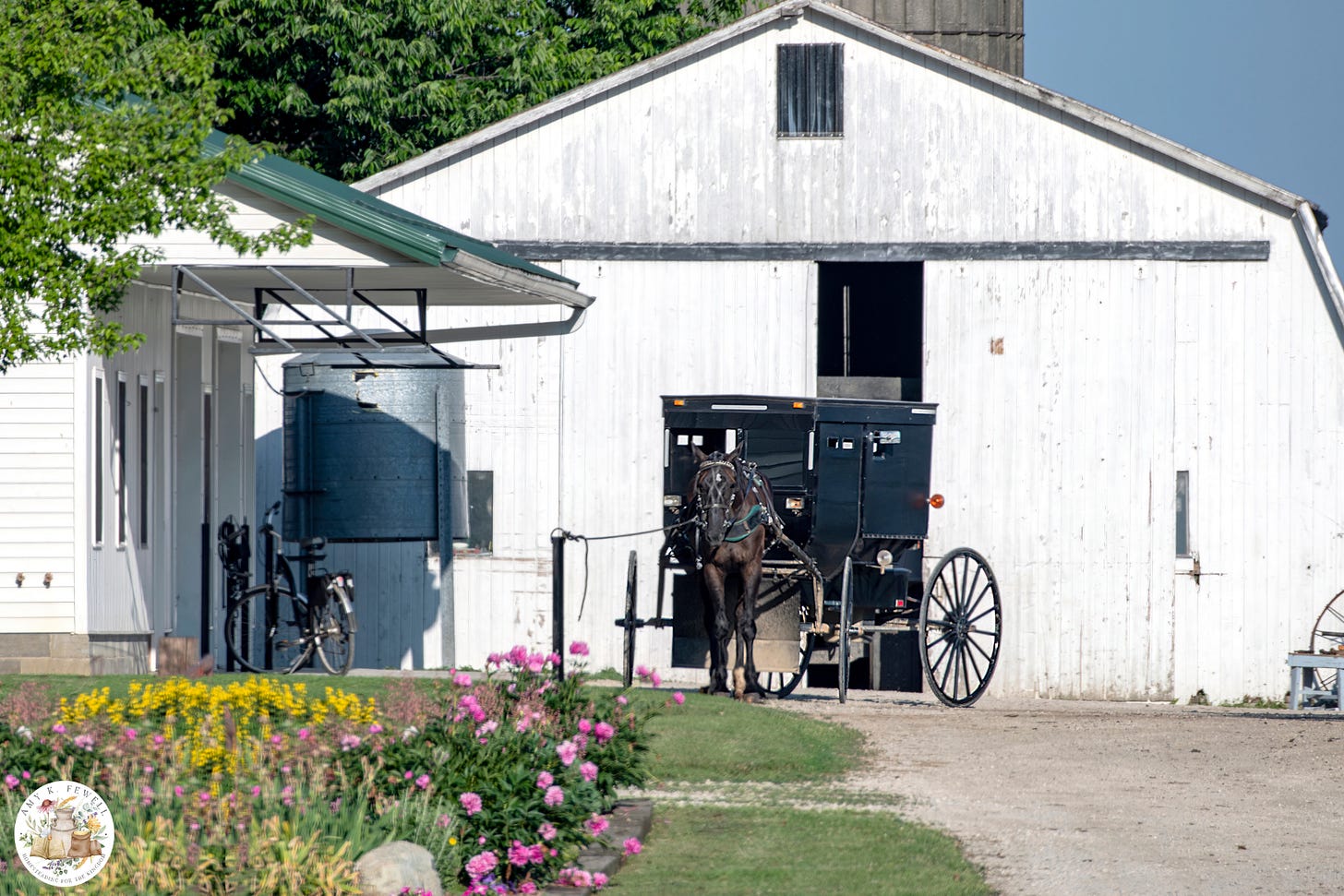
The recent headlines read that the Amish community in New York have been under attack (and fighting since 2024) with a ridiculous vaccine mandate that says religious exemption from vaccinations is no longer available. There are five to six states so far that have followed this guideline—California (2015), Connecticut (2021), Maine (2019), New York (2019). West Virginia and Mississippi have never allowed religious exemption. If you didn’t know, the Amish have a strong conviction against vaccinations (as they should). It’s always “my body my choice” with the government, until it comes to something like this.
But this article isn’t about vaccine mandates or requirements. We’re going to go much deeper than that. Especially with the movement of homesteaders across the nation.
Historically, the government has a vast track record of herding people groups, or certain populations, into certain areas—knowingly or unknowingly. One of the more recent migrations that I’ve been watching has been the migration of homesteaders to more liberty and freedom loving states. While yes, much of that migration is Yahweh inspired, there are other instances that are not.
The United States government, especially, is well known for displacement. My own family was affected by it in the last one-hundred years. Let’s start breaking this down.
When They Ran Homesteaders Off Their Land in Virginia
There’s a stretch of the Blue Ridge that people drive every October for the leaves, and most of them have no idea they’re driving through somebody’s old front yard, corn field, or dairy pasture.
Before Shenandoah National Park was a park, it was home to about five hundred families—2,000 people. Some of them had been on that mountain for two hundred and fifty years. They had orchards that shipped apples to market, one-room schoolhouses, churches, post offices, general stores, and cemeteries full of their parents and grandparents. The government tried to frame them as one-toothed uneducated hicks, which couldn’t have been farther from the truth. They were farmers. They knew their land like the back of their hand. And these communities had never had any government interaction since the 1700s.
That was the real issue—community and independence outside of the system.
In 1926 Congress authorized a national park in the east, but with a catch. Unlike the western parks carved out of land the government already owned, Virginia had to buy this land and hand it over. Buy the land from who? Because they barely paid any of the rightful owners.
So in 1928 the state passed the Public Park Condemnation Act, which let officials condemn whole tracts at once instead of fighting each family in court. By the mid-1930s, more than two thousand people across eight counties had been put off the mountain. Landowners were “paid”, though usually just enough to clear the mortgage. Tenant farmers, some of whose families had worked those hollows for generations, got nothing at all, because they held no deed. Most of the houses were torn down or burned, sometimes while the family watched, so no one could come back.
The crazy part is how it was justified. A book came out in 1933 called Hollow Folk, written by a sociologist and a newspaperman, describing these people as illiterate primitives living in mud-plastered cabins, cut off from law and government since the 1700s. It was widely read and it was largely false. Later research, and the families’ own letters, showed exactly what you’d expect: ordinary rural Americans, growing food, schooling children, selling their harvests, living in community, flourishing…without government input. But the story had to be told the other way, because “we are rescuing these poor people from backwardness” reads better than “we are taking their farms.”
Granted, there were some uneducated folks and families, as in any society. But that was not the majority.
Roughly three hundred of the letters land owners wrote survived, sitting in the park archives in Luray, VA. They’re not dramatic. They’re mostly people asking practical questions—where are we supposed to go, why are you doing this? Can we take our fruit trees? What happens to the graves?
That’s what breaks my heart. My own generational family members were part of this, and I have to wonder what was going through their minds. Their children’s minds. The husband who provides from the land and now can’t. The politeness of their heritage. People who had been told their whole lives to be respectful, writing careful letters to the men taking their land. Were they perfect letters? Not hardly. Some of them didn’t know how to spell, that’s the point. But were they educated beyond spelling? Oh yes, absolutely.
Some wonder what’s under the ground, what’s hiding there, or what motive did the government have to displace 2,000 people just to create a “park”. It sounds like a outrageous hogwash to me—why did we need park? But it has happened before, and it happens still. Just differently.
Here are some other examples throughout history of displacement or moving of people:
The Great Smoky Mountains removed something over a thousand families in the same era, including the Cades Cove community. Just like SNP.
The Indian Removal Act of 1830 and subsequent treaties relocated the Cherokee, Choctaw, Chickasaw, Creek, and Seminole from the Southeast to Indian Territory (now Oklahoma). The reservation system through the late 1800s moved dozens of other nations. Much later, the Indian Relocation Act of 1956 did the reverse—it “paid” Native families to leave reservations for cities like Chicago, Denver, and Los Angeles, part of the “termination” policy.
We won’t even talk about the Native sterilization the government did in the 1960s and 1970s on Native women without their consent (and sometimes without their knowledge). Makes you wonder what’s actually in those pills many women take today, and why the birth rate is at an all time low.
Executive Order 9066 (1942) moved roughly 120,000 Japanese Americansfrom the West Coast into inland camps in Arkansas, Wyoming, Utah, and elsewhere. The Aleut people of Alaska were removed to camps in southeast Alaska the same year.
The Homestead Act of 1862 and its successors deliberately populated the Plains and West by giving land away. The Pacific Railway Acts did something similar through land grants. These weren’t coercive, but they were federal policy designed to move populations into specific regions.
The Resettlement Administration (1935) and the Subsistence Homesteads Division relocated “struggling” farm families to planned communities—Arthurdale in West Virginia, Greenbelt in Maryland, the Matanuska Colony in Alaska, which moved about 200 Midwestern families to farm the valley north of Anchorage.
The Tennessee Valley Authority displaced roughly 125,000 people over its dam-building decades; Norris Dam alone took about 3,000 families. Kinzua Dam flooded a third of the Seneca Nation’s Allegany Reservation in the 1960s and broke the 1794 Treaty of Canandaigua to do it.
In Oak Ridge, Tennessee: roughly a thousand families were given a few weeks to leave in 1942, for a project nobody could explain to them. Same story at Hanford in Washington, where the towns of White Bluffs and Hanford were emptied.
Title I of the 1949 Housing Act plus the 1956 Interstate Highway Act together displaced something on the order of a million Americans. Rondo in St. Paul, Black Bottom in Detroit, Overtown in Miami, the Hill District in Pittsburgh—neighborhoods with churches, businesses, and homeownership, declared “blighted” and routed through.
Poletown in 1981 took a Detroit neighborhood by eminent domain and handed it to General Motors. Kelo v. New London in 2005 upheld taking homes for private economic development, and the promised development was never built.
The pattern—the government has used relocation as a tool for land acquisition, wartime “security”, economic policy, civil rights “remedy”, and humanitarian obligation—sometimes by force, sometimes by incentive, sometimes by deception.
Almost none of these instances were framed as taking. They were framed as improving—rescuing backward people, bringing modern housing, restoring wilderness, developing the economy, integrating people into civilized society.
The point is, it was wrong, and it will continue to be wrong.
But what does it look like now?

Since 2020 many have become more aware of the overreach in the American government (and beyond). But some have forgotten if it is no longer directly affecting them. Year after year we see more and more overreaching laws in our country. Namely vaccines, self-defense, and gun laws, are at the top of the list. Along with high costs of living, it makes it increasingly difficult for folks to stay put.
But what if that has always been the plan?
Naturally, cities and densely populated areas tend to have liberal mindsets when it comes to these laws. They enjoy following the mindset of “lose a little freedom for a little safety”. But it’s a false reality—because there is no safety at all. These policies are driven completely by fear and ignorance.
So when we begin to see people of a certain mindset flocking away from states they once never believed they would leave, I have to sit with that for a little while and ask the question—what’s the motive? What’s the reason? What are the spiritual implications of this?
Now, don’t get me wrong, God is moving people. He is moving people to communities they can trust. He is moving people to regions to advance the kingdom and the gospel. He has always been this way.
I have been saying this for years. It has literally been a part of our ministry. But it only works if you are moving where God told you to move, not the current popular homestead place to move.
On the flip side we have to ask the questions. Where is the balance? Are we witnessing a less noticeable displacement of people who have morals, who grow food, who have faith convictions, and who want to live outside of government overreach?
If God told you to move to Texas, then that’s where you should move. Likewise, if God told you to move to New York, that’s where you should move. Because the reality is that the greatest safety is in the palm of Yahweh, no matter what the politics of that state are.
Not everyone is driven by the Spirit of God, though.
When people begin to start a mass exodus from one state to another, that’s a red flag. We are now basing opinions on politics that are forever changing year to year. What happens if 100,000 homesteaders move to a state that then flips overnight (like my home state of Virginia did) to a democratic governor with over reaching policies? Then what? Are they going to move again?
At some point we have to ask ourselves this question—has God called us to stay, or go? And if the answer is to go, then where will you be safe in the arms of the Creator of all things for the times that are ahead of us?
If you don’t know that answer, then are you falling into a government deception that is simply trying to herd people of like mind into a certain area or region that is popular? Only to find that one day in the future, the motive of this deception will finally rear its head.
I pray this isn’t the case, but governmental history shows otherwise.
As the Amish threaten to leave New York State due to its policies, I have to wonder if the state even cares at all. Principalities could often care less that the ones that disagree with them are leaving their region. This is the point.
When will we stand? If God gives us a territory, are we courageous and brave enough to stand in it and for it?
“Therefore put on the full armor of God, so that when the day of evil comes, you may be able to stand your ground, and after you have done everything, to stand.” Ephesians 6:13 NIV
Justin Rhodes recently said in a Substack note, are you willing to “plant what you won’t sit under”? And then, are you patient enough to wait for it to grow?
Our forefathers knew the cost of freedom. We have reached that point in American history once again. Are we courageous enough to stay? To claim? To declare? Are we patient enough to have babies, grow them well, and support them to be the next generation that stays, claims, and declares?
Never let anyone guilt you out of leaving, this is not the point. If your family is in danger, much like the Amish are, then your focus is your family. I’m not talking about direct danger. Don’t read into something that’s not being stated.
But for those who have no reason outside of safety, I submit these questions and theories to you to consider. And I exhort you to seek the mind of Christ and heart of the Father as you begin to think of these things. He is the only one that knows what is best for your family.
Times change. Be ready to move or stay at a moments notice. Stay within the heart of Yahweh and what He is asking.
And at the end of the day, before making a decision rashly, filter through the lens of history and the Word.
The LORD is in this, my friends. If you seek Him first, you will know His faithfulness and will.
A Prophetic Prayer
We are coming up on the 100-year anniversary of the displacement of homesteaders in the Shenandoah National Park in 2028. Coincidence? I don’t think so. Prophetic word after prophetic word (including what God has impressed on me) have shown that starting in 2027 through 2028 are going to be intense.
Here’s what I will pray for and stand on—a generation of modern homesteaders will see the greatest land restoration and transfer in the current history of man, because God is a God of justice. What the enemy stole from this community and region 100-years ago, the LORD will restore sevenfold.
“People do not despise a thief
If he steals to satisfy himself when he is starving.
Yet when he is found, he must restore sevenfold;
He may have to give up all the substance of his house.”
Proverbs 6:30-31 NIV
This is my prayer. That those who want to steward the land in this new generation will be brought even more land and territory than they could have imagined.
For my family, for your family, for this region, this community, and this nation.
When all of hell and chaos breaks loose, may we be found faithful and stewarding Goshen. Not fearful and weak, but courageous and equipped.
Amen.