• Home
  • Membership
  • Shop
  • Cart
  • Our Farm
  • Gut Health
  • Herbal Practice
  • Buy Trusted Supplements
  • Nav Social Icons

  • Skip to primary navigation
  • Skip to main content
  • Skip to primary sidebar
  • Skip to footer
  • Home
  • Blog
  • About Me
  • Our Farm
  • Gut Health
  • HH Membership
  • My Books
  • Youtube
  • Podcast
  • Homesteading
  • Chickens
  • Herbs
  • Family
  • Farmhouse
  • Homemaking
  • Recipes
  • Sourdough
  • Contact Me
  • Herbal Practice
  • Buy Trusted Supplements
  • Mobile Menu Widgets

    Search

    Connect

Amy K Fewell | Homesteading for the Kingdom

Amy K Fewell | Homesteading for the Kingdom

  • Start Here
    • About Me
    • My Books
    • Podcast
    • Youtube
    • Gut Health
  • Blog
    • herbs
    • Bees
    • chickens
    • rabbits
    • Farmhouse
    • gardening
    • devotional
    • homemaking
    • sourdough
    • recipes
  • Courses & Books
    • HH Membership
    • My Books
  • herbs
  • Podcast
  • Contact Me

The Homestead Dog | Meet Delilah

October 21, 2016 · In: family, homesteading

I’ve always wanted a livestock guardian dog, but it also needed to be an incredible family dog that could be with us at all times. Unheard of, right? Everything I have read has continuously said LGDs must remain with the herd at all times. I thought a livestock guardian was outside of our near future, because honestly, we only live on a half-acre homestead, and I just simply didn’t want to pour $1,000 into a pup that wouldn’t have much space to patrol.
However, we were still in the market for a new puppy this summer. My son’s birthday is the end of August, and the one thing he continued to ask for was a puppy, even though we already have a 2 year old black lab. Do you know how hard it is to find a puppy that’s ready for a new home in a certain month? Very hard, when you’re looking for a specific breed.
I, myself, wasn’t really interested in a new dog. In fact, I tried to talk my husband and son out of it. Because the reality is, guess who’s going to take care of that puppy? Me, yes, that’s right. We already have Samson, our lazy lab. In fact, whenever I post photos of him on Instagram I often hashtag him #notafarmdog. It’s true. He’s nothing but a cuddle bug, but I’m ok with that.


So, I thought to myself, if we’re going to get another dog, then it’s going to be a dog that can do a job around here. Our stipulations were that it had to be a natural guardian of our family and property, it had to be family friendly and not easily aggressive, it had to be fearless and eager to please, and it had to be strong and courageous while remaining gentle and soft towards its pack members. In other words, it had to be strong and fearless enough to go up against our neighboring bear friends, and yet gentle enough to want to sleep in the bed at night. Sounds like the perfect dog, doesn’t it? In no way did I think we would ever find it…I assumed it was a myth in my own mind.
We tossed around the idea of Dobermans, German Shepherds, German Short Haired Pointers, and mixed breeds. But it wasn’t until one morning, when I came across a breed in our local Valley Trader newspaper, that I realized I had found a pup that I could really enjoy here on our homestead.

Enter, the Black Mouth Cur mountain dog—also simply known as, the Black Mouth Cur. While Black Mouth Curs aren’t considered a breed in the “livestock guardian” dog breeds, they are “guardians”. The different between a livestock guardian and a guardian dog is simply that the livestock guardian warns first instead of attacking. And sometimes, never attack with the intent to harm or kill a predator. A guardian may warn, but will most certainly attack a predator with the intent to kill. This is why we chose this breed. We have resilient predators here, including bear. And we needed a tough pup that was up to the job!

As I read through the extensive history of this breed, and the fact that the breeding lineage has been kept fairly narrow over the past century, I was sold. The Black Mouth Cur is a herding, hunting, and guardian dog that has been traced back all the way to 347 BC. The Celts are widely attributed to the development of the Cur breed, and by 1000 to 600 BC, they had already developed several different lines of Curs. Each lineage had a certain job, but each one also excelled in any job you gave it—be it herding, guarding, or hunting. When the Irish and Celts came to settle in the United States, they brought their beloved dogs with them, and so began the Black Mouth Cur generations here in the U.S.A.

Today, we have several different lines of Curs, and many that are mingled in between the few. These lines are the Southern Black Mouth Cur from Alabama, the Foundation Black Mouth Cur from Texas, the Ladner Yellow Black Mouth Cur from Mississippi, and the Florida Black Mouth Cur. With many breeds, dogs are bred for color and standard of perfection, but with Cur breeders, the standard of perfection is how well the dog can perform on demand. If the dog has exceptional abilities, then it doesn’t really matter how black its mouth is or how yellow its body is—it’s a good dog.
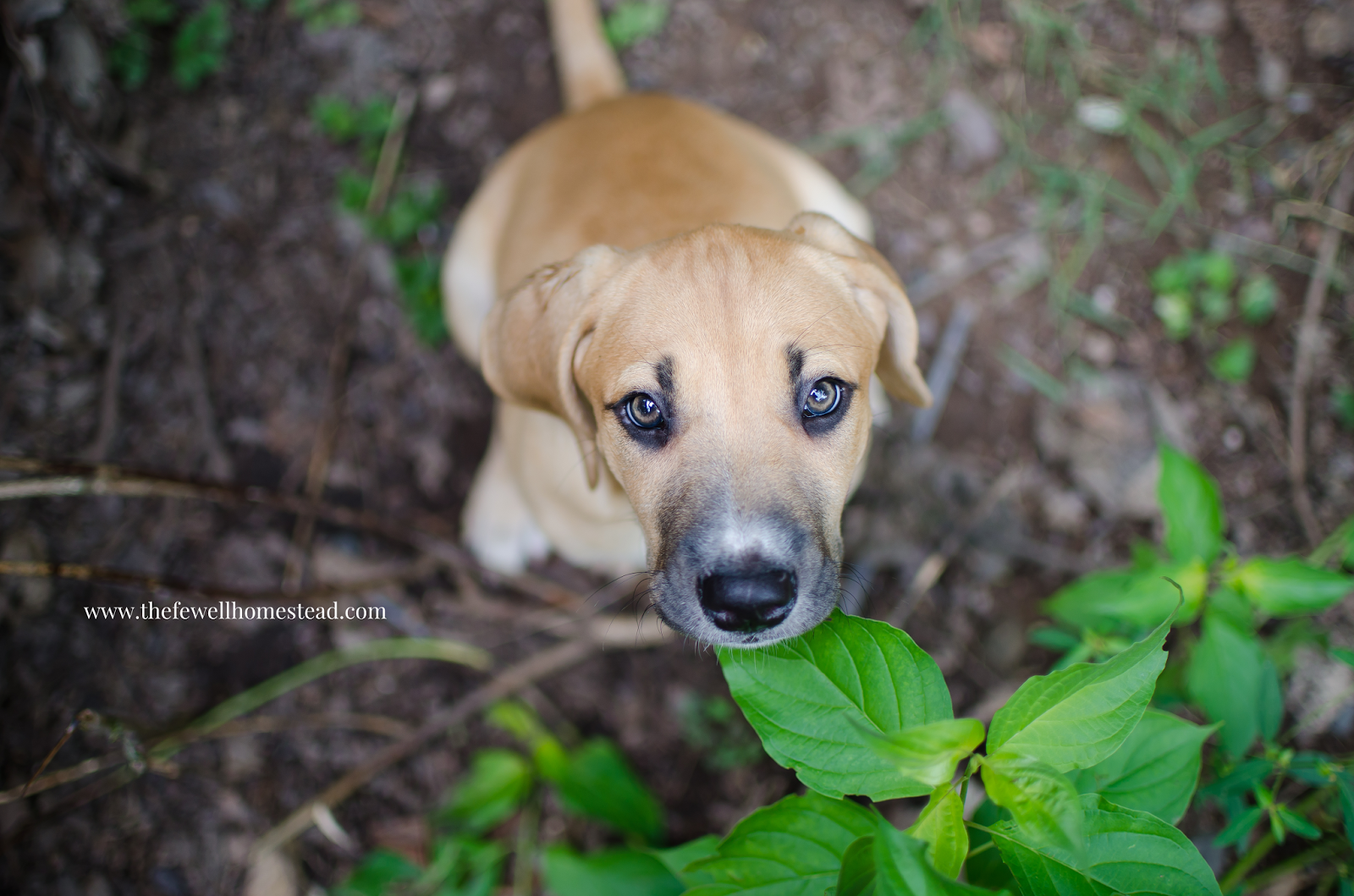
Typically, a Black Mouth Cur can be between 40 lbs and 90 lbs. Again, this is all dependent upon the line that you purchase from. Our pup, Delilah, comes from the Ladner background from her Sire’s side, and a mixture from her Dam’s side. This has created a nice in between color of red and yellow, a black muzzle with a touch of white, and a white chest. Her body will be slender and her legs long, much like a hound.
Curs are typically used for hunting wild boar, treeing coons and squirrels, herding livestock and protecting livestock, and are also greatly used for protecting their own family. Some Curs are even used in search and rescue groups because of their exceptional skill of tracking and their fearless nature. They can take down a bear or coyote quickly, should you come across one. And will even fight until death if it means protecting what is its own.
So, we traveled over an hour and a half into West Virginia, from our home in Virginia, to meet Delilah and her eight puppy siblings. We were instantly in love. She chose us. She instantly clicked with our son and would follow him everywhere…and she still does.
Delilah is almost 10 weeks old, but already shows great promise in her ambitions. She is curious and smart. One of the smartest dogs we’ve ever had. You can see her working problems out in her head as she watches. She was house trained the first week we had her, and she continues to learn her perimeter of our property. She sits with the chickens and pays them no mind—she knows they are “hers” and there is no need to think otherwise. Though, we will continue to monitor her closely.
She is a family dog, but she is a farm dog as well. Our very first farm dog. She runs along behind me when doing chores, and sits and waits patiently for me until I’m done, keeping guard. She already knows basic commands and is becoming more and more trustworthy inside the home as she gains knowledge of what is “no”, what is “leave it”, and what is “good girl”.
The other evening you could hear a pack of coyotes off in the distance, across the river. She stopped and listened intently until they disappeared. She wasn’t leaving her post until they were gone. My heart gleaned with delight as I sat and listened with her. Once gone, she jumped in my lap and gave lots of kisses. What a fine pup she is.
I am excited to see how Delilah grows and learns on our homestead, and I am so happy I didn’t talk these boys out of getting her. She is teaching me as much as I teach her. And if nothing more, she has the sweetest, most spunky spirit a homesteader could ever ask for. This homesteader certainly is honored to train her and guide her into the warrior she will become for our family.

In the meantime, she sleeps at the foot of our bed, and curls up in between our heads when she catches a chill. And in the mornings, she smothers us in kisses. And you know what, that’s ok with me too. This breed in exceptionally versatile and goes against everything I’ve ever learned about LGDs. I’m hopeful this bond will continue through the remainder of her live here in our homestead, and beyond.

Hear All About Delilah Here!

By: Amy K. Fewell · In: family, homesteading · Tagged: Black Mouth Cur, Delilah, farm dog

you’ll also love

16 Sick Chicken Symptoms & Sick Chicken Treatments
The Task of Raising Warrior Sons
Setting Up Your Outdoor Chick Brooder (with video)

Reader Interactions

Comments

  1. Lauren Paolini says

    September 30, 2018 at 4:54 pm

    Hi Amy. I’m researching LGDs for our new home, and the BMC is at the top of my list. I’d love to hear how it’s been going with Delilah the last 2 years!

Next Post >

He Grew Up Today…

Primary Sidebar

meet amy

meet amy
hello!

I'm Amy. I love organic food but I love cookies too I love Jesus and His grace. I believe broken people make the biggest impact in the world when they share their stories. I believe in stories, and I'm sharing mine.

Read More

Connect

Search

Ads & Sponsors

200x400

Advertise

Follow Along

@amy.fewell

For years, I’ve talked about fragile supply chains For years, I’ve talked about fragile supply chains, rising input costs, foreign dependence, and the vulnerabilities built into our modern food system.

Now, the USDA has confirmed the first domestic case of New World Screwworm in a Texas calf. The screw worm is a parasite that is flesh eating in nature. 

If you’ve listened to my interview with AJ Richards, you may remember him sounding the alarm about this months ago. Many people dismissed it as just another agricultural issue happening somewhere south of the border. But AJ explained something important—this is a food system concern, and it could cause a collapse of the already historically low beef herd in the USA.

These farmers are already facing years of drought, high feed costs, regulatory pressure, and economic uncertainty. When breeding stock leaves the system, rebuilding takes years—not months.

Now add a parasite that can rapidly spread through livestock populations and historically cost producers enormous losses. It may not affect the local small farmer who can monitor his herds easier (and probably has healthier herds). But it will absolutely affect bigger herds that are already struggling.

This is why I continually encourage people to think beyond the grocery store. The big ag food system is not one giant crisis away from collapse. It’s thousands of small pressures accumulating at the same time. Together, they create a system that becomes increasingly expensive, increasingly centralized, and increasingly vulnerable. 

Know your local farmer, raise some of your own food, learn skills, build community networks, and create resilient local food economies before they’re needed.

This is why so many of us have spent years talking about food sovereignty and homesteading. Not because we expect disaster around every corner, but because history repeatedly shows that resilient communities weather storms better than dependent ones.

Whether it’s pest, drought, inflation, fertilizer shortages, disease, or a disruption we haven’t seen yet, the lesson remains the same—the future belongs to communities that can feed themselves. And every year, that lesson becomes harder to ignore.
I have nothing to say. Just a pretty photo dump f I have nothing to say.

Just a pretty photo dump for old time IG sake.

The era where we followed homesteaders and farmers because their content was beautiful and practical and took us to a peaceful place. 

This is my peaceful place.
Most homesteaders raise meat chickens. Very few e Most homesteaders raise meat chickens.

Very few ever stop to ask, “What happens if I can’t buy chicks next year?”

For generations, families didn’t depend on hatcheries to fill their freezer. They developed breeding systems that allowed them to raise meat birds year after year, right from their own homestead.

That’s exactly why we began experimenting with a two-breed meat chicken system.

The goal isn’t to compete with a Cornish Cross. You can’t compete when it comes to saving time and money. The goal is resilience.

A good breeding program allows you to maintain your own flock, hatch your own chicks, improve genetics over time, and continue producing quality meat birds without relying on outside sources. It puts one more piece of your food security back into your own hands.

This approach combines the strengths of two different breeds—one contributing growth and carcass qualities, the other contributing fertility, mothering ability, hardiness, and long-term sustainability. The result is a practical system that can provide meat chickens year-round while allowing you to retain breeding stock for future generations.

If you’ve ever wondered how homesteaders raised meat chickens before modern hatcheries, or if you’ve been looking for a more sustainable long-term poultry plan, this article is for you. It utilizes modern Cornish cross broilers, while having a dual-purpose system back up. 

🐓Comment SYSTEM and I’ll send it directly to your inbox.
Mullein is one of those herbs that often gets over Mullein is one of those herbs that often gets overlooked—growing wild along fence rows, in pastures, and even in places most people would call “weedy.” But for generations, it has been one of the most beloved herbs for the lungs, respiratory support, and overall herbal wellness.

Its soft, velvety leaves and tall flower stalk are easy to spot once you know what you’re looking for—and once you learn how to use it, you may never walk past it the same way again.

Mullein has traditionally been used to:

🌿 Support the lungs and respiratory tract
🌿 Encourage the body to clear mucus naturally
🌿 Soothe irritated throats
🌿 Infuse into oil for ear support
🌿 Dry and preserve for teas, tinctures, and the herbal cabinet

And one of my favorite things about it? It grows abundantly and asks for very little.

There’s something deeply beautiful about learning the plants around us—what they are, how to harvest them well, and how God designed creation with so much practical goodness right in our own fields and gardens.

If mullein grows near you, this is your sign to get familiar with it.

Read the full article on my website, and learn how to identify it, grow it, harvest it, and start using it in your herbal routine.

🌿 Comment MULLEIN to have it sent directly to your inbox.
High blood pressure can be due to many different t High blood pressure can be due to many different things. I have always prided myself in coming from generations of people who have high blood pressure (HBP), yet not having it myself. We eat cleaner than most of society. I incorporate herbs in most of my diet. And we live very cleanly when it comes to using chemicals in products like soaps and farm products.

So imagine my surprise when the midwife realized I was dealing with HBP during the last few weeks of my pregnancy with our fourth child.

Looking back on my pregnancy with our third child, I actually believe I was beginning to struggle then with this issue, but it didn’t pop up until days after I delivered.

In this article, I’m using myself as a client “case”, and will show you how I was able to support my body with herbs, hydration, and nutrition during this time. I’ll also share how important it is to support your body before, during, and after pregnancy so that you may help prevent HBP, pre-eclampsia, and postpartum pre-eclampsia.

🍃 Comment PREGNANCY and I’ll send the article directly to your DM.

Footer

Learn More

Chickens
Homemaking
Herbs
Recipes
Devotionals

Info

About
Contact
Privacy Policy
Shop

stay in the know

Copyright © 2026 · Theme by 17th Avenue