








• Home
  • Membership
  • Shop
  • Cart
  • Our Farm
  • Gut Health
  • Herbal Practice
  • Buy Trusted Supplements
  • Nav Social Icons

  • Skip to primary navigation
  • Skip to main content
  • Skip to primary sidebar
  • Skip to footer
  • Home
  • Blog
  • About Me
  • Our Farm
  • Gut Health
  • HH Membership
  • My Books
  • Youtube
  • Podcast
  • Homesteading
  • Chickens
  • Herbs
  • Family
  • Farmhouse
  • Homemaking
  • Recipes
  • Sourdough
  • Contact Me
  • Herbal Practice
  • Buy Trusted Supplements
  • Mobile Menu Widgets

    Search

    Connect

Amy K Fewell | Homesteading for the Kingdom

Amy K Fewell | Homesteading for the Kingdom

  • Start Here
    • About Me
    • My Books
    • Podcast
    • Youtube
    • Gut Health
  • Blog
    • herbs
    • Bees
    • chickens
    • rabbits
    • Farmhouse
    • gardening
    • devotional
    • homemaking
    • sourdough
    • recipes
  • Courses & Books
    • HH Membership
    • My Books
  • herbs
  • Podcast
  • Contact Me

Farmhouse Butcher Block Countertops (with video)

June 7, 2018 · In: Farmhouse, Featured, homemaking

Farmhouse Butcher Block Counters

When we first started our kitchen renovation, we knew the counter tops were an important part of the process. We thought we’d go with formica, but the more we researched butcher block, the more we fell in love with it. Butcher block counter tops are extremely forgiving, easy to maintain, and can easily be buffed or spot sanded down when the counter becomes compromised with scuffs, scratches, water rings, or burn marks.

In this blog post we’ll go over the process of curing the counter tops, and then we’ll walk through the monthly maintenance of them. I’ll show you some pros and cons of  butcher block, and there’s even a video at the end showing you our counter tops!

The Pros and Cons of Butcher Block

I was terrified of our new counter tops when we got them. I thought for sure I’d ruin them within the first year . . . pretty sure my husband thought I would, too! We watched video after video on YouTube talking about the counter tops and how temperamental they can be, and while this can be true, we found that having butcher block wasn’t as hard as some made it out to be. There are, however, pros and cons—as with anything in life. So let’s go over a few of those!

The Butcher Block Pros
  • They are easy to clean.
  • If you get scratches, dents, or water rings; you can spot sand with some sand paper and simply recondition the counter.
  • They are beautiful!
  • They are completely natural.
  • They are tough and resilient.
  • Butcher block will last generations if taken care of properly.
  • They are easily customized (with stains or wood types).
  • Butcher block makes for a beautiful photography backdrop! This is important as an author and blogger, ya know?!
The Butcher Block Cons
  • They get heat marks. You cannot set hot bowls, cups, or any hot dish onto the counter top. Anything that is boiling hot, even just boiling water in a cup for coffee or tea, can leave a heat ring on the counter. Typically it only leaves a ring on the top portion of the beeswax conditioner, but some go super deep into the wood. You can combat this by using trivets, or simply by placing a hand towel under hot items.
  • You shouldn’t cut directly on it. I know that you’re not supposed to cut on any counter top, really, but I often did when I had my laminate counter tops. You can also cut on stainless steel, which is a nice option. While you can cut directly on the butcher block, you’ll ruin it. It allows bacteria and water to seep into the counter, and pretty soon your wood will start to deteriorate even if you condition it every month.
  • You have to clean up the water on the counter. This could be an issue for some people around the sink, though it’s not for me. I always wipe my sink down either way. However, if water is left on the counter or around the sink, and it seeps through the protective wax barrier, it will cause your counter top to mold.
Getting Started with Butcher Block

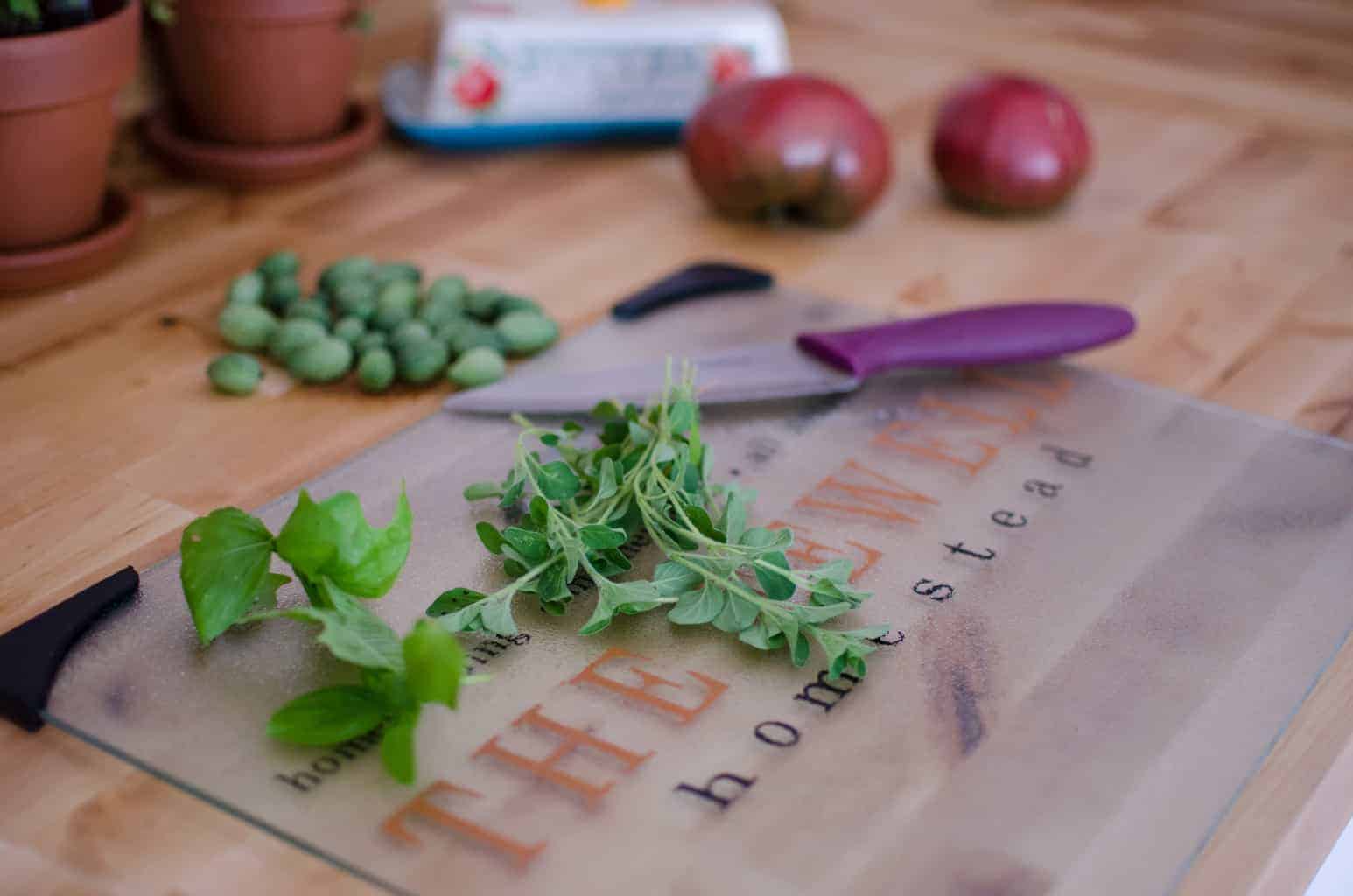
Now that you’ve chosen your butcher block, it’s time to condition it well before putting it into your kitchen. It’s a simple process but can take some time to finish.

  1. Cut your butcher block to size for your counter tops. This includes the sink hole.
  2. Round the edges of the block a bit if you’d like to, otherwise just sand them down a little to get the sharp edges off.
  3. In an open area (either outside or in a garage, etc) make sure no water can get to your butcher block. Set the counter on saw horses or a table and get ready to start conditioning your butcher block. I chose to do ours on a sunny warm day, allowing the sun to hit the butcher block to warm it up and open the pores of the wood more.
  4. Using Howard’s Butcher Block Conditioner, put a thin layer of conditioner onto all sides and edges of the counter top and allow to set for 15 minutes. You can warm up the conditioner in the microwave or simply by setting it in a sunny spot. The heat helps the conditioner penetrate into the wood.
  5. After 15 minutes, put another layer of conditioner on. You’ll do this three times total. After the third time, wait 15 minutes and then buff the counter top with a clean rag, wiping off any excess conditioner.
  6. Allow the butcher block to set for a couple of hours before setting into your kitchen.

Once you’ve set your counter top in place, you’ll still need to condition it weekly for the first month.

Here’s what our schedule was:

  1. Condition everyday for the first week.
  2. Condition once a week for a month.
  3. Condition once a month moving forward.

Always wait 30  minutes before placing anything back on your counter top, as the wax and oils could seep into papers and books.
Monthly Butcher  Block Maintenance

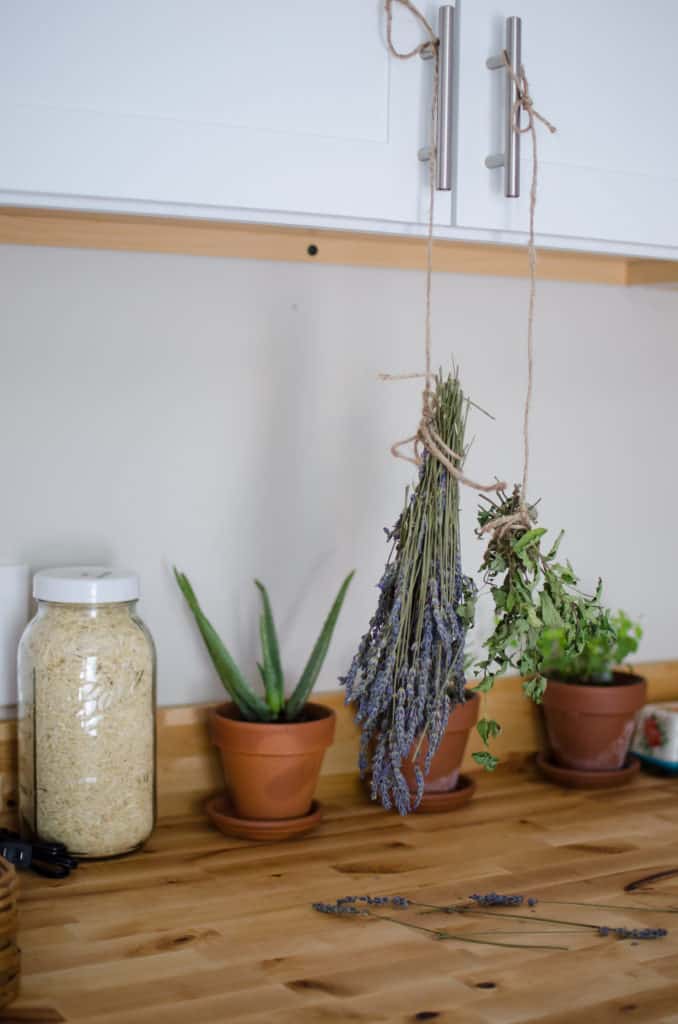
Now that your butcher block is installed and cured well, you only need to worry about monthly maintenance from this point going forward. Condition your counter tops once a month by cleaning them thoroughly (I like to use an enviro cloth), spot sanding where necessary, and then conditioning with the Howard’s Butcher Block conditioner. Allow the conditioner to set for 15 minutes, then buff clean with a new rag.

TIP: Use the same conditioner rag (not the buffing rag) over and over again and simply store it into a ziploc back with your conditioner until ready to use again. Do not wash the rag out, just leave it soaked in the excess conditioner.
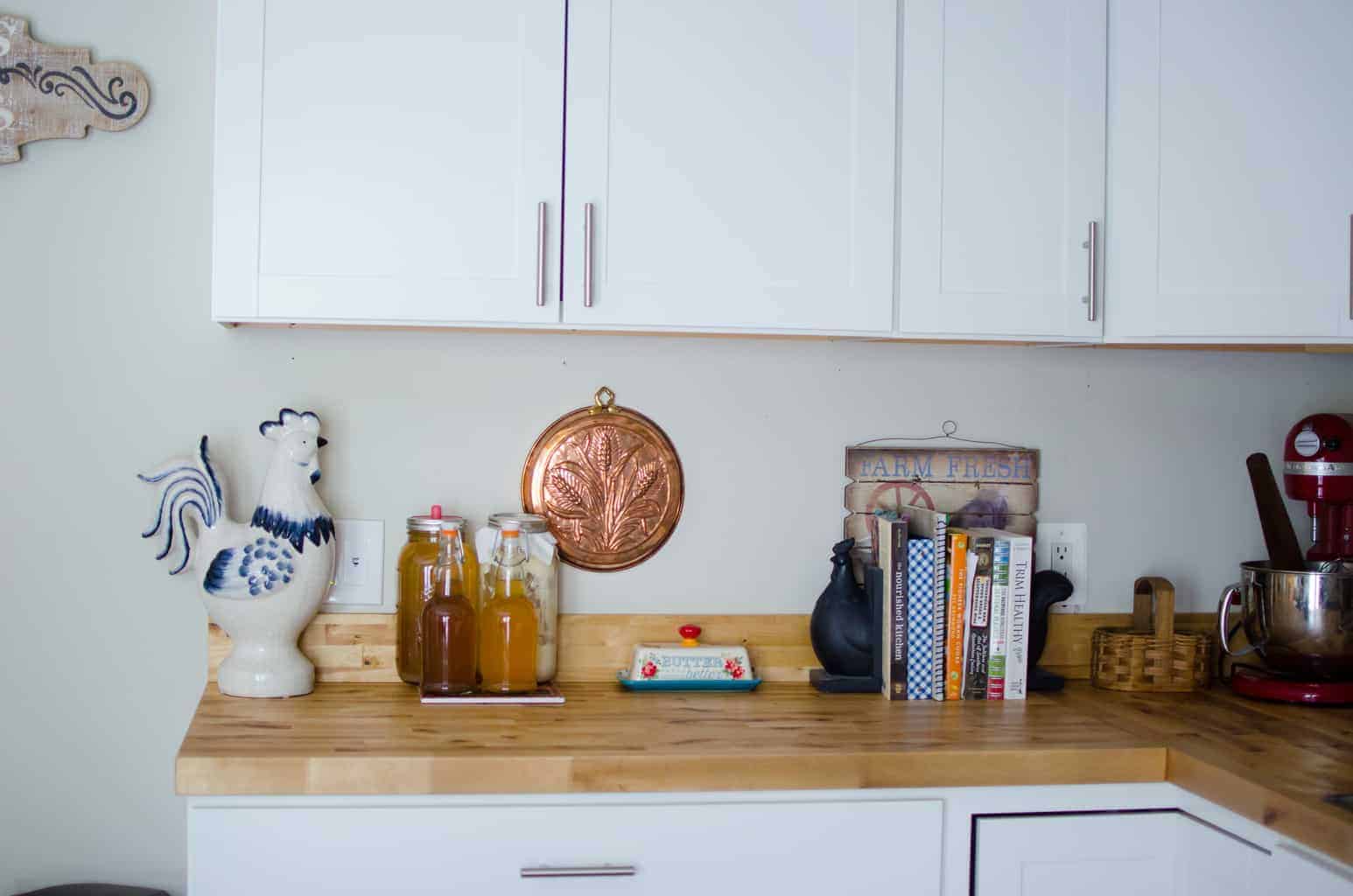
And that’s it! While the initial tasks can seem daunting, I promise you that butcher block is extremely forgiving. You most likely will never have to pull your counter top off and completely refinish it. The best part is that these counters will literally last you for generations if you take care of it properly. The best thing to remember is not to set hot items directly on the counter (trivets are fine!), and to wipe up the water that gets on the counter top—that’s it!

I hope this blog post helps you decide whether or not you want to add butcher block to your kitchen or other living space, and I hope that it shows you just how beautiful and simple it really is to incorporate into your farmhouse home!

Watch the Farmhouse Butcher Block Video!



By: Amy K. Fewell · In: Farmhouse, Featured, homemaking · Tagged: butcher block, countertops, DIY, farmhouse kitchen, how to, kitchen, kitchen countertops, sandpaper

you’ll also love

5 Autumn Homemade Air Fresheners
How to Make Deep Cleaning Chicken Coop Cleaner
How to Make and Pressure Can Chicken Bone Broth (with video)

Reader Interactions

Comments

  1. Heather Z says

    September 27, 2019 at 3:59 pm

    I love butcher block, I wish I had gotten it instead of the Corian. It’s an even bigger folly in that it’s blue. Dark blue. What was I thinking?? Just to update some information, it is a common misconception that wood counter tops harbor mold and bacteria. I would say that abused wood counter tops have the potential to harbor mold and bacteria. Several studies have shown that wood actually has anti-bacterial properties…so yeah! Just another reason to love it!

Next Post >

How to Make Homemade Chicken Feed

Primary Sidebar

meet amy

meet amy
hello!

I'm Amy. I love organic food but I love Oreo's. I love Jesus and His grace. I believe broken people make the biggest impact in the world when they share their stories. I believe in stories, and I'm sharing mine.

Read More

Connect

Search

join the tribe!

Ads & Sponsors

200x400

Advertise

Follow Along

@amy.fewell

Infused honeys are one of my favorite herbals to m Infused honeys are one of my favorite herbals to make. Especially when we can use the honey from our own hives, and herbs from our own garden. 

Today I’m making a sage infused honey. I would normally use dried herbs for infused honey, because fresh herbs can release a lot of water. But today I’m using fresh sage and will store it in the fridge, or a cool place, since we will use it fairly quickly. 

I’m particularly making this infused honey for cuts, scrapes, and wounds because sage and raw honey are both very anti-septic and cleansing. But one of our little ones is getting over a cold, and I’d like to prevent the rest of us from getting it, or at the very least have it on hand if someone gets a springtime cold in the future.

Sage is helpful for colds and fevers. Especially for sore throats and infections. Coupled with raw honey, it becomes a powerhouse herbal remedy. It is also a nerve tonic, which helps support the body in times of stress. Whether you’re sick or simply feeling overwhelmed, sage is an herb that can help the body during these times.

Let’s not make sage a weird thing. The herb sage is very healing and scientifically cleansing. But we aren’t using it in the new age or witchcraft where they believe it cleanses evil spirits and more. We are simply using it for what it does—helps support and heal the body. 

Sage, like any other plant and herbal created by God, is given for our use. Let’s redeem this beautiful, aromatic herb and use it the way God intended. Not the way the enemy perverted it. 

🌿 HOW TO MAKE IT 

Start by filling a jar with fresh or dried sage leaves. 
Pour raw honey over the top until completely covered.
Cap and place on a shelf for several days to allow the honey to infuse. 
If using fresh herbs, I recommend storing in a cool place or the fridge. Otherwise the honey can start to ferment depending on how much liquid the fresh herbs release. 
If using dried herbs, you can leave it setting on a shelf out of the sunlight. 

Sage is not recommend for pregnant or nursing mothers. Unless you are a nursing mother that is trying to wean and dry your milk supply. In which case this herb will be helpful.
Insecurities are loud when you aren’t confident in Insecurities are loud when you aren’t confident in your mission. And especially when you don’t know your mission.

Insecurity is rarely quiet—because it has nothing solid to stand on. It makes you feel like you have to prove yourself. That doesn’t mean you are loud on a platform, it means you’re loud with every opinion you have. 

When a person does not know their mission, they grasp for identity in other people’s opinions—at its root, it’s the fear of man, and pride. They measure themselves against others, compete where they were never called to compete, and speak loudly to compensate for the absence of clarity.

But Scripture shows us something different.

When a man or woman is anchored in their calling, there is a steadiness about them. Not arrogance. Not passivity. But authority and wisdom.

Confusion breeds insecurity.
But calling produces peace.

If you are constantly striving to be seen, heard, or validated, it may not be a confidence issue—it may be a mission issue.

Because when you know what God has asked of you, you don’t need to be the loudest. You don’t need to prove yourself. You don’t need to chase every opportunity. You know your mission, and you are CONFIDENT in that mission you’ve been given.

You become focused.
Grounded.
Unshaken.

Even Jesus didn’t answer every voice that called out to Him—because He was submitted to the will of the Father, not the noise of the crowd.

“I seek not mine own will, but the will of the Father…” (John 5:30)

There is a difference between insecurity and conviction.
One is driven by fear.
The other is anchored in obedience.

So the question is not, “Why do I feel insecure?”
The question is, “Have I clearly sought and submitted to my mission?”

Because once your mission is settled, your voice doesn’t have to be loud—it becomes weighty.
Your calling and my calling look incredibly differ Your calling and my calling look incredibly different. While they may crossover in various places—we are not taking the same steps in every way. 

Sometimes I think it’s easy for Christian’s to put one another in a box. I’ve found when this happens, the tradition of man rules. The reality, however, is that while we should stay in the boundaries set by God—we are all intricately and uniquely different.

We follow His blueprint, but we all have a different part to play. 

So if I don’t fit into the box you’d like for me to fit into, sometimes that’s not my fault. It’s the ideological thought process that has caused many to think wrongly. 

Expand your horizon. 

Not every man was created to goto war but every man can be a warrior. Not every man will write like Luke or teach like Paul—but every man can be a teacher in his own way.

The same goes for calling—you and I are called to the great COMMISSION, but our MISSION may look a lot different. And when we come to terms with this, when we accept it fully in the body of Christ, we begin to see every part of the body flourish. We begin to see more advancement. 

While I’m over here working with the salt of the earth blue collar kind of people, you may be working with white collar suits and ties. Both are equally important. Both have important roles in the kingdom. And kings and rulers will come to both when the world shakes even more than it is. 

I have heard men with deep southern accents preach a simple gospel without a stage and pulpit and cut to the core in less than 15 mins. Likewise, I’ve sat in theological discussions that last hours that I know my more simple friends could never (nor would they want to) sit through. 

My goal—be able to teach effectively to both groups, while staying in my lane. Staying in what I’ve been called and anointed to do. 

And that’s the difference. 

Whatever God has called YOU to do. Do that. Have situational awareness. Be flexible enough to cross over into other lanes to excel foward. But never forget your calling is different than the rest. 

Embrace it. It belongs to God, after all. Walk in obedience. Embrace the callings of others. Stop comparing. We’ll get farther this way.
They are your greatest treasure. The jewels in you They are your greatest treasure. The jewels in your crown. And they are not yours at all, when you really think of it. They are gifted to you for a time, and they belong to the Creator of all things. The King Who made you. 

Parenting is hard. It takes years and multiple children to finally figure it out. By then the damage may have already been done to the older one(s) and now you try to rebuild. Or maybe you don’t. Maybe you decide to just not even try. But which one do you think is the best option knowing the King entrusted one of His children to you to call your own? Try, and then try again. 

If we must become like children to enter the kingdom, how much more important is it to make sure we are intricately involved in every aspect of our own children’s lives? 

I remember growing up. It didn’t matter how much someone said they loved me. If I didn’t feel loved in that moment or situation, then in my mind I wasn’t loved. But we eventually move past childhood thoughts into maturity, where we realize that our parents did the best they could do with what they were handed (outside of abuse etc, which is never condoned). And if we use wisdom, we realize we can be better and do better.

Get healed so that you aren’t spending the rest of your life healing your children or wishing you’d done better.

Get healed before your grandchildren come along and don’t want to be around you. 

You know how you do that? Sit down with your little ones, and your big ones. Give them hours of your time, not just 30 mins total per day. Have conversations with them like people, not subordinates.

And when little girls ask you to dance in the rain with them—don’t say no. 

You are laying the foundation for what your children will expect in their adult lives. If you hand them a controlling parent, they will either look for a controlling spouse, or be one. But if you hand them a calm, authoritative, wise, loving parent (which doesn’t mean a pushover—set boundaries), they will not only look for an authoritative spouse, but they too will walk in authority. 

At the end of the day, remember, it’s all about the kingdom. 

The King is coming. Will He find us busy for Him, or ourselves?
“19 But I trust in the Lord Jesus to send Timothy “19 But I trust in the Lord Jesus to send Timothy to you shortly, that I also may be encouraged when I know your state. 20 For I have no one like-minded, who will sincerely care for your state. 21 For all seek their own, not the things which are of Christ Jesus.” Philippians 2:19-21

Footer

Learn More

Chickens
Homemaking
Herbs
Recipes
Devotionals

Info

About
Contact
Privacy Policy
Shop

stay in the know

Copyright © 2026 · Theme by 17th Avenue