





• Home
  • Membership
  • Shop
  • Cart
  • Our Farm
  • Gut Health
  • Herbal Practice
  • Buy Trusted Supplements
  • Nav Social Icons

  • Skip to primary navigation
  • Skip to main content
  • Skip to primary sidebar
  • Skip to footer
  • Home
  • Blog
  • About Me
  • Our Farm
  • Gut Health
  • HH Membership
  • My Books
  • Youtube
  • Podcast
  • Homesteading
  • Chickens
  • Herbs
  • Family
  • Farmhouse
  • Homemaking
  • Recipes
  • Sourdough
  • Contact Me
  • Herbal Practice
  • Buy Trusted Supplements
  • Mobile Menu Widgets

    Search

    Connect

Amy K Fewell | Homesteading for the Kingdom

Amy K Fewell | Homesteading for the Kingdom

  • Start Here
    • About Me
    • My Books
    • Podcast
    • Youtube
    • Gut Health
  • Blog
    • herbs
    • Bees
    • chickens
    • rabbits
    • Farmhouse
    • gardening
    • devotional
    • homemaking
    • sourdough
    • recipes
  • Courses & Books
    • HH Membership
    • My Books
  • herbs
  • Podcast
  • Contact Me

Rabbit Care Basics for the Beginner

August 2, 2016 · In: rabbits, Uncategorized

Rabbit Care Basics for the Beginner

So you want to start your homestead rabbit journey, and you’re not sure where to begin. What do they eat? How much do they eat? What happens if they get sick? How do they live? While these things can all be elaborated on extensively, I’ll try to sum it up for you in a condensed version.
When you’re done here—or if you’re looking for something more in-depth—head over to our Rabbit page to learn more, and definitely check out the resources list at the end of this post. I’m also currently working on a homestead rabbit book, which I hope to  have completed and for sale next Spring (2017).
Whether you just purchased your rabbit herd, or you’re about to, there are some key rabbit care basics you’ll need to know.

Rabbit Housing

Some people choose to raise on pasture, while others choose to raise in hutches. Some, like us, even choose to do both. While our rabbits can’t be on pasture at all times, we do rotate them out. No matter the housing, you’ll need to make sure they are secure and safe from predators. Rabbits should also be out of direct sunlight, if at all possible, in the warmer months. In the cooler months, direct sunlight is fine. But make sure they have a shaded area where they can go inside of their hutch.
If you choose to do wire hutches that aren’t on pasture, I highly suggest investing in a floor mat that they can sit on should their feet ever get stressed from the wire. You can purchase them here, or you can simply put a small piece of plywood in their hutch.
Make sure all hutches are draft free in the winter months, as cold air can be detrimental to rabbits. You’ll also want to pack their hutches full of straw in the winter time.
Rabbit Feed

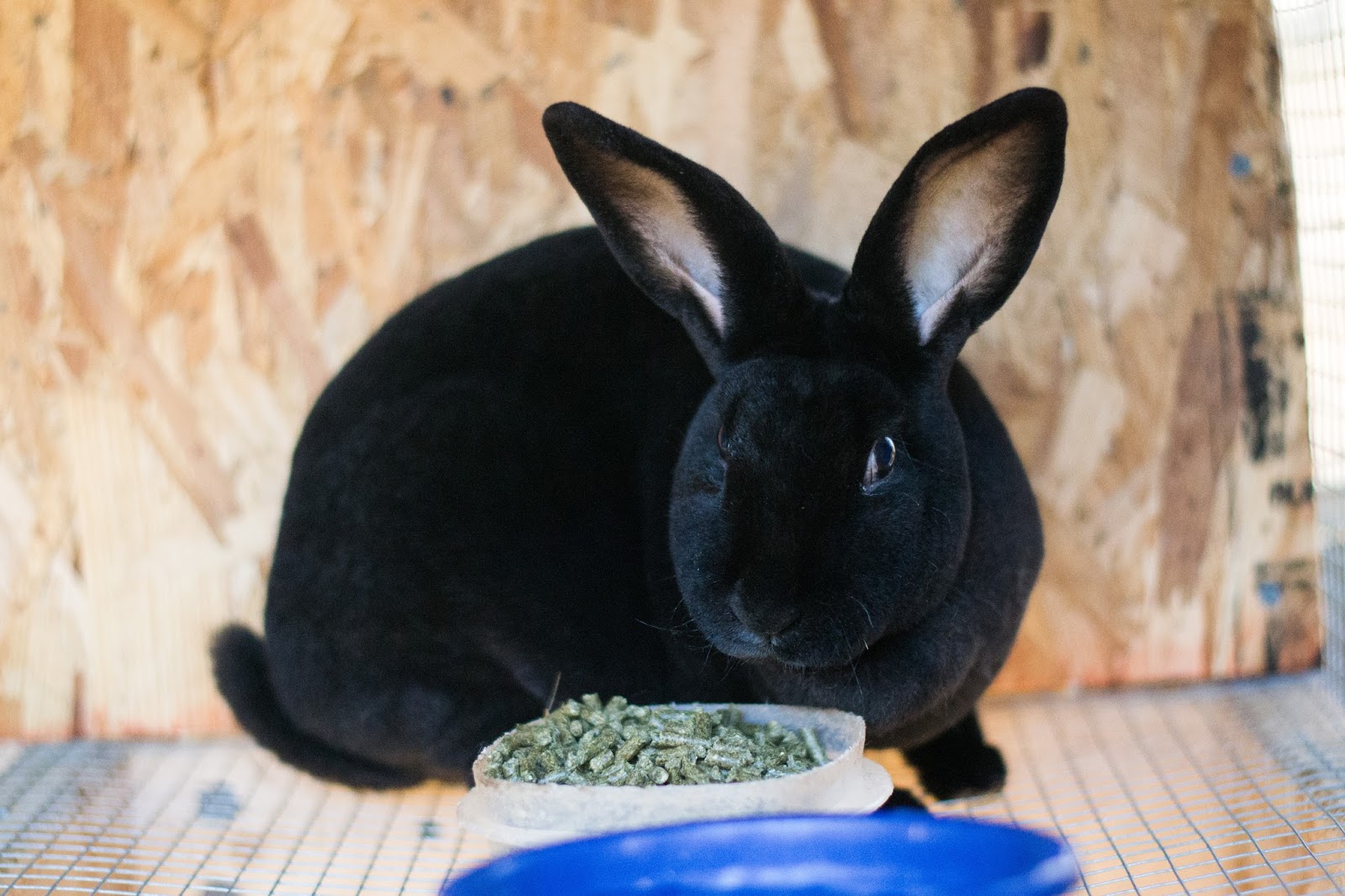
Rabbit feed, to me, is the most interesting part of raising rabbits. Also, don’t forget WATER. Rabbits need a constant supply of water. In the wintertime, this can be hard. We switch over to crocks rather than bottles, so that they can at least lick the ice.
The bulk of a rabbit’s diet should consist of some form of hay—ours love orchard grass. You can also give your rabbits alfalfa hay, but be careful not to over do it. Too much alfalfa means too much calcium. If you’re feeding them alfalfa hay, then they do not need a high calcium/protein pellet.
The next source of feed is raw food. If you choose to do a completely raw food diet, in addition to hay, each rabbit needs about one quart of raw food each day. This can be in the form of carrots, dark greens (such as kale), etc. Fruit can also be given as a treat, but not overly done as they have a lot of sugar in them.
You can raise your rabbits on pasture, but be warned, they will grow much slower on pasture without a pellet or hay supplement.
A rabbit pellet is the final option for rabbit feed. Choose a pellet that is high in protein if you are raising meat rabbits. Organic is best.
What about treats? Your rabbits don’t “need” treats, but we do supplement and add treats to feed, such as Black Oil Sunflower Seeds, and other various types of seeds. Because seeds are high in fat/oil, we give them in rations, as not to make the rabbits fat.
Herbal Additions — we also enjoy adding herbs to our rabbit’s regular diet. Thyme, oregano, rosemary, echinacea, cilantro, parsley, and just about any other herb you can find at the store. Please do your research to see which herbs rabbits can have. However, these I mentioned above are some of our favorites. While they are a tastey treat, they are also an incredible immunity booster.

Rabbit First Aid Kit

Inevitably, your rabbit will find itself in a predicament at some point in its life. Whether it’s a hurt paw, or something more dire like a respiratory issue, there are things to keep on hand so that you aren’t running around frantically trying to find something to help your ailing livestock.
We choose to treat holistically here on our homestead, so I’ll be listing what holistic treatments I keep on hand.
Vibactra Plus Immunity/Digestive Boost — We give this every few months for 3-5 days at a time. This helps boost immunity, aides in digestive issues, and helps cleanse the body of parasites.
Otalgia Drops for Ear Infection — Rabbits are prone to ear infections, and can sometimes get ear mites. Otalgia drops are a great option. If you don’t want to buy Otalgia drops; water, honey and essential oils also help.
Vibactra All Natural Antibiotic — If you’re raising meat rabbits, the last thing you want to do is treat it with antibiotics. That’s kind of why we got into raising meat rabbits, after all. To stay away from commercial treatments. This is a great, all natural option for antibiotics.
Essential Oils — I keep peppermint, oregano, and tea tree in my medicine kit at all times. Great for cuts and scraps (with a carrier oil). I purchase all of my EOs through doTERRA.
Diatomaceous Earth (food grade) — Add this to their feed every few days to help rid their digestive tract of any parasites.
Echinacea Leaves or Powder — Great immunity booster, but also another natural antibiotic treatment.
Other things like gauze pads, stitches, scissors, and wraps are also essential.

Play Time and Bonding

Each and every homestead is different. We all have different ways of raising animals, and as long as they are healthy and happy, that’s what matters.
Here on our homestead, we don’t have a lot of time to spend with the adult rabbits on a regular basis. However, whenever we have a brand new litter, we spend a lot of time with them the first 6-8 weeks of life. This is essential to a well behaved rabbit.
Giving your rabbits something to play with in the meantime is optional, but I believe you’ll find it more fun for them, and your own conscious. A small ball is a favorite here. Something as simply as a dollar store ball. Nothing bigger than them.
Ultimately, rabbits are fairly easy to take care of. I encourage you to check out these more in-depth blog posts of mine, as well as some videos, for more information on purchasing rabbits, breeds, housing, feed, and holistic treatment.

Other Resources:

Preparing Your Rabbits for Winter
The Basics: Raising, Breeding and Processing Rabbits
(highly suggest reading!)
Myth Debunked: “Breeding Like Rabbits”
How I Keep My Rabbits Cool (video)
Raising Meat Rabbits Part 1 — Basics (video)
Raising Meat Rabbits Part 2 — Breeding, Nesting, Selling (video)
Raising Meat Rabbits Part 3 — What to Feed (video)
Raising Meat Rabbits Part 4 — Processing (video)
Why We Are No Longer Raising Meat Rabbits (video)
 

Winter on the Homestead —Preparing Your Animals Naturally (video)

Rabbit Care Basics by Timber Creek Farm

An InLinkz Link-up

By: Amy K. Fewell · In: rabbits, Uncategorized · Tagged: homesteading, meat rabbits, rabbit care, rabbits, raising rabbits

you’ll also love

The Two-Breed System for Year-Round Meat Chicken Breeding
Homesteading: Building a Parallel System of Kingdom Economy
Home Remedies with Onion: Medicinal for Cough and More
Next Post >

Artisan Sourdough Bread and Starter

Primary Sidebar

meet amy

meet amy
hello!

I'm Amy. I love organic food but I love cookies too. I love Jesus and His grace. I believe broken people make the biggest impact in the world when Jesus makes them whole, and when they share their stories. I believe in stories, and I'm sharing mine.

Read More

Connect

Search

Ads & Sponsors

200x400

Advertise

Follow Along

@amy.fewell

I have personally wrestled with the Lord over this I have personally wrestled with the Lord over this topic for months.

Earlier this year, someone asked why we were still hosting fellowship dinners at our home.
My answer was simple:
“Because I refuse to let the sheep scatter again.”

We have watched people leave churches wounded, lonely, and without accountability. Some find healthy places to land. Others simply go through the motions while still feeling empty and unseen.

And it grieves me. More importantly, I believe it grieves Jesus.
Recently, I finally said to a friend, “I think I need to write this out. God is calling back the shepherds.”

And not in the way you may think.

The word translated as “pastor” in the New Testament is poimēn.

It means shepherd.
Not platform speaker.
Not church-building manager.

Biblical shepherds lived among the flock. They knew the sheep by name. They found food and water, recognized danger, fought predators, rescued the wandering, and understood when it was time to move.

They were gentle, but they were not fragile.
They carried lambs, but they also fought lions and bears.
The rod was not used to beat the sheep. It was used to fight off predators.

The staff was not used to control them. It was used to guide and rescue them. And when the wolf came, the shepherd stayed.

Somewhere along the way, we reduced shepherding to preaching a sermon and managing an institution. But biblical shepherding was always more intimate, costly, discerning, and involved than that.

I believe the Lord is about to (or already is beginning to) reform the ministry of the shepherd within the Body of Christ. And do not be surprised when those shepherds do not look the way the religious institution expects.

They may be farmers, homesteaders, mothers, fathers, or people who are perceived as rough around the edges. They may never stand behind a pulpit.

But they will gather around tables, dwell among the people, protect the flock, confront the wolves, and refuse to let the sheep scatter again.

He is calling back the shepherds.

🐑 Comment SHEPHERD and I’ll send the full article to your inbox.
(1/2) In 2016/2017, God began raising up leaders i (1/2) In 2016/2017, God began raising up leaders in many spheres of society. Politics, the marketplace, church leadership, and even the food and health system. We didn’t call ourselves leaders. In fact we really didn’t understand what God was doing. Many of us had no idea what was about to unfold and why we were called to this space. We were living our lives to the fullest and had not a care in the world outside of normal everyday life. 

In the fall of 2019, I began to have this ominous feeling. Others did too. Something was coming. Before then I had no idea the depths of what God had called our family to. But when the 2020 pandemic hit, it became evident. 

Suddenly my phone was ringing off the hook with people asking me to buy chickens they could butcher, but they’d never butchered an animal in their life. Others begged us to teach them how to classes. We saw tens of thousands of brand new homesteaders come into the homesteading movement. 

We watched churches shut down, while very few fought against the state to remain open. Some churches went as far as collecting your information every Sunday so they could do “contact tracing” if someone got sick. No thank you.

I sat in private phone calls and meetings with leaders across the nation, conversing about unconstitutional rights and how we can help our communities that God had us leading. None of us knew what to do—we hadn’t been here before. But there was a common thread that held us together and made us realize we weren’t alone. 

Since then, I’ve been told I’m too much, outspoken, ridiculous, a fraud, or “too forward”. But I think most of the people who lead through 2020 into now remember more deeply what much of the world has now forgotten—if it happened once, it will happen again. 

I know the personalities of leaders that will cave to the system. We remove our family from people and groups that follow the rules blindly—especially religious groups. Because if you shut down your church once, you’ll do it again and then turn my family in when we don’t “comply”. 

You think that’s too straightforward? Not being straightforward is what got us in this mess to begin with.

Cont in first comment…
Oh girl, I feel you. You are walking in God’s will Oh girl, I feel you. You are walking in God’s will with the callings He has placed on your family’s life, and sometimes it’s hard. Notice I said on your family’s lives, not just yours. Just as husband’s calling isn’t just his, it’s also his entire family’s. Why? Because husband and wife are one, in every way. 

I’m specifically speaking, though, to the woman who is both entrepreneur and homemaker. The wife and mother that raises her babes at home while taking business emails and scheduling content—managing people outside of the home and inside of the home. 

It’s easy to fall into the trap of thinking “I don’t have time to focus on my home”. But the reality is that your family and your home are your first priority. You CAN do it, you just have to find YOUR rhythm and routine. Coupled with delegating chores and work to children and others. 

It’s a simple process—but it takes consistency. This is the key. 

I have been in such a funk over the last year in regard to my home. Having a baby on top of “all the things” causes chores to pile up. The mountain of laundry in my bedroom that I need to go through is outrageous. Let’s just be honest. But it didn’t get there overnight. 

This week I started making new routines once again. 

Here are my non-negotiable things:

• the dishes get done throughout the day until afternoon (a cup gets washed and put to drain etc). Then one big batch goes into the dishwasher at night or first thing the next morning. Washing throughout the day takes 5 mins. Dishwasher loaded and unloaded by kids.

• the laundry does not set in the laundry room. As soon as it’s done, it gets folded and put away. The day does not go by without me folding and putting away that load. It literally takes 10 mins. Kids help and put their own clothes away.

• Cleaning up after dinner—nothing left on the stove/table/counter until the next morning. Kids help.

• Floors are picked up before lunch and before bed (kids do this, not me). Vacuumed (kids do this).

There are more, but not many. All of these little things throughout the day make it easier to then focus on purging or deep cleaning other rooms during the week. 

What are your non-negotiable routines?
That’s all… That’s all…
You know you want this BRAND NEW recipe on the blo You know you want this BRAND NEW recipe on the blog!

My family has grown to absolutely love homemade bagels. They are so easy and versatile. But there are bagels—and then there are real, chewy, shiny, homemade bagels.

The kind where your teeth sink through a beautifully browned crust into a dense, satisfying center. The kind that can hold a generous layer of cream cheese without collapsing into a soft little bread ring.

And the secret is not complicated. You have to boil them.

That brief boil in honey-sweetened water is what sets the outside of the dough and creates the signature crust that makes a bagel taste like an actual bagel. It is one small, old-world step that modern recipes are often tempted to skip—and it makes all the difference.

This recipe can be made with active sourdough starter for a slower ferment and deeper flavor, OR with instant yeast when you would rather have fresh bagels the same day.

Mix the dough. Let it rise. Shape it. Boil it. Brush it with egg wash, add your favorite toppings, and bake it until the crust is glossy and golden.

It is a simple process, but it produces the kind of breakfast that reminds you why learning to make food at home is worth the effort.

Make them plain, cover them in everything seasoning, add cheese, fold in cinnamon and raisins, or turn them into hearty breakfast sandwiches.

Save this post for your next baking day, and find the complete printable recipe, instructions, troubleshooting tips, and flavor variations on my website.

🥯 Comment BAGEL and I’ll send it straight to your inbox.

Footer

Learn More

Chickens
Homemaking
Herbs
Recipes
Devotionals

Info

About
Contact
Privacy Policy
Shop

stay in the know

Copyright © 2026 · Theme by 17th Avenue