• Home
  • Membership
  • Shop
  • Cart
  • Our Farm
  • Gut Health
  • Herbal Practice
  • Buy Trusted Supplements
  • Nav Social Icons

  • Skip to primary navigation
  • Skip to main content
  • Skip to primary sidebar
  • Skip to footer
  • Home
  • Blog
  • About Me
  • Our Farm
  • Gut Health
  • HH Membership
  • My Books
  • Youtube
  • Podcast
  • Homesteading
  • Chickens
  • Herbs
  • Family
  • Farmhouse
  • Homemaking
  • Recipes
  • Sourdough
  • Contact Me
  • Herbal Practice
  • Buy Trusted Supplements
  • Mobile Menu Widgets

    Search

    Connect

Amy K Fewell | Homesteading for the Kingdom

Amy K Fewell | Homesteading for the Kingdom

  • Start Here
    • About Me
    • My Books
    • Podcast
    • Youtube
    • Gut Health
  • Blog
    • herbs
    • Bees
    • chickens
    • rabbits
    • Farmhouse
    • gardening
    • devotional
    • homemaking
    • sourdough
    • recipes
  • Courses & Books
    • HH Membership
    • My Books
  • herbs
  • Podcast
  • Contact Me

Homemade Fire Cider | Sometimes it Works, Sometimes it Doesn’t (plus recipe)

January 21, 2025 · In: herbs, homesteading, natural living, recipes

I was recently asked the question why sometimes fire cider works, and sometimes it doesn’t. It’s a valid question, and one that I enjoy answering as an herbalist. For years, fire cider was one of those remedies that would never work for me, but worked wonders for my husband and others in our family. So, why was that?

First, we have to take a look at what fire cider actually is. Let’s break down the ingredients in fire cider, what they do, how they work, and how acidity levels in the gut are the real reason for its efficacy (or inefficacy). 

What Is Fire Cider?

Fire cider is technically an oxymel in the herbal and natural health world. This is went we ferment together raw apple cider vinegar, raw honey, and various herbs, fruits, rhizomes, etc. 

In the case of fire cider, the basic ingredients are raw apple cider vinegar, raw honey, ginger root, turmeric root, horseradish root, onion, garlic, jalapeño or cayenne peppers (or another type of hot pepper), and lemons (or another citrus). Many people add other things like thyme, oregano, or additional citruses and peppers. 

Fire cider has historically been used to help heal and clear the sinuses (since it helps open airways), for acid reflux, and for gastrointestinal issues. These are the most common issues it has been used to improve. It has also been used for sore throat and fungal infections. 

Does Fire Cider Boost the Immune System?

Many people believe that taking fire cider every day can help boost the immune system, or get rid of the common cold or flu, but that’s not really what fire cider was created to do. Can it help improve the digestive tract, therefore improve the immune system?—absolutely! And this is where we get into “sometimes it works, sometimes it doesn’t.”

If you are taking fire cider to help decrease the duration of the common cold and flu, it probably won’t work that way. But, it will help decrease the inflammation in your sinuses, and help your gut. It is not, however, a fever reducing, virus fighting herb like elderberry or astragalus.

So what is fire cider best at doing?

  • helping clear the sinuses through opening the airways and breaking down of mucus (cayenne, horseradish, onion, turmeric, raw honey)
  • relieving and improving sore throat (all ingredients, but especially cayenne)
  • improving blood flow and circulation throughout the body (cayenne, garlic, turmeric)
  • helping fight bacterial and fungal infections (all ingredients, but especially garlic, raw honey, apple cider vinegar)
  • helps decrease inflammation (cayenne, horseradish, turmeric)
  • improving the acidity of the gut to improve acid reflux symptoms (all ingredients)
  • improving overall gut health (all ingredients)

Since over 80% of your immune system is within, or connected to, your digestive tract, making sure your gut is at its healthiest does, in fact, improve your immune system. But fire cider alone does not give you a temporary immune system boost.

So, ultimately, taking fire cider as a preventative every day is absolutely worth it. Not only does it improve digestive function, it helps with circulation, inflammation, and more. 

Use this oxymel to help aid in longterm systemic support. Or use it short term for inflammation, sinus infections, acid reflux, or digestive upsets. 


Fire Cider Recipe

½ cup fresh ginger root, peeled and cut

¼ cup fresh turmeric, peeled and cut

½ cup fresh horseradish root, peeled and cut

½ cup onion, peeled and diced

¼ cup minced garlic

½ cup jalapeno or cayenne peppers, chopped, seeds in

Zest and juice of 2 lemons (measure liquid if possible)

3-4 cups Organic Raw Apple Cider Vinegar (with the mother)

Raw Organic Honey

Method:

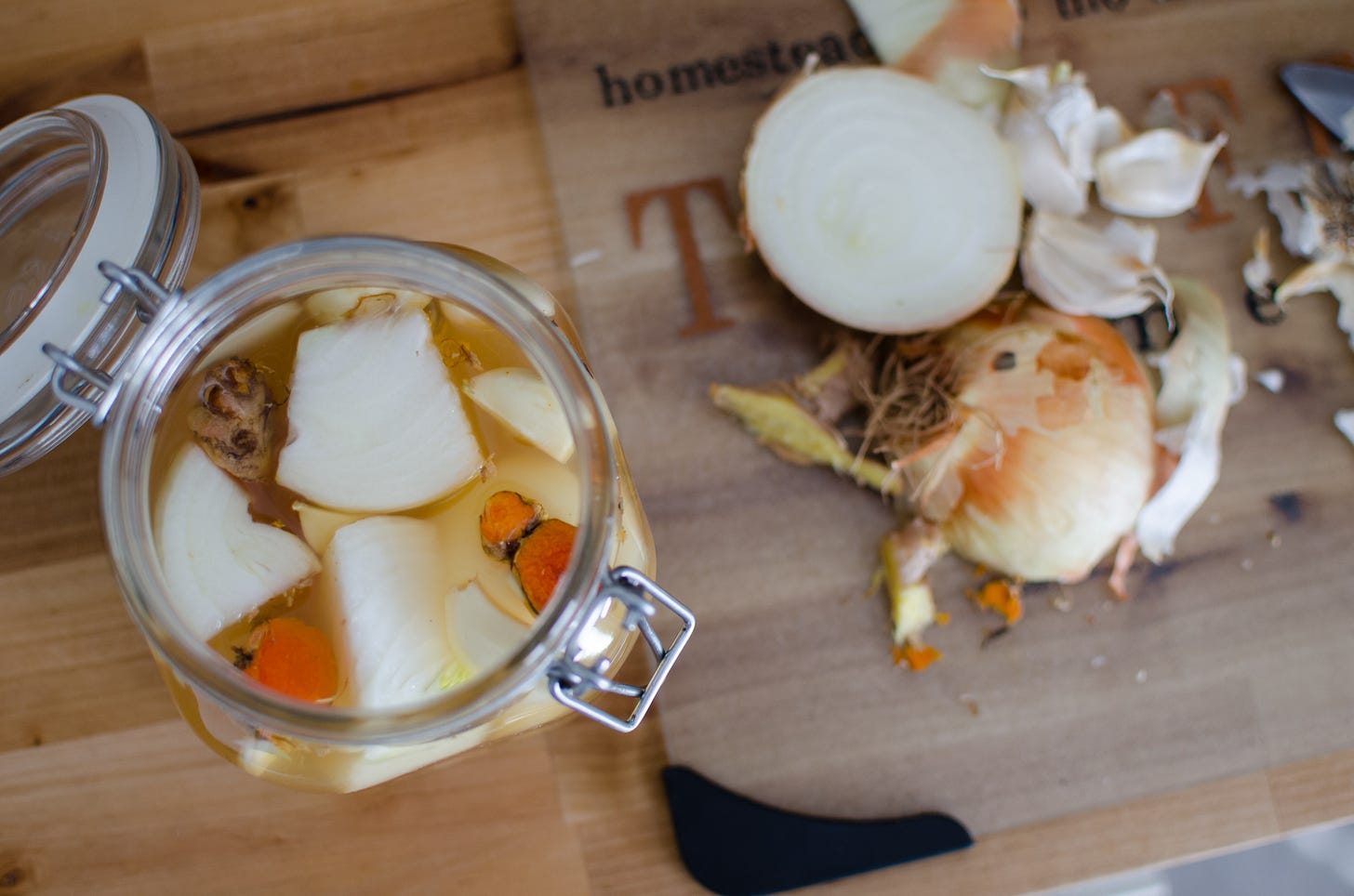
In a quart size mason jar, add all dry ingredients, plus lemons.You can place a fermenting weight on top of your dry ingredients, or you can leave them be. However, they may float.

Add 3-4 cups of raw apple cider vinegar to your quart jar. This will most likely fill your jar almost completely to the top. Leave a 1 inch headspace, as some of your root herbs may expand. If you don’t have enough room in the jar, you can just add enough that it covers the ingredients, or you can transfer to a bigger jar.

Cap the jar tightly with a plastic screw top, shake well, set jar in your pantry or in a place out of direct sunlight and extreme temperatures. Allow your fire cider to macerate for 4 weeks, shaking once each day.

After 4 weeks, strain your liquid into a new glass jar and dispose of the herbs. Add up to 1 cup of honey, or more, until you reach the desired taste and consistency. Label with name, ingredients, and date.

This extraction is best kept in the refrigerator for extended shelf life.

By: Amy K. Fewell · In: herbs, homesteading, natural living, recipes · Tagged: herbs, recipes

you’ll also love

Herbal Remedies for HighBlood Pressure and Pre-Eclampsia During Pregnancy (and Postpartum)
Client Case Study: Kidney & Liver Levels Balanced
Client Case Study: Seasonal Allergies Eliminated with Gut Healing
Next Post >

How to Make Homemade Herbal Chapstick

Primary Sidebar

meet amy

meet amy
hello!

I'm Amy. I love organic food but I love cookies too I love Jesus and His grace. I believe broken people make the biggest impact in the world when they share their stories. I believe in stories, and I'm sharing mine.

Read More

Connect

Search

Ads & Sponsors

200x400

Advertise

Follow Along

@amy.fewell

I almost cut the audio on this one. But I left it I almost cut the audio on this one.

But I left it. Because somewhere in the middle of making pretty reels and instagram-worthy things, in the middle of daily tasks and work and homemaking, in the middle of you scrolling, trying to escape into someone else’s “real”, there is a holy thing happening right where you stand.

This is where wisdom gets passed down. Where memories are made. Where ordinary children become kingdom ambassadors.

The “in between” moments—the ones that feel like interruptions—are the most teachable moments you will ever be given.

When little voices ask the same question for the hundredth time... when little hands climb into the middle of your project and you feel inconvenienced... those are not the moments to rush past. Those are the moments they will remember forever.

So I’ll ask you what I keep asking myself: How did you make them feel today? How did you explain real life to them? Will the way you answered firm up their foundation, or shake it?

“Impress [these words] on your children. Talk about them when you sit at home and when you walk along the road, when you lie down and when you get up.” [Deuteronomy 6:7]

Did you catch that? At home. On the road. Lying down. Getting up. The in between. That is the classroom.

Parenting is not the thing you do once the rest of life is finally organized and perfect. It is the thing you do first. It is the most important work happening in your home.

So slow down. Take a deep breath. One day these little voices will be gone, and you will remember the moments you let pass you by.

Don’t let them pass, friend. Turn around. They’re right there.

If this landed on your heart, save it and tag a mama who needs the reminder today. 🤍
Let’s talk about the new EO that was signed this w Let’s talk about the new EO that was signed this week in regard to regenerative farming. @a.j_richards will also be joining me on the @homesteadersofamerica podcast to talk more about what’s happening in government right now with our food system and farming, so make sure you’re subscribed!

On June 25th, an Executive Order on regenerative agriculture was signed. Healthier soil. Fewer chemicals. A return to how God designed us to steward the land. But discernment is part of stewardship too—so let’s read past the headline.

→ What it does:

Expands a USDA program helping farmers adopt regenerative practices—cover crops, reduced tillage, managed grazing. Voluntary, run through your local NRCS office, open to farms of every size.

Directs the EPA to examine chemical inputs and residues in our food. Especially pre-harvest desiccates.

Funds research into how those chemicals build up in our bodies over time.

→ What the headlines skip:

That “$700 million” isn’t new money. It was announced in December 2025 by redirecting existing conservation dollars. This order expands a program already underway.

For scale: Washington spends $15–16 BILLION a year just on crop insurance. This pilot is about 1% of USDA’s conservation budget. The headlines suggest a revolution. The budget suggests an experiment.

A new 15-member advisory council will guide it—9 seats belong to farmers, but the names aren’t released. The private “partners” aren’t named either. Who fills those seats and controls the new certification systems will matter enormously.

None of this means we dismiss it. There’s real funding and real potential here. One of my questions has always been to be wary of government hand outs. But I also understand that big farms that are already heavily in it need it.

Stay informed. Ask hard questions. Let’s see how this unfolds.

What’s your take on this EO? 👇 comment below
This photo is a testament to the labor of time and This photo is a testament to the labor of time and work we put into this cow. All of us. When we first brought her home in the early winter of 2025, while I was very pregnant, I began to reconsider my decision on bringing her home. 

I knew the first few weeks would bring a transition period, but that period lasted months. She kicked—a lot. Her previous owner said she didn’t kick before. She would run through paddocks and not let us catch her. They said that never happened before either. 

What we soon realized was this mama cow, set in her ways for at least 7 years, wasn’t just protesting us. She was protesting the fact that we took her away from everything she ever knew for 7 years. 

We took her away from her mother and grandmother, both still alive and thriving when we bought her. Right in the same field with her (one was 20, the other was 16). We took her away from the hundreds of acres she got to roam on everyday, to now only having almost 6. She was protesting us because the woman who raised her from day one was no longer her milkmaid. And she protested….hard.

While she is still spicy and knows her size, she has decided to stop protesting. And has for at least the last 9 months or so.

You wouldn’t even recognize her. That crazy cow we brought home? She doesn’t exist anymore. 

Does she lead with a rope? Not greatly, but she doesn’t protest it anymore. 

Does she give us snuggles? Not greatly, but she’s obsessed with that guy holding the baby. 

She’s the healthiest cow we have on the farm.

Moral of the story—when being a steward of creation, it can be hard. Some are worth sticking it out for. Others you turn into beef sticks. But sometimes, they just need time to adjust. Because believe it or not, they feel deeply too. 

God created an intelligent design in the bovine. It’s why He has them on a thousand hills (Psalm 50:10). 🤍
The healer’s kitchen is very simple. We know that The healer’s kitchen is very simple. We know that Jesus is the ultimate healer, and yet we know that these simple herbs and remedies that sit on our shelves and counters also make us capable of healing through Yahweh’s creation. It’s a beautiful symbiotic relationship. 

We are not new age or “witchy”. In fact, with every herb we harvest and remedy we hand out, we thank God for how He created us. And we know that all we are really doing is helping Him bring His creation back into homeostasis. I always chuckle when I see people praise “natural” doctors that rarely recommend anything natural. But then look at you weird when you are literally using nature.

The healer is different. The one who partners with “the Restorer of all things”—Yahweh. We look at the environment around us. We look at the food we eat. We evaluate the water we drink, air we breathe, people we fellowship with, and emotional stresses. Because we know that stress plays a major role on health and disease in the body. 

Years ago, a friend of mine said “well you and I understand, because we are community healers.” And it hit me. I like that word. I like what it conveys. We are healers of the land, soil, family unit, culture, food system—all while being directed by the Holy Spirit, Jesus, THE Healer. 

And it is beautiful. And it is humbling. It is to be revered.

The other night during fellowship, we were processing the potential spiritual gift of healing being present in one of our group members, and someone said “He chose you to be a healer”. In HIM. Another example, but in the spiritual way through equipping and edifying.

Uniquely, when you’re busy healing your life, you come to a point where you don’t need many remedies or protocols on hand for yourself anymore. But recently a friend came over and asked if I had something that she needed immediately, and I didn’t. And I thought to myself “it shouldn’t be this way, I must get back to the way it was, ready to help heal at anytime.” 

So this week I’ve been taking time to do exactly that. Because God has called me—you and I, even—to a unique space and calling. Physically, spiritually, and agricultu
Early this morning I had a dream. In the dream the Early this morning I had a dream. In the dream there were various people, but the significant part of it was me holding my baby on my hip while praying for other people. It seemed chaotic and yet not. 

But as I began to look around in the dream, I kept hearing (while simultaneously saying) “it is compassion that makes the difference.” 

This morning I started reading the book of Mark. And in the very first chapter I read exactly this—Jesus was moved to such compassion for people. It wasn’t a task. It wasn’t a check list. It wasn’t a method. It wasn’t a doctrine or theology assignment. It was compassion and authority and His power. 

That’s it. 

My prayer today, and everyday, is this—Lord, give me compassion for Your people, the body of Christ, and sinners. Give me compassion beyond comprehension, that can only come from You. And the discernment of hearts, so I know when to move on.

Footer

Learn More

Chickens
Homemaking
Herbs
Recipes
Devotionals

Info

About
Contact
Privacy Policy
Shop

stay in the know

Copyright © 2026 · Theme by 17th Avenue