• Home
  • Membership
  • Shop
  • Cart
  • Our Farm
  • Gut Health
  • Herbal Practice
  • Buy Trusted Supplements
  • Nav Social Icons

  • Skip to primary navigation
  • Skip to main content
  • Skip to primary sidebar
  • Skip to footer
  • Home
  • Blog
  • About Me
  • Our Farm
  • Gut Health
  • HH Membership
  • My Books
  • Youtube
  • Podcast
  • Homesteading
  • Chickens
  • Herbs
  • Family
  • Farmhouse
  • Homemaking
  • Recipes
  • Sourdough
  • Contact Me
  • Herbal Practice
  • Buy Trusted Supplements
  • Mobile Menu Widgets

    Search

    Connect

Amy K Fewell | Homesteading for the Kingdom

Amy K Fewell | Homesteading for the Kingdom

  • Start Here
    • About Me
    • My Books
    • Podcast
    • Youtube
    • Gut Health
  • Blog
    • herbs
    • Bees
    • chickens
    • rabbits
    • Farmhouse
    • gardening
    • devotional
    • homemaking
    • sourdough
    • recipes
  • Courses & Books
    • HH Membership
    • My Books
  • herbs
  • Podcast
  • Contact Me

Quail on our Homestead | Not a complete fail, or success

May 9, 2016 · In: homesteading, quail

My sister keeps reminding me that I haven’t really said much about our quail since we’ve added them to the homestead. And if we’re being honest, it’s because I still haven’t made up my mind about them.

Everything on this homestead, in my opinion, should be a sufficient source of something or another. And ultimately, I have to take time to outweigh pros and cons of animals and situations on our homestead. I am not going to post a post or make a video telling you all of these amazing things about something unless I have experienced it first hand myself. I’ll tell you what others have said, but not my opinion or that it is “truth” until I’ve actually experienced it myself.

For example, every post I read online said quail start laying eggs around 6 weeks. Mine didn’t start until week 15 because apparently they weren’t getting enough light. However, my chickens have been laying since February with absolutely no supplemental lighting.
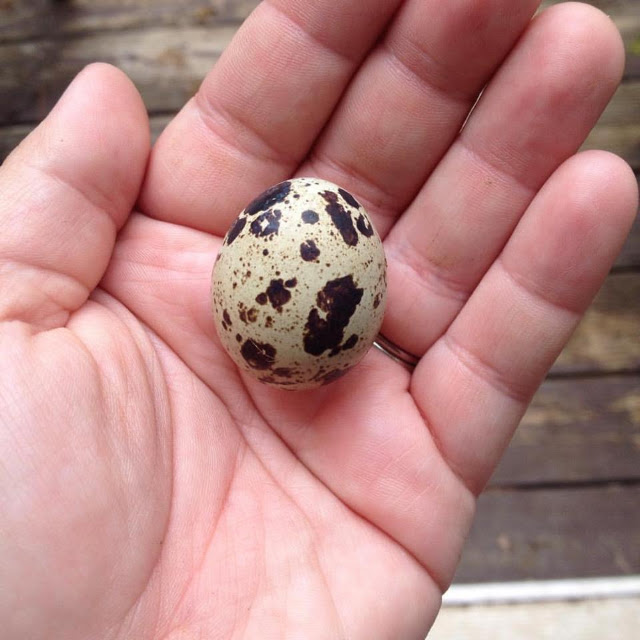
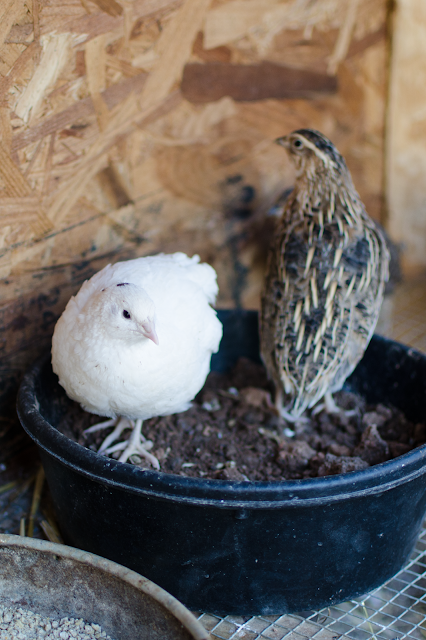
Oh…and the Japanese quail STILL haven’t laid eggs yet. Only the A&M.
So, let me tell you about the first few months of our quail adventure, and the conclusion that I’ve come to about Coturnix quail.
When we first bought our quail, it was extremely inexpensive. We bought them when they were around 5-6 weeks old, and they were $5 each. Not bad for a tiny little bird friend. We were originally supposed to have 6-7, but we only received 5. No biggie at all. We received a pair of Japanese Coturnix, and a trio of A & M Coturnix.
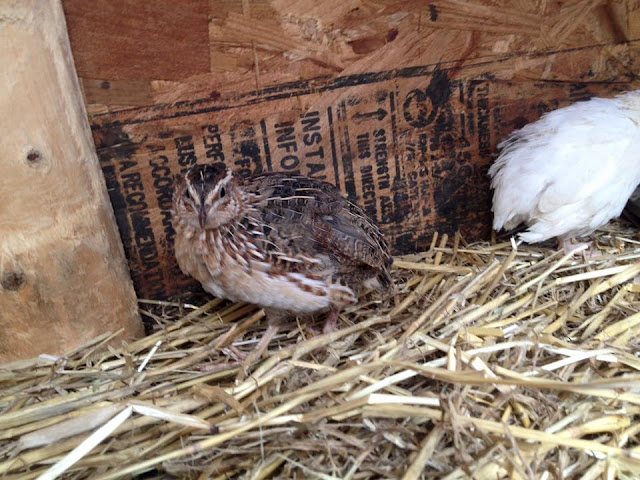
The Japanese are slightly smaller than the A&M, and we have discovered, in our personal opinion, that the Japanese are much more wild and flighty than the A&M. The A&M quail come running to us and interact with us, the Japanese act like we’re going to kill them (and I just might) every time we walk by the pen. Literally, like little ninja birds ready at any moment. With that said, that’s not a deal breaker for me, because I use them as a resource, not as a pet.
The A&M quail were created by Texas A&M college to be an all white meat bird, which really intrigued me in the beginning. If I were to choose between the two, I’d definitely pick the A&M as my keeper.
Quail are similar to chickens, in that they like to forage, take dust baths, lay eggs in the same place, and pick at each other. Therefore, since they are in large hutches on our homestead, we give them a dust bathing area in the hutch, a large pan for their feed so that they can still scratch, and they tend to lay their eggs in their dust bathing area or their feed area rather than on the wire.
The hutches have proven to be the best housing for them here. It allows the droppings to drop right onto the ground rather than in their habitat. This makes my life a lot easier. I am still considering making a small run for the A&M quail that we are keeping. But I still want to wait a little longer.
Which brings me to my next point.
I’m not sure quail will be one of our homestead successes, because, if we’re being honest, I feel like they are slightly useless.
Stay with me here, because they aren’t completely useless, but let me explain what I mean.
The Pros
Quail are extremely easy to take care of, and fairly inexpensive. It costs about 75 cents to $1 to raise one bird from hatch to 6 weeks of age. They don’t eat much, at all. And when given the proper housing, they require little clean up.
Quail are quick to mature, processing age is 5-6 weeks (or up to 8 weeks), and they can begin laying the same time as well.
Quail are a wild source of meat and eggs. The eggs are rich in vitamins and good things that chicken eggs don’t have. Quail eggs have been known to cure diseases, asthma, and heal the body. The meat is an incredibly easy source of protein, and they are very easy to process, taking up little time or room.
Quail don’t require a lot of room, and are therefore perfect for a smaller homestead. We house ours in large rabbit hutches. They spend most of their time laying around, quite honestly.
Quail are adorable for their entire lives. Period. I could squeeze them to pieces.
The Cons
While quail are easy to tend to and fairly inexpensive, you’re evening out to about the same with chickens. Why and how? Because chickens are 4 times the size of quail, and it takes at least 3 quail eggs to equal one chicken egg. It also takes 2-3 quail to equal a chicken (or rabbit) size portion of meat for one meal (not an entire chicken or rabbit, just a portion size).
Quail are only efficient layers for their first year. In fact, their life span is only 3 years. Not their laying span…their entire life span. Which means, unlike chickens who can lay for up to 5 years, you’ll be renewing your quail flock every year and a half or so.
Quail need at least 14 hours of light to lay. So if you aren’t planning on giving them supplemental lighting through out the entire year, you might as well forget about it now. My quail didn’t start laying until 15 weeks of age because we got them in early Spring. Had I of known they were extremely temperamental to lighting, I would have supplemented light. But when my chickens have been laying steadily since February without supplemental light (which is against the norm for most), I assumed my quail would follow suite. I was wrong….and so were the blogs I read online (in my particular case).
Quail aren’t always as quiet as you would think. Now, this isn’t a bad thing for me. In fact, I absolutely love listening to the males make their call. However, if you’re in a suburban or urban area that doesn’t allow livestock or roosters, you might want to reconsider or at least hear quail before buying. My male only hollers when alerting to danger, but he is loud.
Quail aren’t bred with the instinct to be broody or self-sufficient. That was a bummer for me, because I was hoping that since they were made out to be so “wild” online, that they would at least come with the instinct to be mothers. That doesn’t mean you won’t have some that go broody. We have had our fair share of hatchery chickens go broody. But it’s just something that coturnix quail aren’t bred with anymore. Stick with chickens and broody breed ducks if you are looking for self sufficiency.
Quail can fly high, and therefore, are not good free range birds. They’ll be dead within the week if you allow them to range. If not dead, they’ll be gone either way. They have no respect for your property lines. They need a hutch or run area with a top or bird netting so that they don’t get out.
Quail feces is extremely high in ammonia. In other words, it stinks like no body’s business. And they poop a lot. Not a bad thing if you are using a hutch style set up with wire bottom. It allows the feces to fall to the ground. However, it’s something you should be aware of either way.
A&M Quail (left), Japanese Quail (right)
What I Have Decided
Taking all of this, and more, into account—I have decided to temporarily (and possibly indefinitely) keep the A&M Coturnix quail. Though, I’m not sure. I’d like to give it a few more months before making my final decision. I’ll either sell or process the Japanese quail. The Japanese quail are just way too flighty for me. I can’t even interact with them without them trying to kill themselves, and they still haven’t laid a single egg for me. We are already almost to week 20, and all they are doing is eating feeding and freaking out. I believe they are stressed out here for whatever reason, and it could be because we’ve had a predator lurking around for a few weeks.
The A&M quail have slightly earned their keep, but I’m still not convinced. As I’ve stated so many times before, we don’t need a meat source physically on our homestead. Because we are avid hunters and know how to work the land, we don’t need fields full of cattle or chickens or meat animals. We know how to take care of ourselves a different way. Which is why I am still hesitant to take on a project that really isn’t required of us to take on.
I’ll update through out the journey. It has been an interesting journey—this quail adventure—and one that I am happy I get to share with all of you. There are ALWAYS two sides to every story, and I have always promised to be truthful and honest and raw in everything we do and try to do here. I hope this post can be helpful to someone.
Let me reiterate, quail haven’t been a complete and total failure for us, but honestly, they haven’t been a success either. That’s just what’s working and not working FOR US. Other homesteads are different, I am sure. This is why I always stress that you try something yourself before making a final opinion about it, and especially before telling others that it’s the best thing since sliced bread.
Happy Homesteading!

By: Amy K. Fewell · In: homesteading, quail · Tagged: fail, quail, raising quail, success

you’ll also love

Wintertime Hatching
What is True Self Sufficiency?
Why I Let My Child Help Process Animals on the Homestead

Reader Interactions

Comments

  1. Dianne Moffitt says

    April 11, 2018 at 2:47 am

    Very interesting read Amy I will be looking for more information so will be back.
    Thanks Dianne

  2. Tawnya says

    March 26, 2019 at 3:58 pm

    Thank-you for sharing! I had thought about keeping them indoors however have changed my mind and decided to find a place in the barn for them based on your information about the smell.

  3. Songe says

    June 11, 2020 at 6:34 am

    It’s so nice to see an honest review for a change! This has been really helpful, thank you.

Next Post >

What I’ve Learned From Marrying Young

Primary Sidebar

meet amy

meet amy
hello!

I'm Amy. I love organic food but I love cookies too I love Jesus and His grace. I believe broken people make the biggest impact in the world when they share their stories. I believe in stories, and I'm sharing mine.

Read More

Connect

Search

Ads & Sponsors

200x400

Advertise

Follow Along

@amy.fewell

There is another heat advisory today, but this mor There is another heat advisory today, but this morning there was the coolest slight breeze on my back as I milked. Autumn is around the corner. In fact, it is already making its way here. The animals know it, the land knows it, nature itself knows it. Why? Because it’s inevitable. 

There are things in life that are simply laws of nature. The sun always rises in the morning and sets in the evening. The moon always has the same cycles. Many parts of the world have four seasons. Rain makes grass and crops grow. Bugs break down organic matter into soil. What goes up must come down. And so on.

There are laws of the Kingdom of God too. My oldest son and I were talking about this the other day. It’s the scriptures that say “if…then”. It’s “if you love Me, you’ll keep my commandments and obey My teachings”. It’s “honor your father and mother so that you may live well in the promised land”. It’s “observe the sabbath, come to Me you who are weary and heavy burdened, and I will give you rest.” It is “if you truly love Me, the Father will love you, and I will manifest Myself to you.” 

If nature knows the laws of nature, how much more should we know the laws of the kingdom? How much more prepared would we be? How much more in sync with Yahweh would we be? How much more discerning would we be? How much more growth would we see? 

And how do we learn these things? Study the word. Don’t just read it. Study it. Find mentors that can teach you. Download the free Logos Bible app and start researching. And pray that the Holy Spirit would guide you in all things.

The seasons are shifting, friends. Not just physically. I feel it more than ever. And for what’s coming, we cannot forsake fellowship. We cannot just read a few verses and call it a day. We cannot just pray before bed and goto sleep. The Lord is calling for watchmen on the wall. He is calling for intimacy with Him in the secret place. There’s a reason it’s called the secret place. Commanders of armies don’t meet at Starbucks. 

Wait on the Lord. Meditate on scripture. Wash your family in the word. Speak life to them, and yourself. Because who knows but the Lord whether the “winter” will be long or not.
🌿 NEW ARTICLE in your Homestead Herbalist Membersh 🌿 NEW ARTICLE in your Homestead Herbalist Membership! 

Meet burdock (Arctium lappa). For 3,000 years it has been one of the most respected roots in the field.

Its actions read like a quiet inventory of God’s design:
• Alterative, the old “blood purifier”
• Lymphatic, to move a sluggish system
• Bitter, to wake up digestion and the liver
• Diuretic and diaphoretic, for gentle elimination
• Anti-inflammatory and antioxidant

And the uses herbalists reach for most:
• Stubborn skin conditions like eczema, psoriasis, acne, and boils
• Lymphatic congestion and swollen glands
• Liver and digestive support
• Achy, rheumatic joints

But you know I won’t hand you more than the science can carry. The strongest human study showed burdock tea lowering inflammatory markers in people with knee arthritis. Most of the bigger claims still live in animal and cell research. Promising, not proven. But sometimes, traditional testimonies outweigh science. That is always the case with burdock.

Read this entire in-depth dive with a HOMESTEAD HERBALIST membership. 

🌿 Comment BURDOCK and I’ll send the article straight to your inbox
I did my continuing education assignments for natu I did my continuing education assignments for natural healthcare today while alone at home with my kids while they acted like bouncing squirrels. I stayed up until almost midnight last night putting the final edits on a @homesteadersofamerica podcast episode (coming out tonight or tomorrow!) I responded to emails and texts, paid bills and prayed while I was nursing the baby to sleep. I checked the garden for bugs and produce while getting ready for a milk delivery. And in a few weeks I’ll throw back in homeschooling a 7 and 4 year old (the almost 17 year old is well on his way to being done) on top of other things—housework, fellowship dinners, and all the things not listed.

So when you tell me that you’re busy. That you don’t have time to accomplish anything in your life. That you don’t have time to build relationships and community. Or that you’re stressed and exhausted and always tired. Please tell me that you have utilized your time to its fullest, too. Because as a no-nonsense kind of person with a high capacity, you’re not fooling me if you just have a low capacity to deal with life. 

Your dreams are on the other side of exhaustion. 
Your pay raise or extra income is on the other side of sleepless nights and long hours.
Your better parenting is on the other side of inconvenience.
Your deeper marriage is on the other side of yielding your time and will.
Your refined skills are on the other side of prioritizing your time better. 
Your deeper relationship with Yahweh is on the other side of laying everything else down and making Him first in the day.

The list could go on forever. But at the end of it you’ll come to the realization that every person in the world has the same 24 hours in the day. The difference? Some use those hours more wisely than others, understanding that some seasons require less, and some seasons require more. 

Others want to do the bare minimum, call it a day, and then complain about how mediocre or exhausting their life is.

Pick which one you want to be—and whichever you choose, you’ll be the steward of. It’s a pet peeve of mine—I hope you choose to go higher. I’m cheering for you.
Since 2023, I have not been able to shake it. Aft Since 2023, I have not been able to shake it.

After dreams, after long conversations with the Lord, I keep coming back to the same word: something is coming, and God is calling His people to a modern-day Goshen.

Here is what stops me every time. When the plagues fell on Egypt—the hail, the darkness so thick you couldn’t see your own hand—there was one region that still had sunlight and bread on the table. Goshen. 

When God showed Pharaoh a famine was coming, He used Joseph to govern a nation and provide. Goshen was a place of refuge for his family.
 
Same nation, famine, plagues. Two completely different outcomes. The difference was simply that Goshen was where God’s people dwelt. Refuge is the whole point.

During the Exodus plagues, because they happened so suddenly, God providentially sheltered Goshen—the land where His people dwelt. 

But Goshen didn’t happen the same way during Joseph’s time. Years before the famine ever came, God warned Joseph, and Joseph stored up grain through seven years of plenty so his people would eat when the whole land went hungry. 

That is the pattern: provision prepared before the crisis, a people set apart, a storehouse standing ready when the world runs empty—spiritually and physically.

I believe God will once again build both times of Goshen.

So the question isn’t “will this happen again?” The question is, will you be ready? Why is the church not already prepared?

We have built beautiful buildings and polished productions. But when the shelves go bare, what is in the storehouse? 

Will we stand in the same line as everyone else? 

Not me. Not my family. Not the people who sit at my table.

This is Acts 4—land laid down, abundance shared, not one needy person among them. That church had become Goshen, and we can be that again. This isn’t archaic. It’s a blueprint for survival and provision.

The time to build is now. Not out of fear, but out of grace, mercy, and obedience.

Comment GOSHEN to read the entire new Substack…
I walked out one morning, years ago, and found my I walked out one morning, years ago, and found my flock had become mite magnets. Northern Fowl Mites, to be exact.

If you've never dealt with them, I’m so sorry. They feed on your birds' blood, dead skin, and feathers—most often carried in by wild birds passing overhead. And once they've moved in, the feed-store chemicals will burn your chickens' skin before they ever solve the problem.

So I did what our grandmothers would've done. I reached for what the Lord already set growing right on our own homestead.

Here's what actually cleared my flock—no chemicals:

🐓 Strip the coop bare. Pull ALL the bedding, burn it, don't compost it. Leave that floor bare for 2–3 weeks so the mites have nowhere left to hide.

🐓 Treat the coop. Eucalyptus, tea tree, lavender, peppermint, basil + cinnamon bark oils, sprayed top to bottom into every crack and crevice. Dust the roosts with wood ash or DE.

🐓 Dust your birds. Wood ash worked into the skin at the neck, vent, tail gland, and under the wings. I'll take wood ash over DE any day.

🐓 The garlic spray. A Clemson University study found topical garlic wiped out mite infestations in laying hens. My spray pairs it with those same oils and gets applied at night, after they've roosted—when the mites come out to feed.

And yes, your eggs are perfectly safe to eat the whole time. It's applied to skin and feathers, never fed.

God didn't hide your flock's healing behind a chemical label. He set it growing free—in the fields, in the ash of your wood stove, in a bulb of garlic on your counter. That's what stewardship looks like.

📖 The full step-by-step—recipe, treatment schedule, and timing—is on the blog. Comment MITES and I'll send it straight to your inbox.

I'm a homesteader and family herbalist, not your vet—always tend your flock at your own discretion.

Footer

Learn More

Chickens
Homemaking
Herbs
Recipes
Devotionals

Info

About
Contact
Privacy Policy
Shop

stay in the know

Copyright © 2026 · Theme by 17th Avenue