• Home
  • Membership
  • Shop
  • Cart
  • Our Farm
  • Gut Health
  • Herbal Practice
  • Buy Trusted Supplements
  • Nav Social Icons

  • Skip to primary navigation
  • Skip to main content
  • Skip to primary sidebar
  • Skip to footer
  • Home
  • Blog
  • About Me
  • Our Farm
  • Gut Health
  • HH Membership
  • My Books
  • Youtube
  • Podcast
  • Homesteading
  • Chickens
  • Herbs
  • Family
  • Farmhouse
  • Homemaking
  • Recipes
  • Sourdough
  • Contact Me
  • Herbal Practice
  • Buy Trusted Supplements
  • Mobile Menu Widgets

    Search

    Connect

Amy K Fewell | Homesteading for the Kingdom

Amy K Fewell | Homesteading for the Kingdom

  • Start Here
    • About Me
    • My Books
    • Podcast
    • Youtube
    • Gut Health
  • Blog
    • herbs
    • Bees
    • chickens
    • rabbits
    • Farmhouse
    • gardening
    • devotional
    • homemaking
    • sourdough
    • recipes
  • Courses & Books
    • HH Membership
    • My Books
  • herbs
  • Podcast
  • Contact Me

The Cost of Homesteading

February 12, 2016 · In: homesteading

Let’s be honest here, homesteading isn’t free. If you’re uneducated when it comes to history, our ancestors had land they had to buy and pay for. Equipment they had to pay for. Working animals they had to pay for, feed, and take care of. There’s a reason the bank came knocking on their door sometimes to collect money or debts. Of even worse, take their property and rights away.

Even on this small half acre that we own, homesteading hasn’t been cheap. We have to find ways to cut the grocery bill. We have to find ways to live frugally. We have to sell eggs to help offset feed costs. The list goes on….

But we aren’t poor. I never want you to think we are “poor” or need help. In fact, we are fairly well off compared to the rest of the world. But we’ve worked to get to where we are, and we both have supplemental incomes.
Homesteading is hard work. Homesteading requires you to wake up at times you don’t want to. Homesteading teaches you to be tough, because if you aren’t, it will eat you alive. Homesteading means you go outside in the pouring rain or the iciest of snows to tend to animals, to get up wood, to run generators just so things can function. But more than all that, this journey is one to be loved, cherished, and respected. As long as you understand the reality of financial income.

Never EVER put your family in a stressful financial situation just to homestead. You can do this journey the right way, I promise! Homesteading doesn’t happen overnight. It is gradual!

Now that I’ve gotten that off my chest, there are some things you need to know about how I run my small homestead. My homestead might be small, but it’s a working homestead.

I run this show. In case you hadn’t noticed. And I’m proud of it. I’m a pretty tough girl. I’m doing this because I want to do this, come hell or high water. These animals will be taken care of properly, and so will my family. Why? Because I decided this was my responsibility. And I own what I take on.

But even still, I can be quiet, gentle, and a loving wife when I need to be. There’s beauty in balance.

Yes, my husband helps with big things. He helps me make major decisions, and sometimes he flat out says “no”. He is the master mind behind every single building (except the original ones when we bought our house), hutch and structure on this small property. I could do this without him, but it would be a heck of a lot harder and more expensive. And honestly, I don’t want to do it without him. He is my rock, my logic, my sounding board. You can read more about his involvement in our homestead here.

I feed the chickens. I haul feed bags. I muck hutches and coops. I process our meat. I garden and harvest and can. I tend to every single animal on this property and I haven’t complained once. Why? Because I truly love what I do.
Enough rambling though…

The cost of a homesteader is not often spoken of. So, many people think that homesteading, the ultimate homestead, brings in enough resources that you’ll never have to pay for anything. We also like to throw around the term “true homesteader” now days apparently. And I promise you that money does not dictate whether you are a “true” homesteader or not. Homesteading it a journey, and one that should be enjoyed. Don’t ever let anyone say you’re not a “true homesteader” based on where you are in your journey.

But the reality is, whether you work for yourself, work from your homestead (workshops, classes, products), or something different, you’ll always need some kind of income.

** DISCLAIMER: Please keep in mind that my journey looks a little different than yours. We got chickens and rabbits with the understanding of breeding them to sell. You can certainly get away with a lesser quality animal if you’re just using them for your own consumption.

So, before you consider quitting your job and homesteading, here are some things to consider:

1. Homesteading isn’t free — $600+ a year
You’re going to have to buy land at some point. Sure, you can rent it or barter for rent, but eventually, you’re going to want your own piece of land to work on. Equipment costs money. Building good solid structures costs money. Power tools cost money (if you use them). And also, you have taxes to pay. Ugh, I hate taxes. Guess what, Uncle Sam could care less about your homestead and how well you’re doing without money. He still wants his money! Happy happy joy joy.

2. Food isn’t free — at least $100 a month
It is wonderful to be able to grow your own food, but if you’re like me, I can’t grow everything I need. I can’t grow wheat for flour. I’m lucky if I can grow enough tomatoes to eat. I would literally kill myself trying to grow it all. Therefore, I have to buy flour, sugar, corn starch, baking soda, salt—things that just aren’t physically possible for me to grow frugally here.

Food is a really big issue for me. If you are a homesteader, and you’re growing food, utilize it. If you are buying in bulk, you are still spending a large amount of money on buying in bulk. Good quality bulk items (organic and non-gmo) are not inexpensive. But they are worth it. While it’s not inexpensive, discounts matter!

There are a lot of great videos online about stretching your food and your food budget!

3. Utility Bills— $100+ a month
If you are not “off-grid” then you have utility bills. Even the best “off-griders” will tell you they have yearly and monthly expenses. Electricity, heat (if you don’t heat by wood), A/C, phone, cell phone, internet, tv, movies….the list goes on.

4. Upkeep of your homestead— $500+ a year
Your homestead is going to have to be kept up with yearly. Some of my 3 year old rabbit hutches need new wire and wood. And that stuff isn’t free. I’m going to have to march down to the co-op and get more wire and wood. You can’t use old wood for these things.

5. Medical and Vet bills—$200+ a year
We are working our way towards never needing a family doctor ever again (holistic and herbal medicine), especially since our pediatrician is getting ready to close its doors. However, at some point we might have an emergency. How will you pay your Dr. bills? Most M.D.’s with a $600,000 yearly income could care less about bartering for eggs or meat.

What about vet bills? If you have larger livestock, then at some point, you’re going to use a vet.

It would do you good to learn how to treat simple things at home, like treating chicken mites with natural garlic oil. Or how to get your cow up when she’s down.

6. Initial start up costs/Animal investments—$1,000+ 
If you’re buying animals and building structures (properly), it costs money. Be prepared to pour a lot of money into this when you first get started, or if you plan on raising your animals right. I cannot stress to you that the quality of your animals is extremely important. Don’t opt for the $5 rabbits on craigslist. Don’t go for the $50 cow on that facebook group. Don’t….just don’t. If you’re going to do this, do it right. Don’t do it cheap.

If you want a chicken coop to last you more than 2 years, build it with good quality materials. If you want a good quality barn or shed, build it with good quality materials. I am an advocate for using things you already have, we’ve done it before. But also be prepared for those things to fail more quickly, which means more time spent on fixing them and keeping them up. You would have been better off just shelling out the money in the long run.

While all this makes a difference, once again, don’t STRESS and put yourself in financial struggle. It doesn’t have to happen overnight. You can work towards it! If all you have is what you have, then use what you have!

7. Feed for your animals — $15 to $500+ a month (depending on your homestead)
If you only have a few chickens, then you can get away with a bag of feed each month if they free range (not supervised free range, true pasture ranging). Around here, a non-gmo bag of feed is about $15-$17/50 lb bag. Organic feed is higher, at $23 per 50 lb bag. Buying in bulk is cheaper, but not much cheaper. And not necessarily cost efficient. Feed prices depend on how many animals you have and what your homesteading methods are. In the Summer months, our hens mostly free-range, so we can get away with a bag of feed a month. But in the Winter months, we go through a lot more. Same with our rabbits and ducks. If you’re raising meat rabbits, you will still need to supplement feed even if they are on pasture, otherwise you’re wasting your time. You’ll have more money in them than what you’re getting out of them, as pasture raised animals grow slower than feed animals.

8. Your time is equally as valuable—priceless
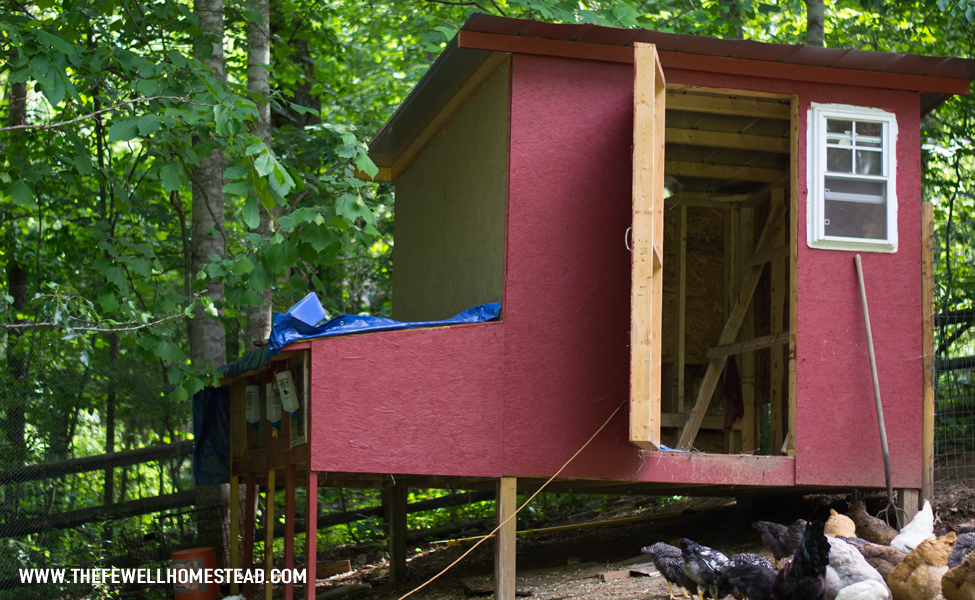
There is nothing more valuable than your time and skills. If I had paid someone to make my 8ft x 8ft coop, it would have cost me thousands of dollars. Because we built it ourselves (because MM has that skill) we were able to only spend about $800. Yes, you read that right. We also paid a friend (included in price) a couple hundred bucks to help MM finish it, as we were in dire need of a chicken coop (we got our chickens before the coop! Don’t do that!).

You also need to consider your own time. If you’re homesteading, and your family isn’t at your side at all times, then that takes time away from them. Time is more valuable than anything. Don’t value your homestead over your family, friends. Family is more important!
Without giving you too much information of specifics, here is a quick and rough run down of how much we’ve spent to get where we are right now (so, in the past 4 years, this is what we’ve spent).

Our Homesteading Expenses (over the past 4 years):

• Chicken Coop — $800
• Chickens — $400
• Rabbits — $500
• Ducks — $100
• Quail — $40
• Chicken feed — $2000+
• Rabbit feed — $3000
• Rabbit hutches — $800
• Straw — $150
• Expanded chicken run — $300
• Home repairs (only) — $5,000
• Yard/pasture repairs (seeding, leveling) — $300
• Wood for the stove — $2,000 +
• New wood stove (2) — $1,000
• Canning Supplies — $100
• Homeschool Supplies — $1,000
• Raised garden beds — $1,200
• Fill dirt (various projects) — $500
• Various gardening — $300

….I’m already up to almost $20,000 over the past 4 years…and that’s not even half of it. I haven’t even stated food costs, clothing, boots, gloves. I haven’t even gotten into the repairs (and other things) that are needed right now. I’m getting ready to rip my coop floor up and replace it. I’m getting ready to rip wire bottoms out of the bottom of 3 hutches and replace it. And, honestly, I’m probably low balling some of these figures. Because I’ve decided to just not keep up with it anymore. Oops!

My habit is easier if I don’t keep up with it…pffff.

There’s always something that needs mending, someone that needs feeding, and eventually someone is going to need stitches. Normally that someone is me, HA!

Homesteading is awesome. It is so much fun and brings so much satisfaction. But it’s not free, and it’s not always easy. Remember that during your best of times.

But remember that homesteading is a gradual journey. You can do this. But I just wanted to be real with you on cost of living. Take baby steps, and it will be much better!


By: Amy K. Fewell · In: homesteading · Tagged: cost of homesteading, finances, homesteading

you’ll also love

The Two-Breed System for Year-Round Meat Chicken Breeding
Homesteading: Building a Parallel System of Kingdom Economy
In Praise of the Simple Onion
Next Post >

How to Make Homemade Mayo

Primary Sidebar

meet amy

meet amy
hello!

I'm Amy. I love organic food but I love cookies too I love Jesus and His grace. I believe broken people make the biggest impact in the world when they share their stories. I believe in stories, and I'm sharing mine.

Read More

Connect

Search

Ads & Sponsors

200x400

Advertise

Follow Along

@amy.fewell

🌼 FEVERFEW (Tanacetum parthenium) I keep finding 🌼 FEVERFEW (Tanacetum parthenium)

I keep finding these little volunteer feverfew plants all over my garden, and I love it.

For centuries, feverfew has earned a place in apothecaries and cottage gardens alike. With its cheerful daisy-like flowers and aromatic foliage, this member of the Asteraceae family has long been valued as a medicinal herb throughout Europe and beyond.

🌿 Botanical Name: Tanacetum parthenium
🌿 Common Names: Feverfew, featherfew, bachelor’s buttons (regional)
🌿 Family: Asteraceae (Daisy Family)
🌿 Parts Used: Primarily the leaves and flowering tops, used fresh or dried.

Historically, herbalists reached for feverfew to support the body in a variety of ways:

🧠 Headache & Migraine Support
Perhaps feverfew’s best-known traditional use is for recurring headaches and migraines. Researchers have identified compounds such as parthenolide, a sesquiterpene lactone that may influence inflammatory pathways and vascular function, making feverfew one of the most studied herbs for migraine prevention.

✨ Inflammatory Support
Traditional herbalists often used feverfew to help calm inflammation throughout the body. Modern studies suggest it may modulate inflammatory mediators, though more research is needed to fully understand its clinical applications.

🤒 Fever & Seasonal Illnesses
As its common name suggests, feverfew was historically brewed into teas or tinctures during febrile illnesses. Its long history explains how it received its memorable name.

💃 Women’s Herbal Tradition
Throughout history, feverfew has appeared in folk medicine traditions for menstrual discomfort and cycle support. Because of its potential effects on uterine activity, it is generally not recommended during pregnancy.

🦴 Joint & Musculoskeletal Comfort
Some herbal traditions have used feverfew for occasional joint discomfort and stiffness, particularly when associated with inflammatory conditions.

🍃 Digestive & General Wellness
Bitter compounds within the herb have historically been used to stimulate digestion and support overall gastrointestinal health

Add this one to your homestead herbalism list to grow in your garden!
I wrote this substack some time ago and then forgo I wrote this substack some time ago and then forgot to finish the series. But it seemed really relevant to share once again. It's the last I'll share on this!

It's one of the most quoted phrases in Scripture—and one of the most misunderstood.
For generations, a single verse has been lifted out of context to build entire doctrines that limit, discourage, or even silence women whom God has clearly called to serve, teach, prophesy, disciple, and lead under His authority. But what if we've been reading Paul's words without reading the entire letter? What if we've missed the historical context, the original language, and the broader testimony of Scripture?
Throughout the Bible, God consistently uses women to accomplish Kingdom purposes. One of the issues is that the American version of church is not the New Testament version and structure.
Deborah judged Israel. Huldah prophesied to kings. Priscilla instructed Apollos. Phoebe served the early church. Anna proclaimed the coming Messiah. Philip's daughters prophesied. At Pentecost, Peter declared that the Spirit would be poured out on sons and daughters, fulfilling Joel's prophecy.
So how do we reconcile those examples with passages like 1 Timothy 2?
The answer isn't found in reading one verse in isolation—it's found in studying the WHOLE counsel of God.
In this article, I take a deep dive into the Greek language behind "authority", "dominion", and "silence," examine the context surrounding Paul's instructions to Timothy, and explore why many common assumptions about this passage deserve a second look. We also look back to Genesis, the design of marriage, mutual submission, and the biblical pattern of accountability within the body of Christ.
The goal isn't to promote cultural trends or modern ideologies.
The goal is to return to Scripture itself.
The Kingdom needs men who sacrificially lead and protect.
The Kingdom needs women who faithfully steward the gifts God has entrusted to them.
If you don't read the whole Book, it's easy to build an entire doctrine on a single sentence.
🌿Comment SILENT and I'll shoot you the link to your inbox!
I have always thought it was so interesting, and s I have always thought it was so interesting, and so telling, when people believe that a woman in a leadership position in the church means she is against men and out of order. 

But many of the same people are ok with a woman in leadership in earthly things, like business, and politics. 

Here’s the reality, men and women were created completely different. We have different emotions, abilities, and giftings. The men I know that are extremely confident in their manhood and burly in nature will immediately tell you they need a woman to help keep them organized. And the women that are confident in their womanhood and feminity will immediately tell you that they need men to help keep them grounded, logical, and not emotionally driven. 

The kingdom was created to be whole—not half. 

So when people say things about women in ministry with a broad stroke, it hurts the body of Christ. Because there is neither male nor female, Jew nor Gentile. 

There are certainly women who should not be in leadership. I have met many of them. They actually do disrespect men and always think men are out to get them. These are the women that we are warned about throughout scripture and the Early church writings. But that does not give the Church the right to broad stroke women as a whole.

That would be like me saying that men are conniving, aggressive, and mean just because I’ve experienced that from a few men in church. But that would be silly and incorrect, wouldn’t it? 

The most healthy church bodies that I’ve been a part of have men as strong leaders with women as complimentary leaders, and never having rule over one another. Who has the final say? Jesus does. Because isn’t that what the church was created to do—seek God in all things? Together?

We must start from the beginning in America. Starting with what the actual early church looked like. When we begin to see that the ministry roles listed in scripture (apostle, prophet, evangelist, pastor/shepherd, teacher) were never governing roles (like elders and deacons), we might simmer down a bit and realize this isn’t as hard as the church Pharisees have made it. 

@thechurchstorehouse has free teachings on this �
Today I have been alive on earth for 39 years. As Today I have been alive on earth for 39 years.

As I prayed myself to sleep last night, it went something like this…

Thank you, Yahweh, for creating me. You knew me before the foundations of the earth, and you knit me together perfectly. 

Thank you, Yeshua, for giving me new life in the Kingdom of God.

Thank You for the life partner you’ve given me to call husband—he is irreplaceable. Thank you for blessing me with children that bring me joy. Thank you for the hard times that have taught me how to be content in all circumstances. Thank you for the rebukes that have refined my rough edges (and continue to). Thank you for Your grace that is sufficient for all of my imperfections. Thank You for Your unconditional love when I feel unloveable. Thank You for giving me wisdom and gifts to further Your kingdom.

Thank You for asking me to walk in victory alongside of You in the tasks You’ve put my hands to. 

Forgive me when I have doubted and not trusted You. 

Help me continue to plow in the direction You’re going. Help me continue to build fertile soil for the seeds to be sown. Show me my blind spots, that they may be rooted up and replaced with new growth. 

Thank you for another year on this beautiful place called earth. Teach me Your ways, and Your heart, O LORD. ❤️‍🔥
For most homesteaders and herbalists, mullein is t For most homesteaders and herbalists, mullein is the herb you reach for when someone has a cough, congestion, or irritated lungs.

But mullein’s story goes much deeper than that.

For centuries, herbalists used mullein in cases of chronic respiratory illness, including conditions that modern medicine would later identify as mycobacterial diseases. Today, we know that the mycobacteria family includes tuberculosis (TB), as well as non-tuberculous mycobacteria (NTM)—environmental organisms commonly found in soil, water systems, and even household plumbing.

What’s particularly interesting is that mullein contains compounds such as saponins, flavonoids, iridoids, and verbascoside (acteoside), which researchers have found to possess antimicrobial, anti-inflammatory, and immunomodulatory properties.

Mullein’s long history of use for persistent respiratory complaints, combined with emerging scientific research, helps us understand why generations of herbalists considered mullein one of the premier herbs for lung support.

As herbalists, we should always be careful not to overstate what an herb can do. Yet we should also appreciate the wisdom of traditional plant medicine and continue exploring why certain plants earned their reputations over centuries of use.

Mullein remains one of my favorite herbs for supporting respiratory wellness, soothing irritated tissues, and helping maintain healthy lung function.

Sometimes the plants growing in our pastures, roadsides, and fence rows have stories that modern science is only beginning to rediscover.

🍃 Comment MULLEIN and I’ll send the entire article about this beautiful herb to your inbox!

Footer

Learn More

Chickens
Homemaking
Herbs
Recipes
Devotionals

Info

About
Contact
Privacy Policy
Shop

stay in the know

Copyright © 2026 · Theme by 17th Avenue