• Home
  • Membership
  • Shop
  • Cart
  • Our Farm
  • Gut Health
  • Herbal Practice
  • Buy Trusted Supplements
  • Nav Social Icons

  • Skip to primary navigation
  • Skip to main content
  • Skip to primary sidebar
  • Skip to footer
  • Home
  • Blog
  • About Me
  • Our Farm
  • Gut Health
  • HH Membership
  • My Books
  • Youtube
  • Podcast
  • Homesteading
  • Chickens
  • Herbs
  • Family
  • Farmhouse
  • Homemaking
  • Recipes
  • Sourdough
  • Contact Me
  • Herbal Practice
  • Buy Trusted Supplements
  • Mobile Menu Widgets

    Search

    Connect

Amy K Fewell | Homesteading for the Kingdom

Amy K Fewell | Homesteading for the Kingdom

  • Start Here
    • About Me
    • My Books
    • Podcast
    • Youtube
    • Gut Health
  • Blog
    • herbs
    • Bees
    • chickens
    • rabbits
    • Farmhouse
    • gardening
    • devotional
    • homemaking
    • sourdough
    • recipes
  • Courses & Books
    • HH Membership
    • My Books
  • herbs
  • Podcast
  • Contact Me

The Homestead Dog | Meet Delilah

October 21, 2016 · In: family, homesteading

I’ve always wanted a livestock guardian dog, but it also needed to be an incredible family dog that could be with us at all times. Unheard of, right? Everything I have read has continuously said LGDs must remain with the herd at all times. I thought a livestock guardian was outside of our near future, because honestly, we only live on a half-acre homestead, and I just simply didn’t want to pour $1,000 into a pup that wouldn’t have much space to patrol.
However, we were still in the market for a new puppy this summer. My son’s birthday is the end of August, and the one thing he continued to ask for was a puppy, even though we already have a 2 year old black lab. Do you know how hard it is to find a puppy that’s ready for a new home in a certain month? Very hard, when you’re looking for a specific breed.
I, myself, wasn’t really interested in a new dog. In fact, I tried to talk my husband and son out of it. Because the reality is, guess who’s going to take care of that puppy? Me, yes, that’s right. We already have Samson, our lazy lab. In fact, whenever I post photos of him on Instagram I often hashtag him #notafarmdog. It’s true. He’s nothing but a cuddle bug, but I’m ok with that.


So, I thought to myself, if we’re going to get another dog, then it’s going to be a dog that can do a job around here. Our stipulations were that it had to be a natural guardian of our family and property, it had to be family friendly and not easily aggressive, it had to be fearless and eager to please, and it had to be strong and courageous while remaining gentle and soft towards its pack members. In other words, it had to be strong and fearless enough to go up against our neighboring bear friends, and yet gentle enough to want to sleep in the bed at night. Sounds like the perfect dog, doesn’t it? In no way did I think we would ever find it…I assumed it was a myth in my own mind.
We tossed around the idea of Dobermans, German Shepherds, German Short Haired Pointers, and mixed breeds. But it wasn’t until one morning, when I came across a breed in our local Valley Trader newspaper, that I realized I had found a pup that I could really enjoy here on our homestead.

Enter, the Black Mouth Cur mountain dog—also simply known as, the Black Mouth Cur. While Black Mouth Curs aren’t considered a breed in the “livestock guardian” dog breeds, they are “guardians”. The different between a livestock guardian and a guardian dog is simply that the livestock guardian warns first instead of attacking. And sometimes, never attack with the intent to harm or kill a predator. A guardian may warn, but will most certainly attack a predator with the intent to kill. This is why we chose this breed. We have resilient predators here, including bear. And we needed a tough pup that was up to the job!

As I read through the extensive history of this breed, and the fact that the breeding lineage has been kept fairly narrow over the past century, I was sold. The Black Mouth Cur is a herding, hunting, and guardian dog that has been traced back all the way to 347 BC. The Celts are widely attributed to the development of the Cur breed, and by 1000 to 600 BC, they had already developed several different lines of Curs. Each lineage had a certain job, but each one also excelled in any job you gave it—be it herding, guarding, or hunting. When the Irish and Celts came to settle in the United States, they brought their beloved dogs with them, and so began the Black Mouth Cur generations here in the U.S.A.

Today, we have several different lines of Curs, and many that are mingled in between the few. These lines are the Southern Black Mouth Cur from Alabama, the Foundation Black Mouth Cur from Texas, the Ladner Yellow Black Mouth Cur from Mississippi, and the Florida Black Mouth Cur. With many breeds, dogs are bred for color and standard of perfection, but with Cur breeders, the standard of perfection is how well the dog can perform on demand. If the dog has exceptional abilities, then it doesn’t really matter how black its mouth is or how yellow its body is—it’s a good dog.
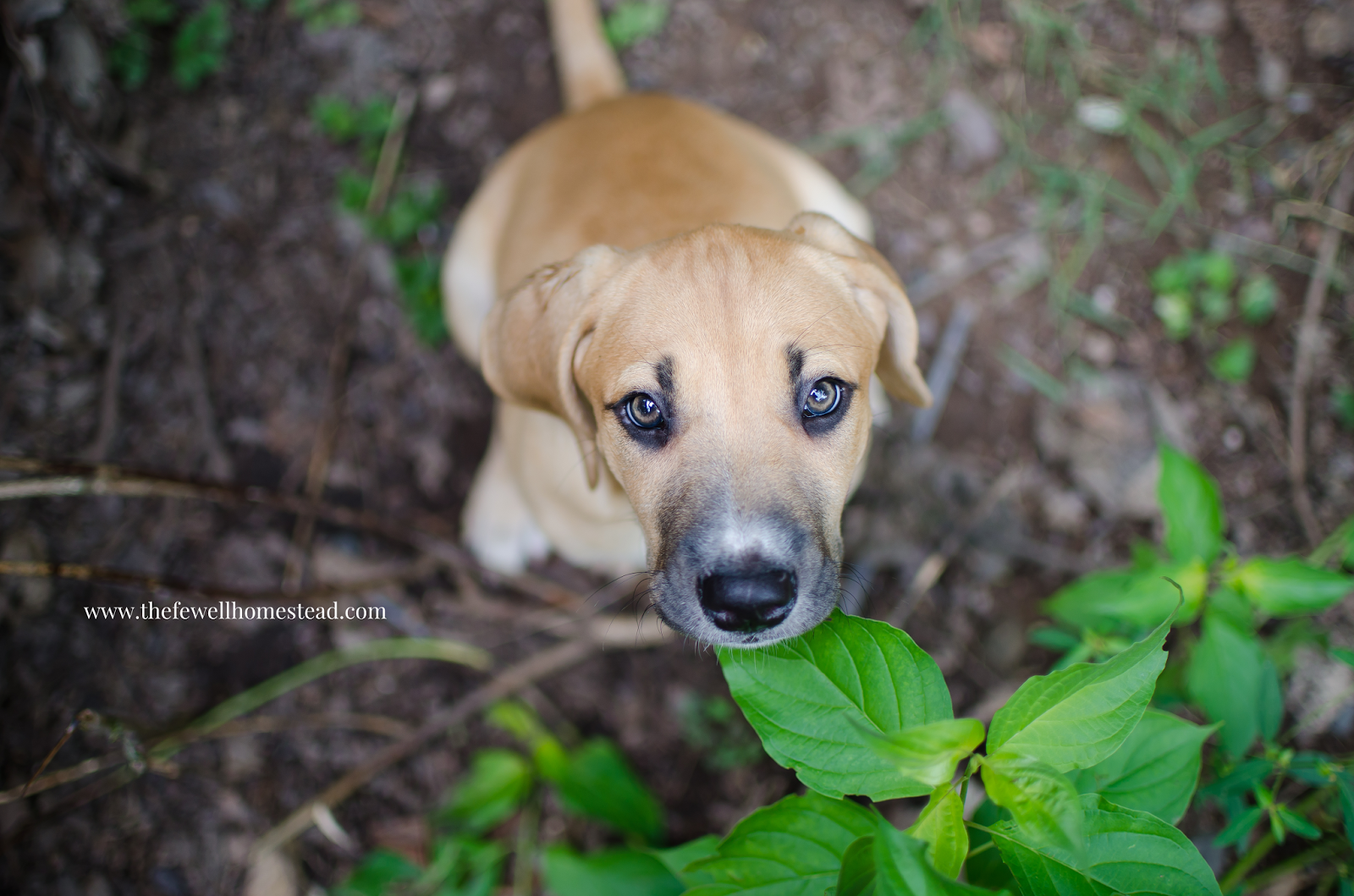
Typically, a Black Mouth Cur can be between 40 lbs and 90 lbs. Again, this is all dependent upon the line that you purchase from. Our pup, Delilah, comes from the Ladner background from her Sire’s side, and a mixture from her Dam’s side. This has created a nice in between color of red and yellow, a black muzzle with a touch of white, and a white chest. Her body will be slender and her legs long, much like a hound.
Curs are typically used for hunting wild boar, treeing coons and squirrels, herding livestock and protecting livestock, and are also greatly used for protecting their own family. Some Curs are even used in search and rescue groups because of their exceptional skill of tracking and their fearless nature. They can take down a bear or coyote quickly, should you come across one. And will even fight until death if it means protecting what is its own.
So, we traveled over an hour and a half into West Virginia, from our home in Virginia, to meet Delilah and her eight puppy siblings. We were instantly in love. She chose us. She instantly clicked with our son and would follow him everywhere…and she still does.
Delilah is almost 10 weeks old, but already shows great promise in her ambitions. She is curious and smart. One of the smartest dogs we’ve ever had. You can see her working problems out in her head as she watches. She was house trained the first week we had her, and she continues to learn her perimeter of our property. She sits with the chickens and pays them no mind—she knows they are “hers” and there is no need to think otherwise. Though, we will continue to monitor her closely.
She is a family dog, but she is a farm dog as well. Our very first farm dog. She runs along behind me when doing chores, and sits and waits patiently for me until I’m done, keeping guard. She already knows basic commands and is becoming more and more trustworthy inside the home as she gains knowledge of what is “no”, what is “leave it”, and what is “good girl”.
The other evening you could hear a pack of coyotes off in the distance, across the river. She stopped and listened intently until they disappeared. She wasn’t leaving her post until they were gone. My heart gleaned with delight as I sat and listened with her. Once gone, she jumped in my lap and gave lots of kisses. What a fine pup she is.
I am excited to see how Delilah grows and learns on our homestead, and I am so happy I didn’t talk these boys out of getting her. She is teaching me as much as I teach her. And if nothing more, she has the sweetest, most spunky spirit a homesteader could ever ask for. This homesteader certainly is honored to train her and guide her into the warrior she will become for our family.

In the meantime, she sleeps at the foot of our bed, and curls up in between our heads when she catches a chill. And in the mornings, she smothers us in kisses. And you know what, that’s ok with me too. This breed in exceptionally versatile and goes against everything I’ve ever learned about LGDs. I’m hopeful this bond will continue through the remainder of her live here in our homestead, and beyond.

Hear All About Delilah Here!

By: Amy K. Fewell · In: family, homesteading · Tagged: Black Mouth Cur, Delilah, farm dog

you’ll also love

The Year of Simplicity and Home
She Intimidates Me…
6 Medicinal Herbs to Forage in Spring

Reader Interactions

Comments

  1. Lauren Paolini says

    September 30, 2018 at 4:54 pm

    Hi Amy. I’m researching LGDs for our new home, and the BMC is at the top of my list. I’d love to hear how it’s been going with Delilah the last 2 years!

Next Post >

He Grew Up Today…

Primary Sidebar

meet amy

meet amy
hello!

I'm Amy. I love organic food but I love cookies too. I love Jesus and His grace. I believe broken people make the biggest impact in the world when Jesus makes them whole, and when they share their stories. I believe in stories, and I'm sharing mine.

Read More

Connect

Search

Ads & Sponsors

200x400

Advertise

Follow Along

@amy.fewell

This… This…
Day 485 of healing my body after baby number 4. It Day 485 of healing my body after baby number 4. It’s a journey, especially running on 3-4 hours of sleep every night with only a partially weaned baby. But, nevertheless, it is. Thankfully I can support my body through it, and you can too! 

This nourishing herbal infusion brings together herbs that support the body through stress, hormonal changes, inflammation, and digestive discomfort.

I add ½ to 1 tablespoon of each dried herb to my infusion teapot, pour hot water over the herbs, cover, and allow them to steep before straining. You can drink 2-3 cups per day. This little tea pot makes about 3 normal sized coffee cupfuls of tea.

• Rose supports the nervous system, uplifts the mood, and gently nourishes the heart and reproductive tissues during hormonal transitions.

• Stinging nettle provides nutrient-rich support with iron, calcium, magnesium, and other trace minerals important to the endocrine system.

• Lemon balm calms stress-related tension while supporting healthy digestion, mood, sleep, and thyroid function.

• Peach leaf is traditionally used as a cooling, moistening herb for heat, irritation, nausea, and nervous tension that may accompany hormonal changes.

• Turmeric supports a healthy inflammatory response, liver function, digestion, and the body’s metabolism and elimination of hormones.

• Peppermint cools excess heat and supports digestion, liver function, mental clarity, and relief from occasional nausea or headaches.

This is a beautiful example of how herbs can nourish multiple systems at once—the nervous, digestive, endocrine, and reproductive systems—while also supporting the body’s foundational nutritional needs.
In a world that is increasingly fake, uniqueness a In a world that is increasingly fake, uniqueness and the ability to be known by something deeply personal, such as your name, is important. This seal says “House of Fewell”. Because as we move into the times ahead, you’ll be known in your community by which “house” you’re from (I’ll write about this more soon). Not just your family name, but the house of Yahweh. 

So, I thought I’d start a new family tradition. Bring back the signet and wax seals.
Two people can both tell you they have “poor circu Two people can both tell you they have “poor circulation” and need completely different herbal approaches.

One may be pale, chilly, sluggish, have cold hands and feet, prefer warm food, and feel considerably better when the weather warms.

Another may flush easily, run hot, dislike summer heat, become restless when overheated, and notice inflammatory complaints worsening with warmth.

The complaint may be the same, but the pattern is not.

In traditional Western herbalism, Heat/Excitation represents excessive activity. We may observe warmth, redness, flushing, irritation, restlessness, a more active pulse, and blood tending toward the surface.

The herbal direction may include cooling, calming, relaxing, or moderating herbs such as yarrow, rose, lemon balm, hibiscus, hawthorn, and elderflower.

Cold/Depression represents insufficient activity. We may see pallor, cold hands and feet, sluggish peripheral circulation, low energy, slower digestion, worsening with cold, and improvement with warmth or movement.

Here we may consider warming and stimulating herbs such as ginger, cayenne, rosemary, cinnamon, angelica, and historically sassafras.

But this is where herbalism requires more than matching symptoms to herbs.

Cold hands do not automatically mean Cold/Depression. Tension and constriction can also restrict blood flow to the extremities. Likewise, heat can exist alongside stagnation.

One symptom does not make a tissue state.

Instead of asking:
“What herb improves circulation?”

Ask:
"What is the blood actually doing—and why?"

Is the person hot or cold? Tense or relaxed? Stagnant or moving freely? Dry or damp? Depleted or robust?

Once we understand the direction of the pattern, we can begin choosing herbs much more intelligently.

Part Two of my "State of the Blood" series is now available inside the Homestead Herbalist membership.

🌿 Comment LESSON and I'll send it to your inbox!
Reach out! 🇺🇸 👩🏻‍🌾 Reach out! 🇺🇸 👩🏻‍🌾

Footer

Learn More

Chickens
Homemaking
Herbs
Recipes
Devotionals

Info

About
Contact
Privacy Policy
Shop

stay in the know

Copyright © 2026 · Theme by 17th Avenue