• Home
  • Membership
  • Shop
  • Cart
  • Our Farm
  • Gut Health
  • Herbal Practice
  • Buy Trusted Supplements
  • Nav Social Icons

  • Skip to primary navigation
  • Skip to main content
  • Skip to primary sidebar
  • Skip to footer
  • Home
  • Blog
  • About Me
  • Our Farm
  • Gut Health
  • HH Membership
  • My Books
  • Youtube
  • Podcast
  • Homesteading
  • Chickens
  • Herbs
  • Family
  • Farmhouse
  • Homemaking
  • Recipes
  • Sourdough
  • Contact Me
  • Herbal Practice
  • Buy Trusted Supplements
  • Mobile Menu Widgets

    Search

    Connect

Amy K Fewell | Homesteading for the Kingdom

Amy K Fewell | Homesteading for the Kingdom

  • Start Here
    • About Me
    • My Books
    • Podcast
    • Youtube
    • Gut Health
  • Blog
    • herbs
    • Bees
    • chickens
    • rabbits
    • Farmhouse
    • gardening
    • devotional
    • homemaking
    • sourdough
    • recipes
  • Courses & Books
    • HH Membership
    • My Books
  • herbs
  • Podcast
  • Contact Me

Preparing for Spring Gardening & Homesteading With Children Underfoot

January 20, 2015 · In: family, gardening

While we are still in the depths of Winter here in Virginia, we homesteaders often start thinking about Spring, seeds, gardening and new life on our homesteads at the beginning of January. We’ve made our New Year’s goals and wishes, and now it’s time to implement them. We are doers, not just dreamers, and we make things happen.
But not all of us have spare time with which to work. Many of us, like myself, are parents. Parents of newborns and toddlers, while delighted in their children, just don’t have enough extra hands to get everything done in the time frame they wish. And let’s not even talk about when Spring and Summer actually begin.

Preparation and planning are key this time of year for parents of little ones, but so is involving and training them. Here are a few things we’ve found help us train our child to be a mini-homesteader, even at a very young age. Not only will this help you have better efficiency on the homestead, but it will also allow your little one to grow and learn amazing new things.

Involvement and Patience

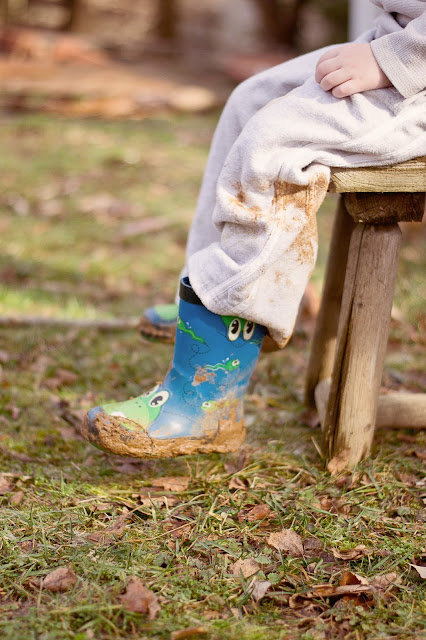
Even a two-year old child knows whether they are wanted or not. And while many may scoff at the idea of allowing a two-year old to help you dig in the mud, bring you small pitchers of water, and tend to the chickens — it is completely the norm on a daily basis here. And you know what, they love it. But let’s start from the beginning — it doesn’t just begin when the seed planting and other Spring chores begin, it begins during the preparation period as well.

First and foremost, patience is a virtue. If you have a newborn or child that isn’t walking yet, I hate to tell you this, but you’ll probably just have to strap that baby to you and submerge them into your daily chores — however, this might be the easiest of all ages, and they will begin to take a natural interest in your daily routine.

For toddlers and older children, keep in mind that you aren’t just letting your child help, you are literally training your child on how to become self-sufficient, reliable, disciplined and diligent. These are character traits that they will use throughout their lives, not just in homesteading and self-sufficiency. Patience, on your part, is a huge necessity. But, I promise, the outcome will be totally worth it. Your training and patience methods will depend upon your child’s personality and age. You know your child better than anyone. Never force your child to do something they don’t want to do, otherwise, they will never take interest in it. For children that are willingly eager, run with it. For older children that might not have any interest at all, take this as an opportunity to teach them on an educational level rather than just hands-on involvement. Offer them free worksheets and garden journals as an educational resource. You can find many of these for free online. This is also a great project if you homeschool, make it part of your curriculum. Explain to them the importance of self-sufficiency — not that they have to do it, but that it’s a skill that is beneficial to them now and in the future, and it is a skill that came naturally to their great-great-grandparents.

Second, involve your children (toddler and older) in the seed buying and planting process. Allow them to pick out at least one seed packet at the store or in a catalog. Even if it’s something off the wall or that you didn’t plan to plant (as long as it is suitable for your zone and preferably a transplant) — who knows, you might end up liking it! The key is finding something that they want and that they will be passionate about planting and tending to. When ready to plant indoors, set out several planters for your child. Allow them to fill them with dirt while following your instruction. In the coming weeks, whenever it is time to tend to the seedlings, involve them in every step. Do not do their work for them on their seedlings — their seedlings are their project, not yours. Give them responsibility over it. They will imitate what you do under your guidance. When it comes time for the plants to be transplanted, from beginning to end, involve them — again, allowing them to own and be responsible for their own plants. It is their responsibility to transplant, prune and harvest their crop (yes, even a toddler). The best part might be getting into the kitchen with them and letting them help you cook and preserve their harvest.

In the beginning of the process, your child may eventually become impatient, as we often do ourselves when we are excited about new growth. Share in their excitement and in their frustrations. Don’t just blow them off. While it is necessary for your child to want to be involved, it is also necessary for you to share all of the emotions, strengths and weaknesses with them in their involvement.
 

Involvement In Other Homestead Chores

My son takes more interest in tending to the animals than he does in gardening, and rightfully so. He’s a bull in a china cabinet but he has a tender soul. When we first got chickens, I hated letting him collect eggs because I just knew that he would break half of them on the way back up to the house. And the very first time that happened, I still remember it so clearly. He was so proud of himself. He had carefully walked all the way up the hill with his eggs, meticulously paying attention so that he wouldn’t drop them. He finally made it into the house and was ecstatic to show me what he had collected. He was hiding one of the eggs in his little hands behind his back and said, “Mom, guess what I have!” I turned around, and as he quickly pulled his hand from behind his back to show me the egg, his hand stopped, but the egg didn’t. Splat…right there all over the kitchen floor. His precious little heart was just broken and those big crocodile tears began. I knew then, just how important it was that my reaction not be one of condemnation, but of grace, followed by an encouraging hug and a “you are so big and helpful and you’ll do better next time, I know it.”

I get it, I do. Many times we don’t want to allow our younger children to help in other homestead chores because they are just too complicated and time consuming. Gardening is simple, other things are not. But keep in mind that a ten year old will not understand and be efficient in helping you with larger jobs around the homestead unless you involve that ten year old when he is a younger age. Here are a few age specific jobs that might help you involve your children a little better. Please understand that you know your child’s mental maturity, so these are just age ranges.

Ages 2 to 4:

Learning things by mainly watching rather than “hands-on”.


• Collecting eggs with supervision from the chicken coop.
• Helping with the garden — planting, watering, harvesting with supervision
• Feeding smaller homestead animals with supervision (chickens, dogs, barn cats)
• Crocheting and other crafts
• Watching while preserving and canning
• Cleaning up around the homestead under supervision, this includes household chores (vacuuming, sweeping, folding wash rags).

Ages 5-7:

All of the above, plus…

• Collecting eggs from the chicken coop (unsupervised)
• Helping with the garden — tending to plants under supervision but independently.
• Feeding medium sized homestead animals with limited supervision (tamed goats and livestock, chickens, etc)
• Learning how-to and milking animals under supervision.
• Cleaning up around the homestead, unsupervised for small jobs (leaves, cleaning small coops/stalls/hutches, etc), supervised for more complicated ones. This includes household chores (helping with laundry, helping prep meals)

Ages 8 and up:

If you have been doing all of the above with them, then they can move on to these next steps. Do not allow an 8 year old to do the things listed in the next level if they do not have the basic concepts and experience as mentioned above.

• Collecting eggs, feeding animals, cleaning coops/stalls and gardening independently and without supervision.
• Helping with the preserving and canning process independently and with supervision for more complicated projects.
• Milking independently with you there beside them in case help is needed and to ensure that milk is being extracted properly. If you have multiple goats or cows to milk, get them set up and then milk alongside your child. This gives them independence but also allows you to supervise.
• Helping tend to new livestock births with supervision.
• Aiding in the breeding process of livestock, incubating eggs independently with guidance, tending to smaller young livestock independently (chicks, rabbit kits, etc.)
• Tending to household chores — doing laundry (washing, drying, folding), preparing and making age appropriate meals with limited supervision, sewing and mending clothes.

These are just a few idea’s to get you started. Each homestead is different and each child is different. However, the ultimate goal is starting young (with patience) and allowing that to grow into a very handy helper and a self-sufficient child. Not only is it about having your children help around the homestead, it’s about teaching them life skills that will be so beneficial to them throughout their lives. It’s about giving them responsibility and fueling their desire to learn. And honestly, it’s about spending time with them and teaching them. The best way to learn is to watch and be submerged into it. Do not underestimate the ability of your child. If they are never given the chance to have responsibility, then you cannot blame them when they are older for not efficiently taking on responsibility. At the same time, do not overwhelm your child. Allow them to do the things they are passionate about, while watching what they aren’t as passionate about.

All in all, make planning for Spring and upcoming projects fun for your kids — and I promise, you won’t regret it in the long run!

By: Amy K. Fewell · In: family, gardening · Tagged: children, Christian living, Christian parenting, garden planning, gardening, homestead family, homesteading with kids

you’ll also love

Building, Laboring, and Trusting | A Word for 2026, and 2025 Recap
A New Season, A New Purpose
S3E1: God Still Speaks to Us | The Story of Our New Homestead
Next Post >

{What Is Homesteading?} And Why We Call Ourselves Homesteaders

Primary Sidebar

meet amy

meet amy
hello!

I'm Amy. I love organic food but I love Oreo's. I love Jesus and His grace. I believe broken people make the biggest impact in the world when they share their stories. I believe in stories, and I'm sharing mine.

Read More

Connect

Search

join the tribe!

Ads & Sponsors

200x400

Advertise

Follow Along

@amy.fewell

Sometimes you’ll hear people say “I have good frie Sometimes you’ll hear people say “I have good friends”. But recently I have found myself saying “I have steadfast friends”. 

The definition of someone who is steadfast means to be resolutely firm, loyal, and unwavering in your beliefs, actions, or loyalty. A steadfast person is reliable, stays focused on their purpose, and refuses to give up or change their mind, even when faced with difficult circumstances.

To be a steadfast friend means you have a mission and purpose, and you don’t waver from it. That purpose is the kingdom of Yahweh. 

For the last 5 to 10 years I have had a fluid group of friends. Some come and some go. But there is a core group that has remained through it all. The enemy has tried to divide and conquer. And sometimes we still have to realize this. But yet, here we are…steadfast. 

Sometimes we pick at each other, get mad at each other, assume or think wrongly. Sometimes we don’t talk for a week. Sometimes we talk everyday. But here’s the truth, and I think I can say it with full confidence….

We love one another enough to praise each other when it is due, and to correct each other when it is due. To push each other to the next level, and to tell each other when to sit down and be silent. Without getting offended and storming off to find a new friend group. 

It is incredibly rare, I am discovering, to see this in action. There is something beautiful about friends that see you at your worst and choose to be steadfast. No worldly judgement. When I’m lacking, they have abundance. When they are lacking, I have abundance. When they are crying, I can be strong. When I am crying, they can be strong (and some will cry with me 😆). 

1 Cor 15:58 says “Therefore, my beloved brothers, be steadfast, immovable, always abounding in the work of the Lord, knowing that in the Lord your labor is not in vain.”

How committed are you to other people? Because the kingdom is about kinship, not friend hopping. It’s about kindred spirits, not emotional highs and lows to please the flesh. 

Don’t just find good friends—find steadfast friends. And more importantly…be a steadfast friend.
If you’re trying to grow a garden while raising ba If you’re trying to grow a garden while raising babies, chasing toddlers, homeschooling, cooking meals, and keeping a home—you don’t need perfection. You need rhythms that work with your season of life.

Here are a few simple things that make gardening with little ones so much easier:

• Work the garden in the early morning or evening when the heat and sun are lower. It’s easier on your body, your plants, and your children.

• Harvest herbs and vegetables in the morning when they are most hydrated and nutrient dense. The flavor, oils, and freshness are often at their peak before the heat of the day sets in.

• Keep a kiddie pool, shaded tent, or simple play area near the garden so little ones can stay close, play safely, and still be part of what you’re building.

This is the beauty of homestead life. Children don’t always have to be separated from the work—they can grow alongside it.

The garden doesn’t just feed your family.
It disciples them too.
Three weeks ago during our Friday night fellowship Three weeks ago during our Friday night fellowship, a consistent topic or word would come forth out of the individuals sitting around the table. As I sat and listened to each one so deeply, yet differently sharing, I realized that on this night, we were all mostly saying the same thing. This is often how Jesus will work through a group of believers—bringing each one together to share in unity. But differently. 

I immediately recalled Psalm 126–especially the part about weeping. How we sow with our tears but we reap in joy. How those who continually go forth weeping bear seed for sowing. 

Our genuine cries do something—they produce, and they sow. It is where we can feel the burden of another. When one cries, it is contagious. But really it is the mercy of God that we feel upon us. 

There is not a fellowship night that goes by anymore without someone, or multiple people now, crying. We’ve learned to embrace it. Why? Because we reap a harvest and bring our sheaves with us as we rejoice. 

Each tear is a seed that sows deeply into one another. Into others. Into ourselves. Our tears have a genuineness that many things do not have. And when they are genuine, they produce great fruit.

Ever since that night, I continue to see this scripture being spoken over and over again from leader after leader. Post after post. 

The Lord is stirring. He is doing something in His bride. He is calling back the captives, the dreamers, the singers. “Once again,” He says. With tears and weeping we sow, and with tears and weeping we harvest—rejoicing joyfully.
If you follow people online, you often call them a If you follow people online, you often call them an “influencer”. Let me be the one to tell you that most of us in the sphere that I am in do not consider ourselves “influencers”. Some may consider themselves teachers, leaders, ministers, and more, but the term influencer has never been something we’ve enjoyed. 

The reality is this—we found ourselves in the middle of a crossroad on our timeline where someone needed to pick up a mic and speak truth in the midst of chaos. Most of us have no interest in being online at all. We wouldn’t be sad if the internet disappeared tomorrow. But we were handed that microphone, influence, and anointing to go along with it.

Don’t be fooled—it’s not because of algorithms and marketing plans. If you are succeeding in this online world or your physical sphere of influence for Jesus, it’s because you were given the open door to do so. It’s not about you. It’s about what God knows He can entrust to you for His will and kingdom. 

Some people chase after people, trends, validation, recognition, and the spotlight. But can I tell you what comes along with those things? Hatred, bullying, misunderstanding, monitoring people and spirits, people lying about you, persecution—and if you’ve really made it, threats on your life and persecution.

You see, people want the influence. People want to be close to a Kingdom influencer. But if you aren’t ready to roll with the good AND bad, then you’re not ready. 

Jesus was the OG influencer, and He was spit on, lied about, and killed for His influence. Follower of Jesus—you are told to prepare for the same thing in the world. No matter your influence level.

A time is coming in America where influence online won’t matter anymore, yet the outcome will remain the same. The time to prepare for that is now—spiritually and emotionally. 

But take heart, dear one. He has overcome the world. I speak to believers and leaders everyday who are truly influencing to make a difference—some online, some never touching a screen. 

Jesus is building His church stone by stone. Some of us have mics, some of us will never be broadly known to man. Yet the struggle is still the same. Pray for us.
This morning I made a Mother’s Day tea—this one is This morning I made a Mother’s Day tea—this one is for you, ladies! 

My hormones have been all over the place as I inch closer to 40 and begin to slowly wean our little one. I’ve been snappy and know I need more nourishment. My skin has been out of sorts and, moral of the story, my body needs help. This tea is great for anyone—but it is especially healing for women. 

The jar made in the reel is a concentrate (I used lots of herbs), meaning, I add about 1 cup or more (whatever you’d like) of this liquid concentrate to my pint/quart jar and fill the rest with ice and cold water. But the “amounts” would stay the same in “parts”. 

If I were to add one more thing to this tea, it would be lemon balm. It is also very calming and aromatic. But since lemon balm is growing fresh right now, I add a sprig of it to each glass made with this herbal concentrate when I pour. 

This blend is fabulously cooling, nourishing to the body, and especially beneficial to women of all ages. 

You can add raw honey to sweeten this tea, and it is divine. 

🌺 Hibiscus flower (Hibiscus sabdariffa)
An incredible antioxidant which helps support the immune system, reduces oxidative stress, and supports your health at the cellular level. It may also help with cholesterol and cardiovascular health. This is a wonderful cooling herb for summer time, peri- and regular menopause. (Use sparingly while pregnant).

🌼Chamomile
Most noted for its ability to calm, relax, and cool. It is an efficient gentle anti-inflammatory and works well for the gastrointestinal tract. It is a gentle nervine, making it ideal for the central nervous system.

🌿 Stinging Nettle
An extremely nourishing herb, it is rich in iron, magnesium, calcium, proteins, and so many minerals. Nettle is anti-inflammatory and anti-allergenic. Nettle will help build strength in your body, and nourish it to its core—every system in the body is nourished by it. It is a natural antihistamine, mast cell stabilizer, and tonic.

🍃Red Raspberry Leaf
Rich in minerals and manganese. It works effectively in supporting and toning the reproductive system. It is also great for use as an antacid, hormones, heart and eye h

Footer

Learn More

Chickens
Homemaking
Herbs
Recipes
Devotionals

Info

About
Contact
Privacy Policy
Shop

stay in the know

Copyright © 2026 · Theme by 17th Avenue