
• Home
  • Membership
  • Shop
  • Cart
  • Our Farm
  • Gut Health
  • Herbal Practice
  • Buy Trusted Supplements
  • Nav Social Icons

  • Skip to primary navigation
  • Skip to main content
  • Skip to primary sidebar
  • Skip to footer
  • Home
  • Blog
  • About Me
  • Our Farm
  • Gut Health
  • HH Membership
  • My Books
  • Youtube
  • Podcast
  • Homesteading
  • Chickens
  • Herbs
  • Family
  • Farmhouse
  • Homemaking
  • Recipes
  • Sourdough
  • Contact Me
  • Herbal Practice
  • Buy Trusted Supplements
  • Mobile Menu Widgets

    Search

    Connect

Amy K Fewell | Homesteading for the Kingdom

Amy K Fewell | Homesteading for the Kingdom

  • Start Here
    • About Me
    • My Books
    • Podcast
    • Youtube
    • Gut Health
  • Blog
    • herbs
    • Bees
    • chickens
    • rabbits
    • Farmhouse
    • gardening
    • devotional
    • homemaking
    • sourdough
    • recipes
  • Courses & Books
    • HH Membership
    • My Books
  • herbs
  • Podcast
  • Contact Me

Naturally Treating Chicken Lice

March 27, 2015 · In: chickens, herbs

I can still remember that feeling — that punch in the gut that doesn’t go away. I was still fairly new to the wonderful world of chickens, and everything had gone so smoothly up until this point. I had amazing mentors, friends and bloggers helping me along the way. And then this happened….
my chickens got lice.
 
No, no way was this happening to me. All of my chickens had been extremely healthy and parasite free up until this point. And now, all of a sudden, one of the hens started acting lethargic. She had only been here for 3 weeks, if that. I quickly checked her over to notice that she was literally infested with lice. This poor girl had been this way quite a long time, and I brought her into our flock this way because I was naive and figured I didn’t need to check them over since they came from a trusted breeder whom I had bought from before. But unfortunately, even the best of breeders can have issues when they are used to having a normally healthy and happy flock. We get comfortable in not doing our weekly check-ups, and then, something like this happens and can affect so many others.

Moral of my story — always, always check over the chickens you buy….even if they are from people you know personally.
 
I reached out to several fellow chicken keepers on how to treat this girl and eventually my entire flock. In just 3 short weeks, the lice had spread to over half of our flock, though, it was minimal for my original flock. The other hens she came with were much worse off than my flock.
I received suggestions such as dusting in Sevin dust, poultry dust, Eprinex pour on, bathing in dawn dish liquid, dusting in DE and treating with poultry spray. Sadly, this one hen was already anemic and on her last leg, and I simply wanted something that worked quickly. So, I chose the Sevin dust and dusted all of our chickens with them….all 50 of them….
….and I was sick.as.a.dog. afterwards.
 
Please, learn from my mistake, and never ever use Sevin dust to treat lice or anything else on your property…not even in your garden. It is an extremely harmful chemical, not only for yourself and your animals, but it kills bees and beneficial bugs on your property. And, let’s face it, if you use it in your garden, you are certainly NOT gardening organically. I also refuse to use “poultry dust”, as it is equally as toxic and harmful.
I broke out in hives, had a fever, coughed uncontrollably (I even had a mask on). I was a wreck, and I can only imagine what it did to my chickens.

Thankfully, it immediately killed the lice, however, I retreated with DE a week later (because more lice had hatched) and DE did the job just fine with zero chemicals and absolutely no reaction. I completely understand there is a DE debate on whether it is safe or not, but when used wisely, it works wonders, and my own body thanked me afterwards as well.

If you’re looking to treat chicken MITES, you can check out this article.
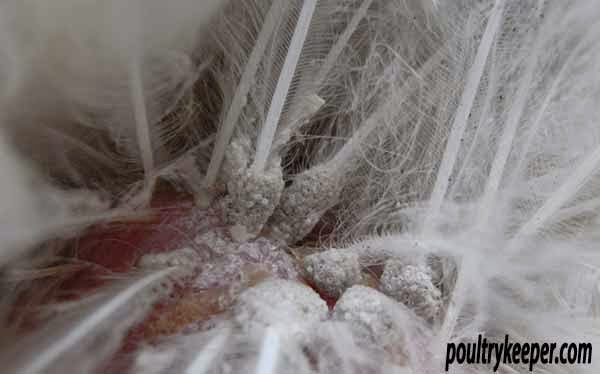
Lice eggs — Photo via poultrykeeper.com
Unfortunately, in the end, I also ended up using another pour-on chemical to treat all of our chickens topically. However, along the way, I found that all natural remedies would have worked (on their own!!!!) just as well.
Here is the schedule and the products you should use to treat chicken lice {completely all natural}.

1. Examine all chickens. Lice will be visible on the skin of the belly and around the vent. They will be nasty and crawling quickly, so look thoroughly. Assume that all of your flock could potentially have lice or lice eggs on them. Lice eggs will be seen (pictured above) at the base and on the shaft of the feather. Separate chickens that look anemic or lethargic from the rest of the flock. For chickens that visibly have lice on them, dust (to the skin) cautiously with food grade Diatomaceous Earth (DE). Wood ash is a more natural option if you are against DE. However, DE works just fine on our homestead and we have absolutely zero issues using it.

2. Create a large bathing area for your chickens if you do not already have one. Fill it with fresh wood ash. Wood ash is a completely all natural way to rid chickens of lice and mites. In fact, you can even rub your chickens down (to the skin) with wood ash and a little dusty dirt rather than using DE. It will naturally kill mites and lice. Make sure there is plenty of wood ash in the dust bathing area for the next 4 weeks.

3. Thoroughly clean out coop and give a good layer of DE to the entire coop, including roosts and nesting boxes. Do not put bedding down for 1 hour. Do not allow your chickens back into the coop for 2 hours so that the dust settles. Lock them in their run or allow them to free range without coop access for 2 hours, total.

4. Lice eggs hatch every 7 to 10 days. So, you will need to inspect them again in exactly one week after the first treatment, and until the eggs hatch and complete their cycle (we suggest treating for 4 weeks). The wood ash dust bath, in and of itself, should kill all of the newly hatched lice from your regular flock. However, if you actually see lice (not just eggs) on your chickens in one weeks time, reapply DE or wood ash directly on the chicken down to the skin once more. The same with week #3. By week #4, there should be zero lice (in most cases, there’s no lice after week #2). Continue to make sure there is plenty of wood ash in their dust bathing area, or bathe them in the wood ash instead of the DE.
 
5. For your more delicate chickens who may have become anemic, you’ll need to pamper them a bit more. You will need to put the wood ash or DE directly on their skin and give them a nice rubdown for the next couple of weeks since they will be too weak to bathe themselves. You will also need to get their iron levels back up. This will require giving them plenty of raw red meat (which they will love) and other iron rich snacks and meals. After the 4 week healing period, they will most likely be ready to go back in with the rest of the flock. However, if you have roosters, you will need to make sure your ladies are strong enough to support being mated. If not, wait until they are strong enough before putting them back in with the flock.
If you prefer a more gentle way than rubbing your chickens down with DE or wood ash, a nice warm bath with dawn dish liquid will work just fine. But you’ll need to make sure it’s done on a warm day or that they are blown dry so that they do not get cold. Also, I just can’t imagine giving anymore than 4 chickens a bath!

I hope that my horrible experience can help many of you. I doubt we will ever have to deal with this again, as we are completely on top of things now and will give any new hens brought in a thorough run down. However, sometimes life just throws you lemons — and it is better to be prepared now than when you actually need the reference!

As always, the key is prevention — weekly check overs, quarantining new chickens, a clean coop and living area, and good diets are important!

On our homestead, we strive to treat as naturally as possible. Certainly, there are some dire instances when less natural remedies must be used. However, thankfully, we have not had to use anything other than all natural treatments for quite some time now.

With that said, if you find that this natural remedy is just too much, or your chickens aren’t progressing, the chemical fix is simple and can be used as a last resort. Don’t beat yourself up about it!! Use 2-3 drops of Eprinex or Ivermectin on the skin of the back of the chickens neck. Just keep in mind there is a withdrawal period of 2 weeks after treating, and you’ll probably have to treat once a week for 2-4 weeks.


By: Amy K. Fewell · In: chickens, herbs · Tagged: chickens, herbs, lice, natural chicken lice treatment

you’ll also love

The Medicinal, Nutritional, and Famine Benefits of Lambs Quarters (Chenopodium album)
15 Chicken Processing Day Mistakes That Waste Time and Meat
The Two-Breed System for Year-Round Meat Chicken Breeding

Reader Interactions

Comments

  1. Mizala says

    November 20, 2018 at 11:34 am

    Yes, using wood ash in every aspect of your chickens daily needs will increase its output exponentially, I got proof.

  2. Bonnie McCarthy says

    August 25, 2023 at 6:44 am

    This is exactly what I was hoping I’d get when I googled natural lice remedies for poultry – thank you so much! My chickens thank you too.
    x

Next Post >

{Garden Project 2015}…when things go right.

Primary Sidebar

meet amy

meet amy
hello!

I'm Amy. I love organic food but I love cookies too. I love Jesus and His grace. I believe broken people make the biggest impact in the world when Jesus makes them whole, and when they share their stories. I believe in stories, and I'm sharing mine.

Read More

Connect

Search

Ads & Sponsors

200x400

Advertise

Follow Along

@amy.fewell

I have personally wrestled with the Lord over this I have personally wrestled with the Lord over this topic for months.

Earlier this year, someone asked why we were still hosting fellowship dinners at our home.
My answer was simple:
“Because I refuse to let the sheep scatter again.”

We have watched people leave churches wounded, lonely, and without accountability. Some find healthy places to land. Others simply go through the motions while still feeling empty and unseen.

And it grieves me. More importantly, I believe it grieves Jesus.
Recently, I finally said to a friend, “I think I need to write this out. God is calling back the shepherds.”

And not in the way you may think.

The word translated as “pastor” in the New Testament is poimēn.

It means shepherd.
Not platform speaker.
Not church-building manager.

Biblical shepherds lived among the flock. They knew the sheep by name. They found food and water, recognized danger, fought predators, rescued the wandering, and understood when it was time to move.

They were gentle, but they were not fragile.
They carried lambs, but they also fought lions and bears.
The rod was not used to beat the sheep. It was used to fight off predators.

The staff was not used to control them. It was used to guide and rescue them. And when the wolf came, the shepherd stayed.

Somewhere along the way, we reduced shepherding to preaching a sermon and managing an institution. But biblical shepherding was always more intimate, costly, discerning, and involved than that.

I believe the Lord is about to (or already is beginning to) reform the ministry of the shepherd within the Body of Christ. And do not be surprised when those shepherds do not look the way the religious institution expects.

They may be farmers, homesteaders, mothers, fathers, or people who are perceived as rough around the edges. They may never stand behind a pulpit.

But they will gather around tables, dwell among the people, protect the flock, confront the wolves, and refuse to let the sheep scatter again.

He is calling back the shepherds.

🐑 Comment SHEPHERD and I’ll send the full article to your inbox.
(1/2) In 2016/2017, God began raising up leaders i (1/2) In 2016/2017, God began raising up leaders in many spheres of society. Politics, the marketplace, church leadership, and even the food and health system. We didn’t call ourselves leaders. In fact we really didn’t understand what God was doing. Many of us had no idea what was about to unfold and why we were called to this space. We were living our lives to the fullest and had not a care in the world outside of normal everyday life. 

In the fall of 2019, I began to have this ominous feeling. Others did too. Something was coming. Before then I had no idea the depths of what God had called our family to. But when the 2020 pandemic hit, it became evident. 

Suddenly my phone was ringing off the hook with people asking me to buy chickens they could butcher, but they’d never butchered an animal in their life. Others begged us to teach them how to classes. We saw tens of thousands of brand new homesteaders come into the homesteading movement. 

We watched churches shut down, while very few fought against the state to remain open. Some churches went as far as collecting your information every Sunday so they could do “contact tracing” if someone got sick. No thank you.

I sat in private phone calls and meetings with leaders across the nation, conversing about unconstitutional rights and how we can help our communities that God had us leading. None of us knew what to do—we hadn’t been here before. But there was a common thread that held us together and made us realize we weren’t alone. 

Since then, I’ve been told I’m too much, outspoken, ridiculous, a fraud, or “too forward”. But I think most of the people who lead through 2020 into now remember more deeply what much of the world has now forgotten—if it happened once, it will happen again. 

I know the personalities of leaders that will cave to the system. We remove our family from people and groups that follow the rules blindly—especially religious groups. Because if you shut down your church once, you’ll do it again and then turn my family in when we don’t “comply”. 

You think that’s too straightforward? Not being straightforward is what got us in this mess to begin with.

Cont in first comment…
Oh girl, I feel you. You are walking in God’s will Oh girl, I feel you. You are walking in God’s will with the callings He has placed on your family’s life, and sometimes it’s hard. Notice I said on your family’s lives, not just yours. Just as husband’s calling isn’t just his, it’s also his entire family’s. Why? Because husband and wife are one, in every way. 

I’m specifically speaking, though, to the woman who is both entrepreneur and homemaker. The wife and mother that raises her babes at home while taking business emails and scheduling content—managing people outside of the home and inside of the home. 

It’s easy to fall into the trap of thinking “I don’t have time to focus on my home”. But the reality is that your family and your home are your first priority. You CAN do it, you just have to find YOUR rhythm and routine. Coupled with delegating chores and work to children and others. 

It’s a simple process—but it takes consistency. This is the key. 

I have been in such a funk over the last year in regard to my home. Having a baby on top of “all the things” causes chores to pile up. The mountain of laundry in my bedroom that I need to go through is outrageous. Let’s just be honest. But it didn’t get there overnight. 

This week I started making new routines once again. 

Here are my non-negotiable things:

• the dishes get done throughout the day until afternoon (a cup gets washed and put to drain etc). Then one big batch goes into the dishwasher at night or first thing the next morning. Washing throughout the day takes 5 mins. Dishwasher loaded and unloaded by kids.

• the laundry does not set in the laundry room. As soon as it’s done, it gets folded and put away. The day does not go by without me folding and putting away that load. It literally takes 10 mins. Kids help and put their own clothes away.

• Cleaning up after dinner—nothing left on the stove/table/counter until the next morning. Kids help.

• Floors are picked up before lunch and before bed (kids do this, not me). Vacuumed (kids do this).

There are more, but not many. All of these little things throughout the day make it easier to then focus on purging or deep cleaning other rooms during the week. 

What are your non-negotiable routines?
That’s all… That’s all…
You know you want this BRAND NEW recipe on the blo You know you want this BRAND NEW recipe on the blog!

My family has grown to absolutely love homemade bagels. They are so easy and versatile. But there are bagels—and then there are real, chewy, shiny, homemade bagels.

The kind where your teeth sink through a beautifully browned crust into a dense, satisfying center. The kind that can hold a generous layer of cream cheese without collapsing into a soft little bread ring.

And the secret is not complicated. You have to boil them.

That brief boil in honey-sweetened water is what sets the outside of the dough and creates the signature crust that makes a bagel taste like an actual bagel. It is one small, old-world step that modern recipes are often tempted to skip—and it makes all the difference.

This recipe can be made with active sourdough starter for a slower ferment and deeper flavor, OR with instant yeast when you would rather have fresh bagels the same day.

Mix the dough. Let it rise. Shape it. Boil it. Brush it with egg wash, add your favorite toppings, and bake it until the crust is glossy and golden.

It is a simple process, but it produces the kind of breakfast that reminds you why learning to make food at home is worth the effort.

Make them plain, cover them in everything seasoning, add cheese, fold in cinnamon and raisins, or turn them into hearty breakfast sandwiches.

Save this post for your next baking day, and find the complete printable recipe, instructions, troubleshooting tips, and flavor variations on my website.

🥯 Comment BAGEL and I’ll send it straight to your inbox.

Footer

Learn More

Chickens
Homemaking
Herbs
Recipes
Devotionals

Info

About
Contact
Privacy Policy
Shop

stay in the know

Copyright © 2026 · Theme by 17th Avenue