• Home
  • Membership
  • Shop
  • Cart
  • Our Farm
  • Gut Health
  • Herbal Practice
  • Buy Trusted Supplements
  • Nav Social Icons

  • Skip to primary navigation
  • Skip to main content
  • Skip to primary sidebar
  • Skip to footer
  • Home
  • Blog
  • About Me
  • Our Farm
  • Gut Health
  • HH Membership
  • My Books
  • Youtube
  • Podcast
  • Homesteading
  • Chickens
  • Herbs
  • Family
  • Farmhouse
  • Homemaking
  • Recipes
  • Sourdough
  • Contact Me
  • Herbal Practice
  • Buy Trusted Supplements
  • Mobile Menu Widgets

    Search

    Connect

Amy K Fewell | Homesteading for the Kingdom

Amy K Fewell | Homesteading for the Kingdom

  • Start Here
    • About Me
    • My Books
    • Podcast
    • Youtube
    • Gut Health
  • Blog
    • herbs
    • Bees
    • chickens
    • rabbits
    • Farmhouse
    • gardening
    • devotional
    • homemaking
    • sourdough
    • recipes
  • Courses & Books
    • HH Membership
    • My Books
  • herbs
  • Podcast
  • Contact Me

Poke Root | A Powerful Infection Fighting Herb

June 7, 2023 · In: herbs, natural living

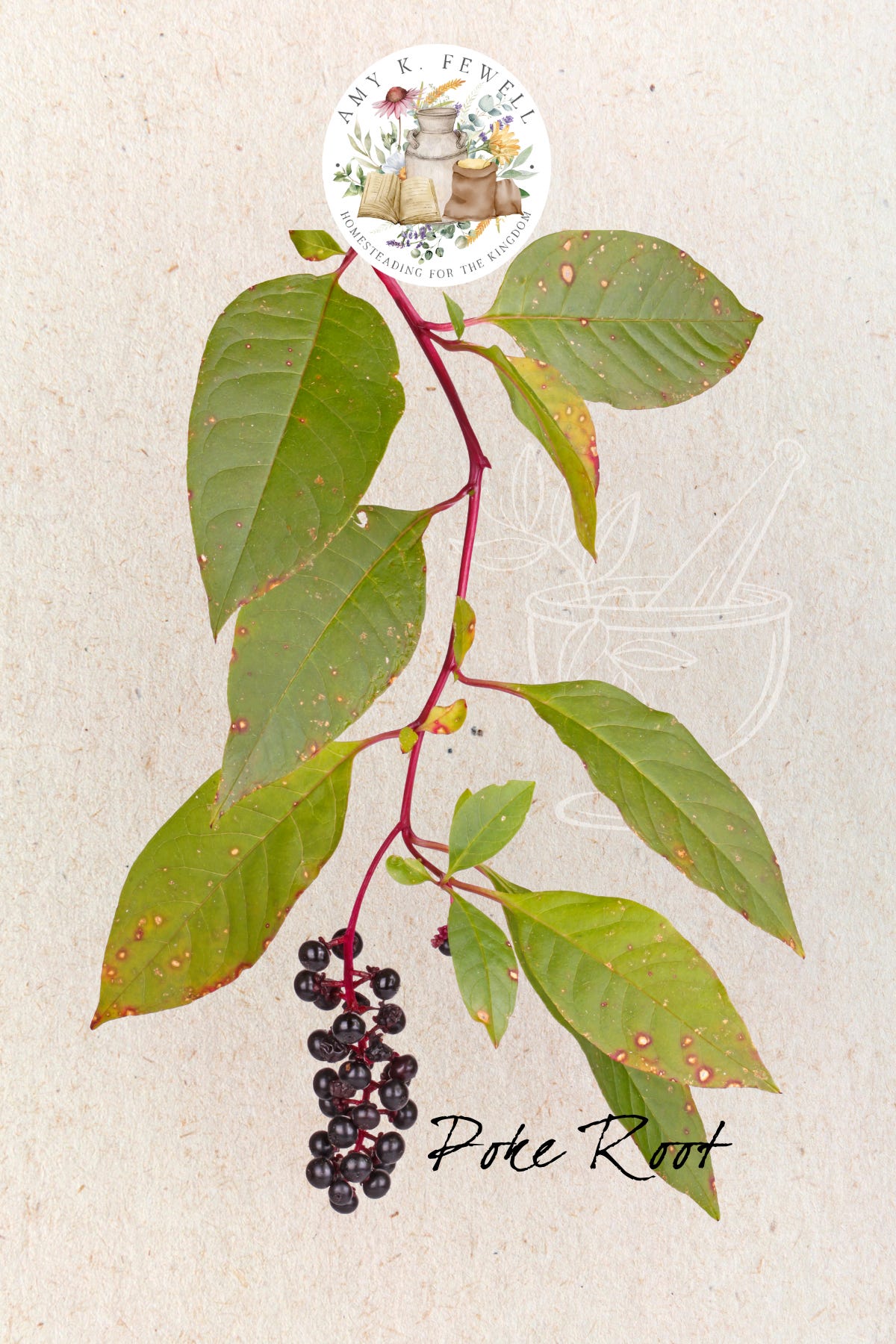
Now, right before spring switches over into summer, is the time to start paying attention to where this wild foraged herb may grow. It will often grow in fields, along roadsides, and in soil that isn’t necessarily the healthiest. You can find it in dried out flower beds, driveways, and fields. The herb I’m talking about is poke weed, and more specifically, the root. 

Phytolacca americana L. (poke)

The name of the plant is actually just “poke”. I grew up hearing this plant called “poke berry” or “poke root”. Old folks called it this because these were generally the parts used. Throughout history, the berries have been used as a dye or ink. Maybe you even tried it out yourself as a child. The new, baby leaves were often used in salads in the spring time, however, they should be boiled multiple times first (with the water changed each time). The root is where all of the medicinal value seems to be condensed, though.

This plant should absolutely be respected, because it is a toxic medicinal plant, not a tonic plant.

Actions: Anti-rheumatic, stimulant, anticatarrhal, purgative, emetic, antibacterial, antiviral, anticancer

In the herbal world, poke root is most commonly known for its ability to cleanse the lymphatic system and glands. It is a primary remedy for infections in the upper respiratory tract, tonsillitis, laryngitis, catarrh of any kind, swollen glands, and even mumps. 

However, poke root is also a very effective natural antibiotic for infections specifically of the respiratory tract, lymphatic system, and breasts. 

Poke root, taken internally and even used as a poultice, may help with rheumatism and skin issues. 

A 2014 study showed that poke root had incredible antimicrobial effects on certain periodontal bacteria.

Another 2014 study showed that poke root has anticancer effects, especially on the colon. This would also be true for the lymphatic system, since we know that poke root cleans the lymphatic system. I always recommend that cancer patients should also be taking poke root at all times.

More recent studies on this medicinal plant have focused on its antiviral properties. Could poke root have antiviral properties? Maybe. If you’re like me, you question the existence of viruses to begin with. However, it could be more possible that, virus or not, poke root flushes the lymphatic system so well that nothing in your body trying to make you sick even has time to replicate. More studies need to be done, but this would be one of the best theories, in my opinion.

Safety & Dosage

In large doses, poke can cause vomiting, diarrhea, and even light headedness. 

Tincture dosage (1:5 ratio), is 3-5 drops a day, or up to twice a day. A 1:10 ratio is .25 ml three times a day. 

You may, eventually, be able to work up to 8 or 10 drops a day if necessary, but that would only be for chronic illnesses.

I, personally, never recommend the herb in tea or decoction form. However, in a bind, you certainly can. Use 1/4 tsp of root in 1 cup of water, bring to a boil, and simmer for 10-15 minutes. Drink up to 3 times a day.

Healing Mastitis With Poke Root

Perhaps one of my greatest loves for poke root is its ability to keep busy, tired, nursing mamas away from antibiotics. I know, because I’m a living testimony of it working. With our first son, I kept mastitis. Part of it was due to the fact that I had to work outside of the home and pumping was torture. With our second son, I also had mastitis quite a few times—more than likely due to a horrible latch in the beginning. 

Both experiences led to a drop in milk supply, supplementation, and a not-so-blissful nursing experience, at least for the first few months. I couldn’t stay ahead of the game because mastitis made me feel so sick and tired, on top of taking antibiotics to heal it. 

Towards the end of my nursing season with our second son, I knew so much more about herbalism not just from a textbook standpoint, but an experience standpoint. Looking out my living room window one day, I saw a large poke root plant growing in a weedy flower bed. Procrastination on this homesteaders part really does pay off sometimes. 

Instantly, the Holy Spirit quickened my spirit and I just knew, I needed to harvest this root. I was going to need this one day. We had no plans of having another baby, and didn’t even know if we could (another long story). But somehow I knew, we would have another baby, and I would need this remedy.

Read the rest of this paid article on my Substack!

REad NOw

By: Amy K. Fewell · In: herbs, natural living · Tagged: herbs

you’ll also love

Herbal Remedies for HighBlood Pressure and Pre-Eclampsia During Pregnancy (and Postpartum)
Client Case Study: Kidney & Liver Levels Balanced
Client Case Study: Seasonal Allergies Eliminated with Gut Healing
Next Post >

The Genetics of a Might But Tiny Homestead Milk Cow

Primary Sidebar

meet amy

meet amy
hello!

I'm Amy. I love organic food but I love cookies too I love Jesus and His grace. I believe broken people make the biggest impact in the world when they share their stories. I believe in stories, and I'm sharing mine.

Read More

Connect

Search

Ads & Sponsors

200x400

Advertise

Follow Along

@amy.fewell

I have nothing to say. Just a pretty photo dump f I have nothing to say.

Just a pretty photo dump for old time IG sake.

The era where we followed homesteaders and farmers because their content was beautiful and practical and took us to a peaceful place. 

This is my peaceful place.
Most homesteaders raise meat chickens. Very few e Most homesteaders raise meat chickens.

Very few ever stop to ask, “What happens if I can’t buy chicks next year?”

For generations, families didn’t depend on hatcheries to fill their freezer. They developed breeding systems that allowed them to raise meat birds year after year, right from their own homestead.

That’s exactly why we began experimenting with a two-breed meat chicken system.

The goal isn’t to compete with a Cornish Cross. You can’t compete when it comes to saving time and money. The goal is resilience.

A good breeding program allows you to maintain your own flock, hatch your own chicks, improve genetics over time, and continue producing quality meat birds without relying on outside sources. It puts one more piece of your food security back into your own hands.

This approach combines the strengths of two different breeds—one contributing growth and carcass qualities, the other contributing fertility, mothering ability, hardiness, and long-term sustainability. The result is a practical system that can provide meat chickens year-round while allowing you to retain breeding stock for future generations.

If you’ve ever wondered how homesteaders raised meat chickens before modern hatcheries, or if you’ve been looking for a more sustainable long-term poultry plan, this article is for you. It utilizes modern Cornish cross broilers, while having a dual-purpose system back up. 

🐓Comment SYSTEM and I’ll send it directly to your inbox.
Mullein is one of those herbs that often gets over Mullein is one of those herbs that often gets overlooked—growing wild along fence rows, in pastures, and even in places most people would call “weedy.” But for generations, it has been one of the most beloved herbs for the lungs, respiratory support, and overall herbal wellness.

Its soft, velvety leaves and tall flower stalk are easy to spot once you know what you’re looking for—and once you learn how to use it, you may never walk past it the same way again.

Mullein has traditionally been used to:

🌿 Support the lungs and respiratory tract
🌿 Encourage the body to clear mucus naturally
🌿 Soothe irritated throats
🌿 Infuse into oil for ear support
🌿 Dry and preserve for teas, tinctures, and the herbal cabinet

And one of my favorite things about it? It grows abundantly and asks for very little.

There’s something deeply beautiful about learning the plants around us—what they are, how to harvest them well, and how God designed creation with so much practical goodness right in our own fields and gardens.

If mullein grows near you, this is your sign to get familiar with it.

Read the full article on my website, and learn how to identify it, grow it, harvest it, and start using it in your herbal routine.

🌿 Comment MULLEIN to have it sent directly to your inbox.
High blood pressure can be due to many different t High blood pressure can be due to many different things. I have always prided myself in coming from generations of people who have high blood pressure (HBP), yet not having it myself. We eat cleaner than most of society. I incorporate herbs in most of my diet. And we live very cleanly when it comes to using chemicals in products like soaps and farm products.

So imagine my surprise when the midwife realized I was dealing with HBP during the last few weeks of my pregnancy with our fourth child.

Looking back on my pregnancy with our third child, I actually believe I was beginning to struggle then with this issue, but it didn’t pop up until days after I delivered.

In this article, I’m using myself as a client “case”, and will show you how I was able to support my body with herbs, hydration, and nutrition during this time. I’ll also share how important it is to support your body before, during, and after pregnancy so that you may help prevent HBP, pre-eclampsia, and postpartum pre-eclampsia.

🍃 Comment PREGNANCY and I’ll send the article directly to your DM.
❤️‍🔥❤️‍🔥❤️‍🔥 ❤️‍🔥❤️‍🔥❤️‍🔥

Footer

Learn More

Chickens
Homemaking
Herbs
Recipes
Devotionals

Info

About
Contact
Privacy Policy
Shop

stay in the know

Copyright © 2026 · Theme by 17th Avenue