
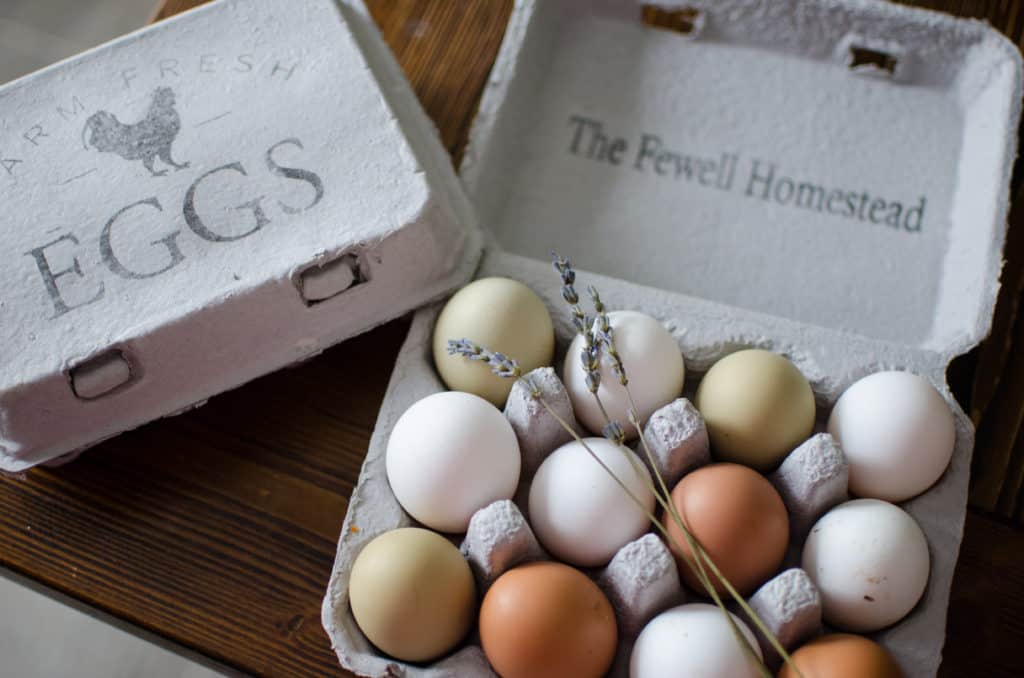
A few years back I remember the great egg carton debate. The question was asked by many backyard chicken keepers and farmers—can I reuse egg cartons? As with everything safety related, the FDA went on a rampage stating that eggs and salmonella go hand in hand, and that under no circumstance should egg cartons be reused. But, as an herbalist, and someone who has studied infectious disease, I beg to differ.
First of all, let’s question the tactic. Since the backyard chicken movement began in the early 2000s, the government has been looking for ways to impose more and more regulations on backyard chicken keepers and farmers. This is just what happens in the agricultural industry. But it’s not just the ag industry, it’s all natural and healthy living industries. We have seen herbs banned in the United States. We have seen herbal remedies banned in the United States. Certain methods of healing have been banned. Likewise, in the ag industry, we now have rules where we can only sell certain things from our farms, or we can only butcher 100 chickens to sell without applying for a special license or butchering in a special facility.
This is the same FDA that wants to make raw milk illegal (everywhere). The same FDA that tells you what you can and can’t do on your farm, in your home, and with/to your body.
So, excuse me if I don’t take to heart every single thing the FDA and other government agencies say. They are one of the worst organizations to base your freedoms on—oh, the irony. With that said, they do some things well, and ultimately they hide behind the mask of “making everyone healthy”. But if you truly believe in health, let’s talk about how reusing egg cartons really won’t make a difference in illness.
Also, for the record, the FDA recommends you not wear the same shoes in your chicken coop as you do in your home. How many people bring their chore boots to the front door or place them in a closet inside? If you’re doing that, you have no say in this argument, because you’re literally bringing viruses and bacteria into your home 100 times worse than an egg carton. We’ve been doing it our whole lives, though, and we’re just fine.
So let’s break down the claim, but first, you must know the claim.
CLAIM:
You should not reuse egg cartons because they can harbor infectious bacteria and viruses, causing illness in humans and other poultry.
Now, let’s debunk it from a scientific standpoint, and a common sense one, too.
Terrain vs. Germ Theory
If we’re going to do this properly, we have to talk about the human body and how it works. For years the FDA has been claiming that eggs cause the biggest salmonella outbreaks in the country, but that’s just not true. We have never done a study based on comorbidity, and overall health conditions of the people who contract salmonella. In fact, growing up around farming, we were always told that farm kids had a greater resistance to pathogens like salmonella and listeria, because we had come into contact with it over and over again, causing our bodies to do what they do best—adapt. This is also where your secondary immune system kicks in—remembering the pathogen, and then learning how to fight it better each time.
Germs (aka, viruses and bacterias) can make people sick, but ultimately, the terrain is what matters the most. Terrain means the environment that your body has created. Is it the perfect environment for the spreading of pathogens? Or is it healthy and a hostile environment for pathogens? The perfect environment for pathogenic spread is someone who isn’t healthy, who has digestive issues, and who’s immune system is sub par. A hostile environment for pathogens is one where the person is generally healthy, has an active immune system, and who takes care of their body without many pre-conditions.
Thus, as with every pathogen, begging to question why we are so afraid of pathogens if we are living an otherwise healthy lifestyle. Why are we making broad range laws and recommendations due to one people group who is generally unhealthy?
Of course, children and elderly can be more susceptible to pathogens, but it depends on the pathogen, and it also depends on their terrain.
This same theory is correct for your poultry flock.
How Long Do Bacteria & Viruses Live on Surfaces
Let’s talk about science first. Here in the twenty-first century, we’re now seemingly all about science, even if it’s false science. But there is some science that is consistent. So, if we want to be confident in our knowledge about this subject, we have to know some basic science. Let the record show that all science, however, is fallible.
All About Poultry Viruses
Viruses cannot live without hosts. Period. So concern about viruses living on egg cartons, while slightly true, is very irrelevant. It is very rare that a zoonotic disease can transmit without the perfect terrain conditions (meaning, an unhealthy body is more susceptible to it than a healthy body). However, it is possible. With that said, it is extremely rare for a virus to spread to a person or a flock based on an egg carton, due to the fact that viruses need living hosts in order to stay alive and replicate. Viruses do not replicate without a host. If someone has told you that they do, they’re lying.
Viruses can last longer on surfaces that are colder, but only to a certain degree, which varies by virus. However, most backyard chicken keepers and farmers don’t keep their eggs refrigerated. And many of their customers don’t, as well. With that said, in most states, eggs are to be washed before placing in cartons. In this case, most viruses are voided, as their structural make up is disturbed, and most of the virus (especially if using a washing solution) are washed away.
If you are concerned about viruses spreading to humans or other chicken flocks, simply wash your eggs before placing them in cartons and you can avoid the spread of viruses through egg cartons if it’s a concern of yourself or your customer. All eggs should be refrigerated after washing. Eggs that are not washed do not need to be refrigerated.
The concern that infectious viruses on eggs or in reused cartons is also very weak in evidence. Actually, there’s really no evidence. First of all, most people buying eggs don’t have their own flock. So that completely eliminates that opportunity. Otherwise, those who have flocks more than likely aren’t keeping their flocks near their countertops or refrigerators where the flock can easily come into contact with another flock’s virus. Poultry viruses don’t typical have aerosol transmission (which means they are not normally airborne). And even if they are, it would require transmission through droplets (coughing or sneezing), and last I checked, your egg carton shouldn’t be coughing near your chickens. If it is, you have other issues.
All About Poultry Bacteria
Bacteria are a bit different. Bacteria can absolutely replicate and spread without a host. This is why people like to practice bio security and what not. However, most bacteria have short lifespans without hosts. For example, salmonella can only live on a surface for 4 hours before becoming non-infectious. As with viruses, some bacteria can last longer on surfaces if refrigerated. However, bacteria aren’t creeping into your egg cartons and living there, waiting to pounce on you, like some people and the FDA state. That’s not how bacteria works. If it were, millions of people would be sick from poultry every single week. And that’s just not happening. The Centers for Disease Control and Prevention (CDC) estimate that each year in the U.S., there are about 1.35 million cases of salmonellosis, with 26,500 hospitalizations and 420 deaths. But that’s not just from chicken eggs. That’s from all kinds of food.
Did you know that salmonella gets on things like spinach, corn, and other crops because commercial farmers use feces on their fields? The same farmers that sell their produce to the grocery store you buy your lettuce from? You’re more likely to get salmonella from produce or raw meat than you are backyard chicken eggs. Salmonella spreads primarily through feces. Commercial farms spread feces all over your food. Your food is then washed and packaged. It doesn’t matter if that package is reused or not, salmonella is still there. Period. But we aren’t having arguments about that, now are we?
Only 20% of salmonella cases are poultry related. Only 20%. So that’s roughly 270,000 cases in the United States for poultry related salmonella every year. And if I had to guess (and I’m pretty good at guessing), I’d guess that the bulk of those cases come from commercial farms that wash their eggs that then go directly into a refrigerator and then directly to the consumer at the grocery store. Not your backyard chicken enthusiast or hobby farmer.
Again, most county and state laws state that commercial and hobby farms selling to the public must wash their eggs before placing in cartons. It’s not the carton that is the issue. The issue now becomes the egg itself.
Contamination with Infectious Disease — Eggs and Salmonella
Eggs are porous, therefore, when they become wet, the porous holes in the shell can absorb bacterial and viral pathogens. This is why backyard chicken keepers often stress not washing your eggs. We actually know a thing or two about this. When studies are done on people that have contracted salmonella from eggs, it’s typically because they’ve eaten the egg. Not because they licked the outside of the shell. Not because they rub their face all over their egg carton. And, also typically, it’s because the salmonella was inside of the egg, not on the outside of the egg. Again, completely eliminating the egg carton here. I cannot stress this enough, reusing egg cartons more than likely won’t make you sick.
Eggs and salmonella can go hand in hand, but only because we do it to ourselves. Salmonella can certainly be shed by backyard poultry flocks. In fact, many flocks have it and no one has an issue with it. The salmonella is excreted through feces. Feces can then be ingested and can contaminate the infected host. The end. But did you know that salmonella is normally only shed by flocks during times of stress? Guess which flocks are always under stress. That’s right, commercial chicken houses where chickens can’t walk more than a foot. Or, they are stuck in cages all day long. Winner winner, chicken dinner.
But if we aren’t washing our eggs, and we’re washing our hands after handling feces covered eggs, what’s the big deal? If we’re practicing good hygiene, there’s really no issue. See how that works? Out of 330,000,000 people that live in the United States, .018% actually contract salmonella from poultry, and .00000001% die from salmonella, period, each year. That’s all salmonella cases, not just poultry.
This percentage is a minute percentage, and in the science community we know that with such a small percentage, we can probably guess correctly that most of these people had other health issues (most likely digestive issues), that caused such a simple bacteria to invade their bodies and cause illness or death. Many of us contract salmonella frequently. If you have a quick bout of diarrhea or nausea, you could have salmonella. The reality is that almost all of us get over it very quickly, within hours or days, because our bodies can efficiently fight it. Because that’s how science works.
You can see where I’m going with this, I hope. Friend, reusing egg cartons is not the next pandemic of the world. You will not kill people. Your egg cartons are not a biohazard. Keep reusing your egg cartons and stop listening to the google experts and the FDA.
The End.
Other Posts You May Enjoy:
- How Much Feed Do Chickens Eat?
- Growing Fodder for Chickens—Chicken Fodder Growing System
- 10 Easy Steps to Start Raising Chickens
- How to Preserve Chicken Eggs
- 6 Herbs for Your Chickens | Oregano, Stinging Nettle, & More
- 3 Common Chick Illnesses and How to Naturally Treat Them
- 8 Common Chicken Illnesses & How to Treat Them
- Using Astragalus to Boost Your Chicken’s Immune System
RESOURCES & REFERENCES:
Looking for resources & references? Normally, as an herbalist, this is where I list all of them. But all of this information can be found on the CDC and FDA website while diving into various different studies, forms, and graphs. There aren’t enough studies done on poultry to warrant a reference portion of this blog post. I would encourage you to use the knoggin the good Lord gave you, and research this process on your own. Don’t just grab a study online, learn how the body and infectious disease work, then test everything against it.



Oh Lord… I leave my eggs on the counter unwashed of course.. the only time I was them is when I am making hard boiled in my smart pot. I hardly was them ever even when I grab them and crack open to fry.., I’m sure my family has eaten a fair share of poop 😂
Let’s not forget that all those shells AND poop end up in my compost to grow vegetables we eat! Full circle health here at my house! I’ll take what I’m doing over what the FDA Monsanto GMO tells us to do!
Always enjoy your news letter!
Salmonella are destroyed at cooking temperatures above 150 degrees F. Muffins usually aren’t done until they reach 190 to 200 F.
This article made my day and gave me a good laugh! I will make sure to direct anyone with questions about this issue to your site. It was funny and informative. Thank you for including the science we all know but few take into consideration. If people would just stop and think about how our ancestors didn’t drop like flies from their eggs, maybe fresh ones aren’t as dangerous as some say. My Great-great Grandmother lived to be 108. Raised chickens all of her life. She didn’t have running water or refrigeration. We all ate them and we’re just fine. Just take 5 minutes and educate yourself and consider the source. The ones saying that they are looking out for you have their own interests. The sad thing is a lot of people were not taught natural ways of living and don’t know what the truth is. I am only the second generation that wasn’t raised on a farm (my Grandfathers were) and I am having learn all of the things my Grandparents knew. A lot of my family one generation older than me has moved to farms over the past couple years, and I love this shift. The truth is, the healthiest kids play in the dirt ; )